A 504 plan gives classroom accommodations, while an IEP provides special education services and a detailed learning program. This is the main difference people want to know when they search “504 or IEP.”
Many parents hear these terms when their child struggles in school. Teachers or school counselors may suggest a 504 plan or an IEP.
Both help students who have disabilities or learning challenges. The goal is to support the student and help them succeed in school.
The two plans are similar in purpose. Both protect students and give them support in class. But they are not the same.
A 504 plan usually provides small adjustments in the classroom. An IEP, or Individualized Education Program, offers special education services and a detailed learning plan.
Understanding the difference between 504 and IEP plans helps parents, teachers, and students make the right choice.
Each plan serves different needs. In this guide, you will learn what 504 and IEP mean, how they started, their key differences, examples, and common questions.
📖 504 vs IEP Definition
📚 504 Plan Definition
A 504 plan helps students who have disabilities but can still learn in a regular classroom.
The plan gives accommodations.
Accommodations help the student learn in a fair way.
A 504 plan comes from Section 504 of the Rehabilitation Act of 1973.
Common 504 plan supports include:
- Extra time on tests
- Seating near the teacher
- Use of assistive technology
- Short breaks during class
- Modified homework rules
Examples of students who may use a 504 plan:
| Condition | Support |
| ADHD | Extra time for work |
| Diabetes | Time for medical care |
| Anxiety | Quiet testing space |
| Asthma | Health support in class |
Example sentence:
A student with ADHD may have a 504 plan that allows extra time during exams.
🧑🏫 IEP Definition
An IEP means Individualized Education Program.
It is a special education plan for students with disabilities.
The plan includes special teaching services and learning goals.
An IEP comes from the Individuals with Disabilities Education Act (IDEA).
The program is more detailed than a 504 plan.
Common IEP services include:
- Special education classes
- Speech therapy
- Occupational therapy
- Learning goals and progress reports
- Individual teaching plans
Examples of students who may receive an IEP:
| Condition | Support |
| Autism | Specialized teaching |
| Dyslexia | Reading support |
| Speech disorder | Speech therapy |
| Learning disability | Individual instruction |
Example sentence:
A student with dyslexia may receive an IEP with special reading support.
⚡ IEP or 504: Quick Answer
The difference depends on the type of support provided.
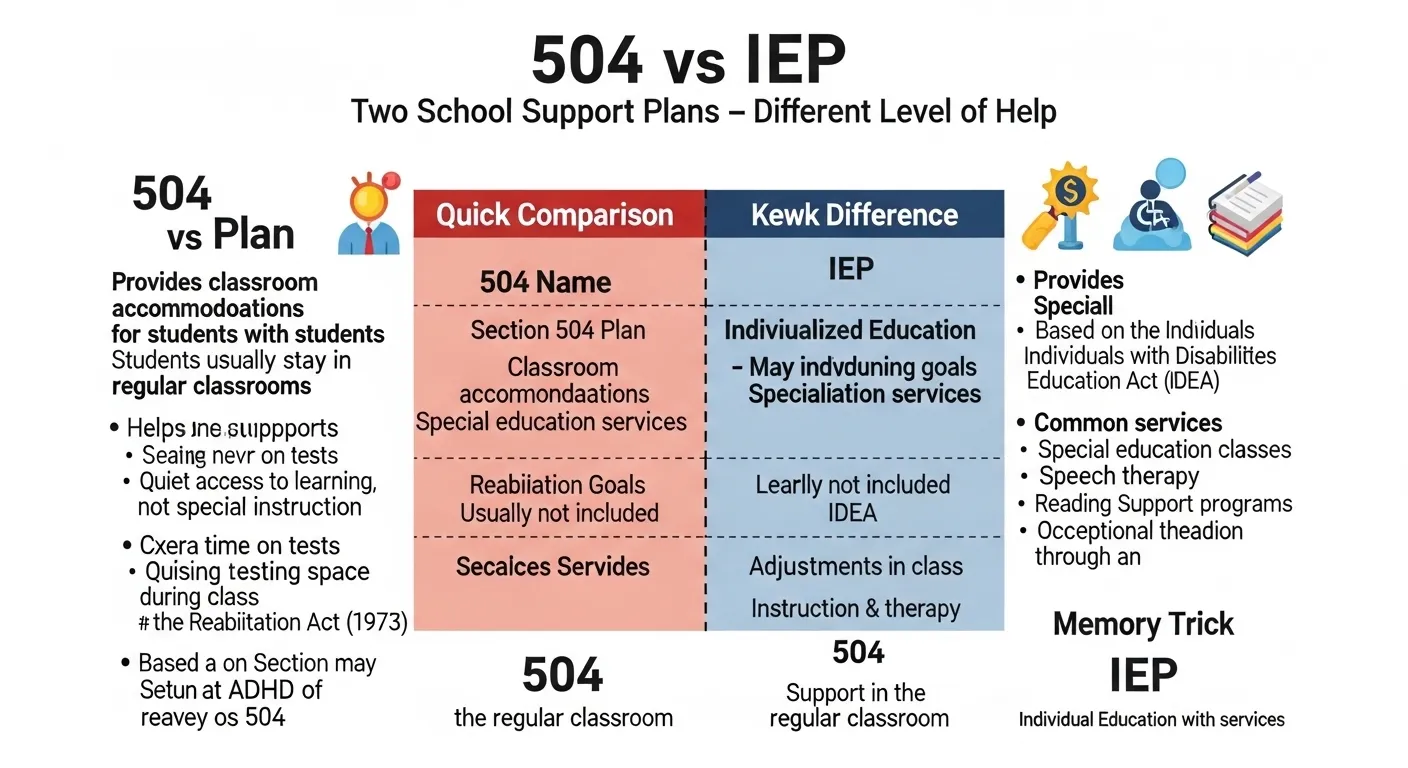
| Feature | 504 Plan | IEP |
| Full name | Section 504 Plan | Individualized Education Program |
| Main purpose | Classroom accommodations | Special education services |
| Law | Rehabilitation Act | IDEA |
| Learning goals | Usually not included | Included |
Simple idea:
- 504 Plan → Classroom support
- IEP → Special education program
🕰️ Origin of 504 and IEP
Origin of the 504 Plan
The 504 plan comes from Section 504 of the Rehabilitation Act of 1973.
This law protects people with disabilities from discrimination.
Schools must give equal access to education.
The law requires schools to provide reasonable support.
This support helps students learn in regular classrooms.
Origin of the IEP
The IEP comes from the Individuals with Disabilities Education Act (IDEA).
This law started in 1975.
It requires schools to provide special education services.
Each student receives a plan based on their needs.
The plan includes learning goals and progress checks.
🌍 Key Differences Between 504 and IEP
504 plans and IEPs both help students, but the level of support is different.
| Property | 504 Plan | IEP |
| Purpose | Equal classroom access | Special education |
| Services | Accommodations | Instruction and therapy |
| Learning goals | Usually none | Required |
| Evaluation process | Simpler | Detailed evaluation |
IEPs usually provide more structured support.
🔬 Examples of IEP and 504 Support
504 Plan Support Examples
Students with mild learning challenges often use a 504 plan.
| Support | Purpose |
| Extra test time | Reduce pressure |
| Quiet test room | Improve focus |
| Flexible seating | Comfort |
| Medical breaks | Health needs |
These supports help students learn in a regular classroom.
IEP Support Examples
IEP programs provide specialized instruction.
| Support | Purpose |
| Special education class | Focused learning |
| Speech therapy | Improve communication |
| Reading programs | Support literacy |
| Occupational therapy | Improve motor skills |
These services support deeper learning needs.
⚠️ Common Mistakes with 504 or IEP
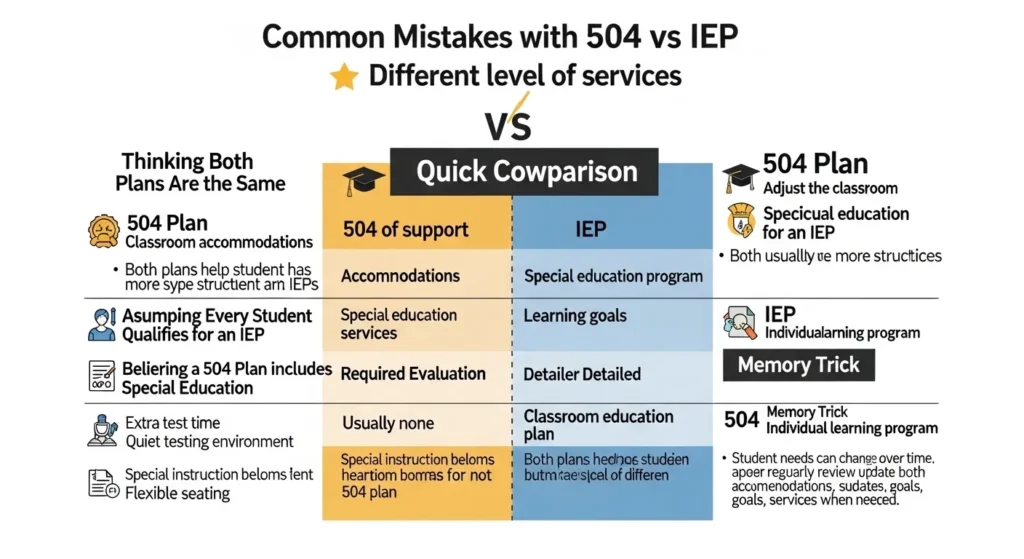
Thinking both plans are the same
Both help students with disabilities.
But the level of support is different.
Assuming every student qualifies for an IEP
IEPs require detailed evaluation.
Not all students meet the requirements.
Believing a 504 plan includes special education
A 504 plan usually provides accommodations only.
Ignoring regular progress reviews
Students’ needs can change.
Schools review plans regularly.
💬 504 or IEP in Everyday Examples
Parent meeting
A teacher may say:
“Your child may benefit from a 504 plan.”
School evaluation
A specialist may recommend an IEP for a student with learning disabilities.
Classroom support
A student with anxiety may receive a quiet space for tests through a 504 plan.
Therapy support
A child with speech difficulties may receive speech therapy through an IEP.
📊 504 vs r IEP: Keyword Variations
| Keyword | Meaning |
| 504 plan vs IEP | Comparison |
| what is a 504 plan | Definition |
| IEP meaning | Special education plan |
| special education support | Learning services |
These searches are common among parents and teachers.
❓ FAQs About 504 or IEP
What is the main difference between a 504 plan and an IEP?
A 504 plan gives classroom accommodations. An IEP provides special education services and learning goals.
Which plan provides special education?
An IEP provides special education.
Can a student move from a 504 plan to an IEP?
Yes. If the student needs more support, schools may create an IEP.
Who qualifies for a 504 plan?
Students with disabilities that affect learning or school access.
Who qualifies for an IEP?
Students with specific disabilities that require special education services.
Do both plans protect students?
Yes. Both plans protect students under U.S. education laws.
Are parents involved in the process?
Yes. Parents usually take part in planning meetings.
Conclusion
Both 504 plans and IEPs help students with disabilities succeed in school. The two plans share a common goal. They ensure students receive fair access to education and the support they need to learn.
A 504 plan focuses on classroom accommodations. These adjustments help students learn in a regular classroom environment. For example, a student may receive extra time on tests or special seating arrangements.
An IEP, on the other hand, provides a full special education program. It includes learning goals, specialized instruction, and sometimes therapy services. This type of plan supports students who need more structured learning help.
Understanding the difference between 504 and IEP plans helps parents and teachers choose the right support for each student.
With the right plan, students can overcome learning challenges and reach their full academic potential.
Discover More Articals!
🌏 Vietnam or Thailand: Which Destination Is Better?
🌸 BV or UTI: Understanding the Difference and Correct Treatment
🪙 Heads or Tails: Meaning, Difference, Origin, and Correct Usage

Rulediff.com is my English grammar comparison website where I simplify confusing words, spelling differences, and usage rules through clear explanations and examples. My goal is to help learners, writers, and students understand English easily and use correct grammar with confidence.