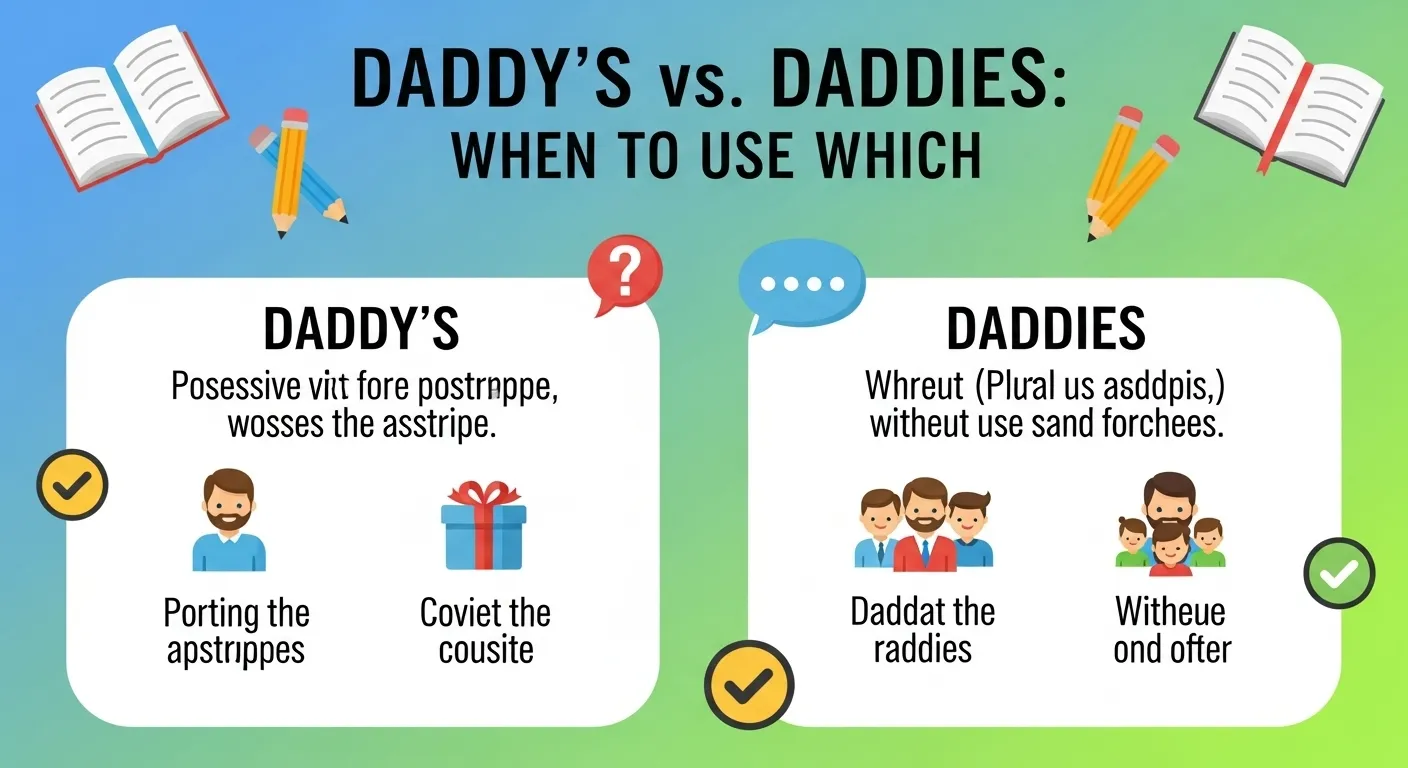
Both daddy’s and daddies are correct, but they are used in completely different situations.
This simple fact answers the main question and clears most confusion right away. People often search for “daddy’s or daddies” because apostrophes and plurals in English are confusing, especially with family words.
Writers are unsure If they are showing possession, making something plural, or doing both at once. This confusion appears in emails, captions, cards, school writing, and even professional content.
This article solves that problem step by step. You will learn what daddy’s and daddies really mean, how they are formed, when to use each one, common mistakes to avoid, and which spelling fits your audience and context.
Daddy’s or Daddies: Quick Answer

Daddy’s is the possessive form of daddy.
Daddies is the plural form of daddy.
They do not mean the same thing.
Examples:
- This is my daddy’s phone. (something belongs to one daddy)
- The kids waved at their daddies. (more than one father)
Simple rule:
Apostrophe (’s) = ownership.
No apostrophe + -ies = more than one daddy.
The Origin of Daddy’s or Daddies

Where the Word “Daddy” Comes From
The word daddy is a familiar term for father. It comes from early child language, where sounds like da and pa were easy for babies to say. Similar forms appear in many languages, which is why words like dad, daddy, papa, and abba exist worldwide.
Over time, daddy became common in everyday English, especially in family speech, storytelling, and informal writing.
Why the Spelling Changes
English follows clear grammar rules for:
- Possession (using apostrophes)
- Plurals (changing -y to -ies)
Because daddy ends in -y, its plural changes to daddies, while possession is shown with ’s, creating daddy’s. These grammar rules are the reason spelling differences exist.
British English vs American English Spelling
There is no spelling difference between British and American English for daddy’s and daddies. Both follow the same grammar rules.
Shared Rules in Both Varieties
- Daddy’s = something belonging to one daddy
- Daddies = more than one daddy
Examples (UK & US)
- This is daddy’s jacket. (UK & US)
- The children thanked their daddies. (UK & US)
Comparison Table
| Form | Meaning | British English | American English |
| daddy’s | possessive (one father) | ✅ same | ✅ same |
| daddies | plural (many fathers) | ✅ same | ✅ same |
Which Spelling Should You Use?
Use “Daddy’s” When
- Something belongs to one father
- You are showing ownership
Examples:
- Daddy’s car is outside.
- This is daddy’s favorite chair.
Use “Daddies” When
- You are talking about more than one father
- No ownership is involved
Examples:
- Many daddies attended the school meeting.
- The kids ran toward their daddies.
For Global and Professional Writing
The rules are universal. Choose based on meaning, not location.
Tip:
Ask yourself: Am I showing ownership or talking about many people?
🔍 What Is the Plural of Daddy? (Daddies or Daddys Explained)
Many learners search “plural of daddy,” “what is the plural of daddy,” “is it daddys or daddies,” or “how do you spell daddies.”
The correct answer is:
👉 The plural of daddy is daddies
❌ Daddys is incorrect
Why “Daddies” Is Correct:
- Words ending in -y change to -ies in plural
- So:
- daddy → daddies
This also answers:
- “plural form of daddy”
- “daddy plural form”
- “plural of daddy in English”
- “daddies spelling”
Examples:
- Many daddies attended the event. ✅
- The kids hugged their daddies. ✅
❌ Many daddys attended the event.
💡 Tip: If you’re unsure how to spell daddies, just change y → ies
Common Mistakes with Daddy’s or Daddies
Mistake 1: Using an Apostrophe for Plurals
❌ The daddy’s were waiting outside.
✅ The daddies were waiting outside.
Mistake 2: Forgetting the Apostrophe for Possession
❌ This is my daddy car.
✅ This is my daddy’s car.
Mistake 3: Confusing Plural Possessive
Many writers forget that daddies’ (with apostrophe after s) also exists.
- daddies’ room = room belonging to many fathers
Mistake 4: Overthinking Capitalization
Capitalization does not change meaning.
- daddy’s = Daddy’s (same grammar)
Daddy’s or Daddies in Everyday Examples
Emails
- Please return daddy’s documents by Monday.
- All daddies are invited to the meeting.
News Writing
- The event honors working daddies across the city.
- The suspect used daddy’s credit card.
Social Media
- Missing my daddy’s hugs ❤️
- Shoutout to all amazing daddies 👨👧👦
Formal Writing
- The child relied on daddy’s support.
- Programs were designed to help young daddies.
Daddy’s or Daddies: Google Trends & Usage Data
Search interest in “daddy’s or daddies” is steady worldwide, especially among:
- Students
- ESL learners
- Parents
- Content writers
Popular Search Regions
- United States
- United Kingdom
- Canada
- Australia
- India and Pakistan
Usage by Context
- Daddy’s is searched more in grammar and apostrophe questions
- Daddies appears more in parenting and social topics
The difference in popularity reflects grammar confusion, not regional spelling.
Comparison Table: Daddy Variations
| Form | Type | Meaning | Example |
| daddy | singular | one father | My daddy is home |
| daddy’s | possessive | belonging to one father | daddy’s bag |
| daddies | plural | more than one father | many daddies |
| daddies’ | plural possessive | belonging to many fathers | daddies’ room |
📖 Daddy’s vs Daddys vs Daddies (Common Confusion Explained)
Many users search “daddys vs daddies,” “daddy’s vs daddys,” or “is it daddy’s or daddies.”
Here is the simple breakdown:
✅ Daddy’s
- Possessive (belongs to one father)
- Example: This is daddy’s car
✅ Daddies
- Plural (more than one father)
- Example: The children ran to their daddies
❌ Daddys
- Incorrect spelling (not used in standard English)
This section also answers:
- “daddies vs daddy’s”
- “daddys or daddy’s”
- “is daddies a word”
- “daddies meaning in English”
Quick Tip:
- One father → daddy’s
- Many fathers → daddies
- Never use → daddys
FAQs About Daddy’s or Daddies
Is “daddy’s” plural?
No. Daddy’s shows possession, not plurality.
Is “daddies” possessive?
No. Daddies is only plural.
What does “daddies’” mean?
It is the plural possessive form.
Which is correct: daddy’s day or daddies day?
- Daddy’s Day = one father
- Daddies’ Day = many fathers
Is “daddy’s” informal English?
It is informal in tone, but grammatically correct.
Are the rules the same in UK and US English?
Yes. The rules are identical.
Why do people confuse these forms?
Because apostrophes and plurals look similar.
Conclusion
Understanding the difference between daddy’s or daddies is all about grammar, not spelling preference. Both forms are correct, but they serve different purposes. Daddy’s
shows possession something that belongs to one father. Daddies simply refers to more than one father. Once you understand this key difference, the confusion disappears.
These rules apply in American English, British English, and global English. The meaning never changes. Many mistakes happen because writers add apostrophes when they want to
make a word plural, or forget them when showing ownership. Asking one simple question can help every time: Is this about ownership or number?
Using the correct form improves clarity, professionalism, and confidence in your writing. If you are writing a message, a caption, a school assignment, or professional content,
choosing daddy’s or daddies correctly shows strong command of basic English grammar. With practice, this distinction becomes natural and easy.
Related posts!
Incase or In Case: Quick Answer
USPS or UPS: Which One to Choose(2026)
Bring vs Take: What Is the Difference Between Them(2026)

