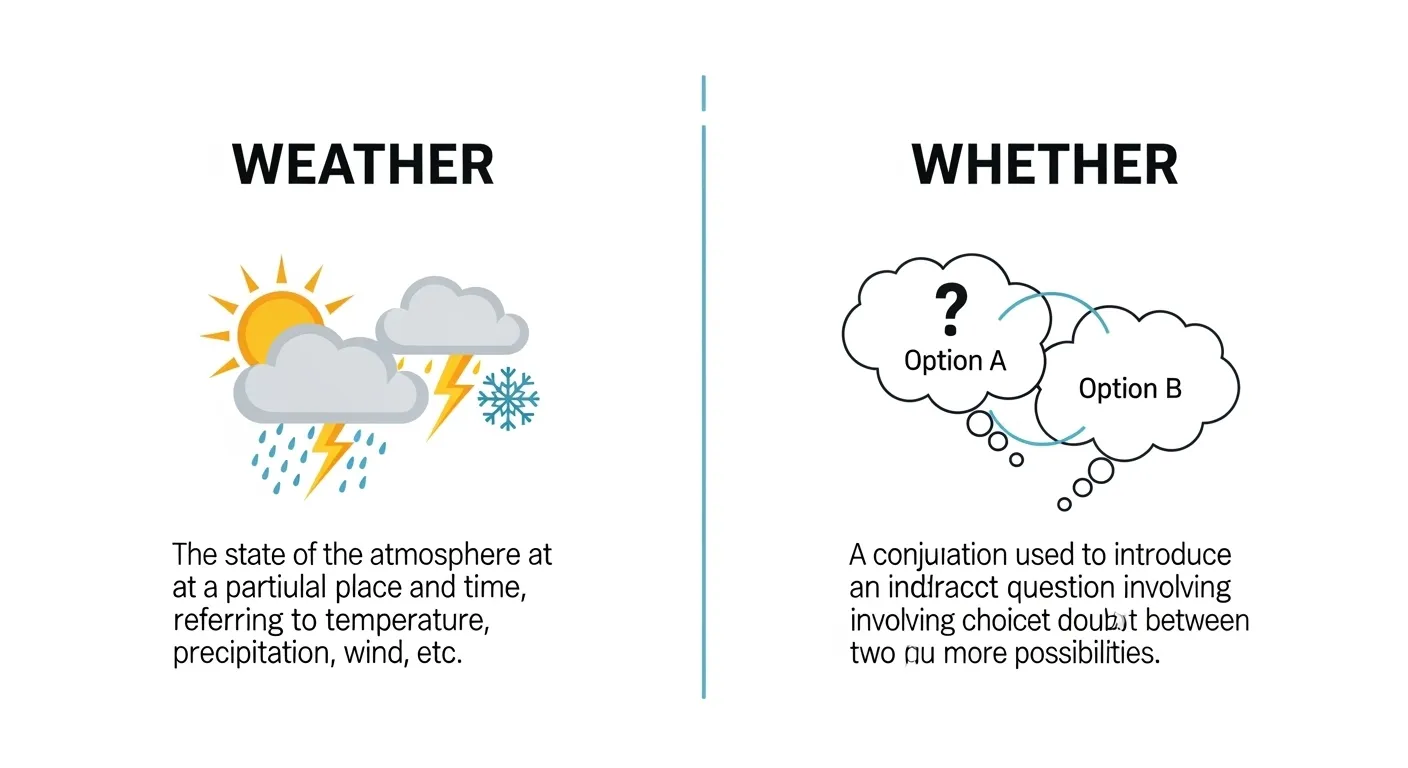
The correct word depends on the meaning: “weather” relates to climate, while “whether” introduces choices.
Many people search for “weather or whether” because both words sound the same and look similar, but they are used in different situations. This confusion is common in emails, essays, social media, and even in professional writing.
People want to know which spelling is correct so they can avoid mistakes that make their writing look unprofessional. This article clears the confusion by explaining the difference, origin, examples, common mistakes, and how to use each word correctly in everyday English.
Weather or Whether : Quick Answer
Weather is about climate and conditions outside.
Whether is used to show choice or doubt.
Examples
Weather
- The weather is sunny today.
- We should check the weather forecast.
Whether
- I don’t know whether I should go.
- Tell me whether you will attend the meeting.
Simple rule:
👉 If you are talking about rain, sun, or wind → use weather.
👉 If you are choosing between options or showing doubt → use whether.
The Origin of Weather or Whether
Origin of “Weather”
The word weather comes from Old English “weder,” meaning air, storm, or sky. It has been used for centuries to describe atmospheric conditions.
Over time, the word evolved into weather and became the standard term for climate, temperature, rain, and wind.
Origin of “Whether”
Whether comes from Old English “hwæðer,” meaning which of two or if. It has been used in English for many centuries to show choice or doubt between two possibilities.
Why the Confusion Exists
- Both words sound identical in pronunciation (homophones).
- They look similar in writing.
- Many people learn English by listening, not reading.
- Mistakes spread quickly through informal writing and social media.
British English vs American English Spelling

There is no difference between British and American English for these words. Both countries use the same spellings and meanings.
Comparison Table
| Word | Meaning | British English | American English |
| weather | climate conditions | ✔️ Same | ✔️ Same |
| whether | choice or doubt | ✔️ Same | ✔️ Same |
Examples (British vs American)
British English:
- The weather in London is unpredictable.
- I don’t know whether I will travel.
American English:
- The weather in New York is cold.
- Tell me whether you are coming.
Which Spelling Should You Use?
For US Audiences
Use the same rules as everywhere else:
- Weather for climate
- Whether for choices
For UK and Commonwealth Audiences
The rule is the same. There is no special UK spelling.
For Global English Users
If you write for an international audience, follow this rule:
- Use weather for climate
- Use whether for options
For Exams, Professional Writing, and Formal Writing
Using the wrong word can cause confusion and lower your credibility. Always double-check your sentence.
Common Mistakes with Weather or Whether
Mistake 1: Using “Weather” Instead of “Whether”
❌ I don’t know weather I should go.
✅ I don’t know whether I should go.
Mistake 2: Using “Whether” Instead of “Weather”
❌ The whether is sunny today.
✅ The weather is sunny today.
Mistake 3: Confusing “Whether” with “If”
Whether is more formal and often used in writing.
- I’m not sure whether I can attend.
- I’m not sure if I can attend.
Both are correct, but whether is stronger for choices and formal writing.
Mistake 4: Using Both Words Together
❌ I’m not sure about the weather whether I should go.
✅ I’m not sure whether I should go.
Weather or Whether in Everyday Examples
Emails
- Weather: “Please check the weather before leaving.”
- Whether: “Please confirm whether you will attend the meeting.”
News Headlines
- Weather: “Stormy weather expected this weekend.”
- Whether: “Government debates whether to raise taxes.”
Social Media
- Weather: “The weather is amazing today!”
- Whether: “Not sure whether I should accept the offer.”
Formal Writing
- Weather: “The weather conditions impacted the project timeline.”
- Whether: “The study examines whether the policy was effective.”
Weather or Whether: Google Trends & Usage Data
Search trends show that “weather or whether” is a popular query because learners and writers frequently mix these two words.
Most Common Countries Searching
- India
- Pakistan
- United States
- United Kingdom
- Canada
- Australia
Usage Context
- Weather is used in daily conversations, forecasts, and travel.
- Whether is used in writing, decision-making, and questions.
Why it trends:
People want to avoid mistakes in formal writing, exams, and professional communication.
Comparison Table (Keyword Variations Side by Side)
| Phrase | Correct? | Meaning | Example |
| weather | ✔️ Yes | Climate conditions | The weather is hot today. |
| whether | ✔️ Yes | Choice or doubt | I’m not sure whether to go. |
| weather or whether | ✔️ Yes (question) | Clarification | Weather or whether: which is correct? |
| whether or weather | ✔️ Yes (question) | Clarification | Whether or weather is correct? |
FAQs
1. Is “weather” a verb?
Yes. “Weather” can be a verb meaning to survive or endure.
Example: “We weathered the storm.”
2. Can “whether” be replaced with “if”?
Often yes, but whether is more formal and clearer when showing choices.
3. Do British and American English use different spellings?
No. Both use the same spellings: weather and whether.
4. Why do people confuse weather and whether?
Because they sound the same and are homophones.
5. Which word is used for climate?
Weather is used for climate and conditions like rain, wind, and temperature.
6. Which word is used for choices?
Whether is used for choices, doubts, and decisions.
7. Is “whether” only used for two options?
Mostly yes, but it can be used for more than two choices in formal writing.
Conclusion
The difference between weather and whether is simple once you understand the meaning. Weather refers to climate conditions such as rain, sun, wind, and temperature.
You use it when talking about forecasts, seasons, or outdoor conditions. Whether is used when you want to show doubt or choice between options. It often appears in questions and formal writing.
Many people confuse these words because they sound identical. This confusion is common in everyday writing, social media posts, emails, and exams.
The key is to focus on the meaning: if the sentence is about climate, choose weather; if it is about a decision or option, choose whether.
Both words are correct, but using the wrong one can make your writing unclear and unprofessional.
Remembering the difference will improve your writing instantly. In global English, there is no British vs American spelling difference both follow the same rules.
So the next time you are unsure, just check the meaning and you will choose the correct word.
Related posts!
The Origin of Wellbeing / Well-being

