Farthest and furthest are both correct, but they are used in slightly different ways, and this quick answer solves the main confusion instantly.
Many people search for “furthest or farthest” because both words look similar, sound natural, and often appear in the same sentences.
Writers, students, bloggers, and professionals want to know which one sounds right, which one is grammatically correct, and If British or American English changes the rule.
The confusion exists because English allows overlap between physical distance and abstract meaning. This article clears that confusion completely.
You will get a clear rule, history, British vs American usage, real-life examples, common mistakes, trends, FAQs, and professional advice in simple English.
Furthest or Farthest – Quick Answer
Farthest is usually used for physical distance.
Furthest is often used for figurative or abstract distance, though it can also be used for physical distance, especially in British English.
Examples:
- This is the farthest house from the city. ✅ (physical distance)
- That was the furthest I could go emotionally. ✅ (abstract distance)
Simple rule:
Distance = farthest | Ideas, degree, progress = furthest
The Origin of Furthest or Farthest
Historical Background
Both farthest and furthest come from Old English words related to far. Over time, English developed two comparative forms instead of one, which is unusual but not rare.
- Farthest developed from far → farther → farthest
- Furthest developed from an older variant further → furthest
In earlier English, spelling and usage were not fixed. Writers used both forms freely, and meanings overlapped. As English became more standardized, subtle differences began to appear.
Why Two Spellings Exist
The reason both spellings survived is usage, not strict grammar rules. English often keeps multiple forms when:
- Both are widely understood
- Both appear in respected writing
- Neither causes confusion in meaning
That is why modern English accepts both furthest and farthest.
✅ Furthest vs Farthest – Meaning, Usage, and Spelling Guide
You may still wonder things like “furthest vs farthest meaning,” “which is furthest,” “the furthest or the farthest,” or even “farthest versus furthest.”
Both words are correct, but their meaning depends on context.
- Farthest meaning → refers to measurable physical distance
- Furthest meaning → refers to degree, progress, or abstract ideas
Examples:
- This is the farthest distance we have traveled. ✅
- This is the furthest point in his career. ✅
Many learners also ask:
- How do you spell farthest? → F-A-R-T-H-E-S-T
- How do you spell furthest? → F-U-R-T-H-E-S-T
👉 Quick clarity:
- Farthest in a sentence:
He ran the farthest in the race. - Furthest in a sentence:
She pushed herself to the furthest limit.
💡 Tip:
If you are unsure between furthest or farthest distance, choose:
- Distance → farthest
- Meaning/ideas → furthest
British English vs American English Spelling
The difference between furthest and farthest becomes clearer when comparing British and American English.
British English Usage
British English prefers furthest for both physical and abstract distance.
Examples:
- This is the furthest village in the region.
- She pushed herself to the furthest limit.
American English Usage
American English prefers farthest for physical distance and furthest for abstract meaning.
Examples:
- This is the farthest point on the map.
- His explanation went the furthest.
Comparison Table
| Aspect | British English | American English |
| Physical distance | Furthest | Farthest |
| Abstract meaning | Furthest | Furthest |
| Both accepted? | Yes | Yes |
Which Spelling Should You Use?
For US Audiences
Use farthest when talking about measurable distance. Use furthest for ideas, effort, progress, or degree.
For UK and Commonwealth Audiences
You can safely use furthest in almost all situations. It sounds natural and standard.
For Global English
If your audience is international, furthest is the safest choice because it works for both physical and abstract meanings.
In Formal Writing
Many editors prefer consistent usage. Choose one form and apply it logically throughout your text.
✅ Furthest or Farthest – Which One Should You Use? (UK, US & Global)
Many people search questions like “furthest or farthest UK,” “farthest or furthest more common,” “furthest vs farthest usage,” or “the farthest or the furthest.”
Here is the simple answer based on region and usage:
🇺🇸 American English
- Physical distance → farthest
- Abstract meaning → furthest
🇬🇧 British English
- Furthest is commonly used for both meanings
🌍 Global English
- Furthest is safer and more flexible
📌 Common usage patterns
- Farthest to the right → physical position
- Furthest to the right (opinion/idea) → abstract meaning
- Farthest distance meaning: measurable length
- Furthest meaning: limit, degree, or extent
⚠️ Common confusion queries explained
- Furthest vs farthest → both correct, context matters
- Furthest of farthest → depends on meaning
- Farthest or furthest? → choose based on distance vs idea
- Furthest or furtheres ❌ → incorrect spelling
💡 Final tip:
If you want a safe and modern choice for most writing,
👉 Use “furthest” (works in both meanings in many cases)
Common Mistakes with Furthest or Farthest
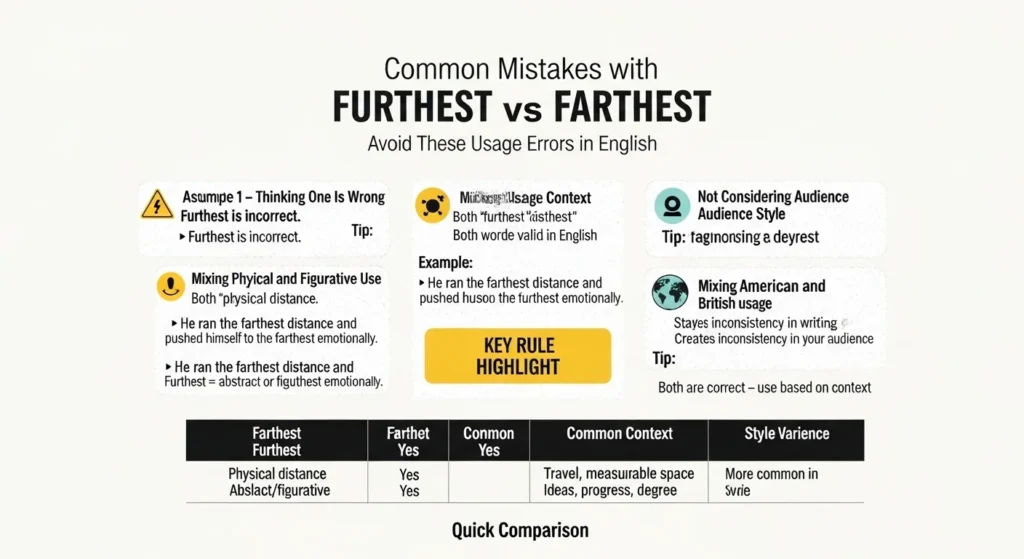
Mistake 1: Thinking One Is Wrong
❌ Furthest is incorrect. ✅ Both words are correct.
Mistake 2: Mixing Styles
❌ He ran the farthest distance and pushed himself to the farthest emotionally. ✅ He ran the farthest distance and pushed himself the furthest emotionally.
Mistake 3: Ignoring Audience
Using American rules in British writing (or the opposite) can make text feel inconsistent.
Furthest or Farthest in Everyday Examples
Emails
- This is the farthest location from our office.
- Please take this issue to the furthest extent.
News Writing
- The storm reached the furthest parts of the coast.
- Scientists traveled to the farthest point north.
Social Media
- That trip was the furthest I have ever traveled!
- We went to the farthest corner of the city 😄
Formal Writing
- The study explores the furthest implications of the policy.
- The expedition reached the farthest measurable point.
Furthest or Farthest – Google Trends & Usage Data
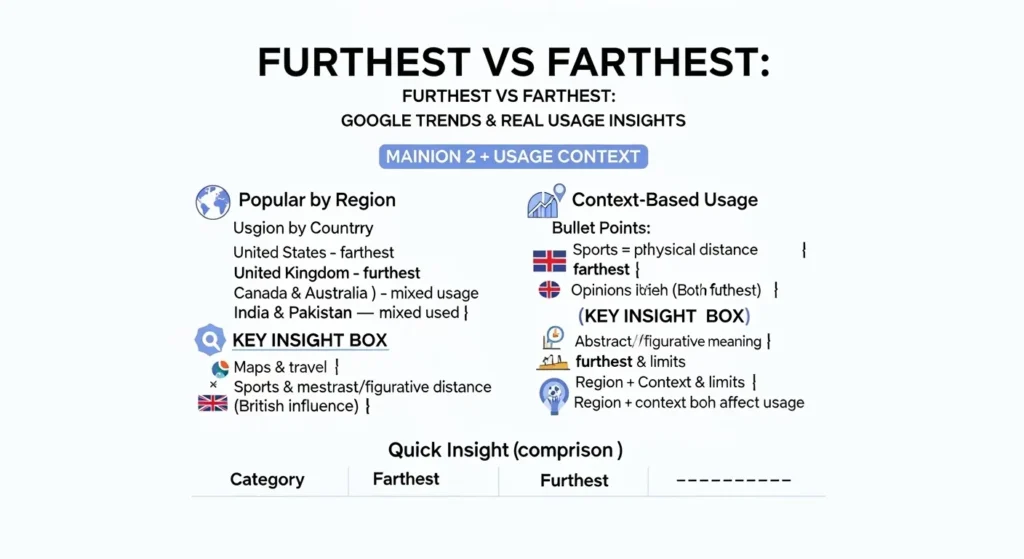
Search data shows steady interest in “furthest or farthest”, especially among students and writers.
Popular by Country
- United States: prefers farthest
- United Kingdom: prefers furthest
- Canada & Australia: mixed usage
- India & Pakistan: both used, often influenced by British English
Usage by Context
- Maps, travel, sports: farthest
- Opinions, progress, limits: furthest
This shows that meaning and region both influence choice.
Comparison Table: Furthest vs Farthest
| Feature | Furthest | Farthest |
| Correct | Yes | Yes |
| Physical distance | Yes (UK) | Yes (US) |
| Abstract meaning | Yes | Rare |
| Formal writing | Common | Common |
Frequently Asked Questions
Are furthest and farthest interchangeable?
Sometimes, yes. But context and audience matter.
Which one should I use in exams?
Follow the rule: distance = farthest, abstract = furthest.
Is furthest more British?
Yes, British English prefers furthest.
Is farthest American English?
Yes, especially for physical distance.
Can furthest refer to distance?
Yes, especially in British English.
Which sounds more formal?
Both are equally formal.
Which is safer for global writing?
Furthest is usually safer.
Conclusion
The difference between furthest or farthest is subtle but important. Both words are correct, both are widely used, and neither is a mistake on its own.
The key difference lies in meaning and audience. In general, farthest works best for clear, measurable physical distance, especially in American English.
Furthest is preferred for abstract ideas such as effort, progress, degree, or limits, and it is the dominant choice in British English.
If you write for a global audience, furthest is often the safest option because it sounds natural in both physical and figurative contexts.
If you write for a US audience and want precision, use farthest for distance and furthest for ideas.
The most important thing is consistency. Choose the word that fits your meaning and stick to it throughout your writing.
By understanding this small difference, you can write more clearly, sound more professional, and avoid a very common English confusion.
Related posts!
Life or Death: What Is the Difference?
Hydrate or Die:Simple Meaning and Key Differences(2026)
Accept vs Except: What’s the Difference?(2026)

