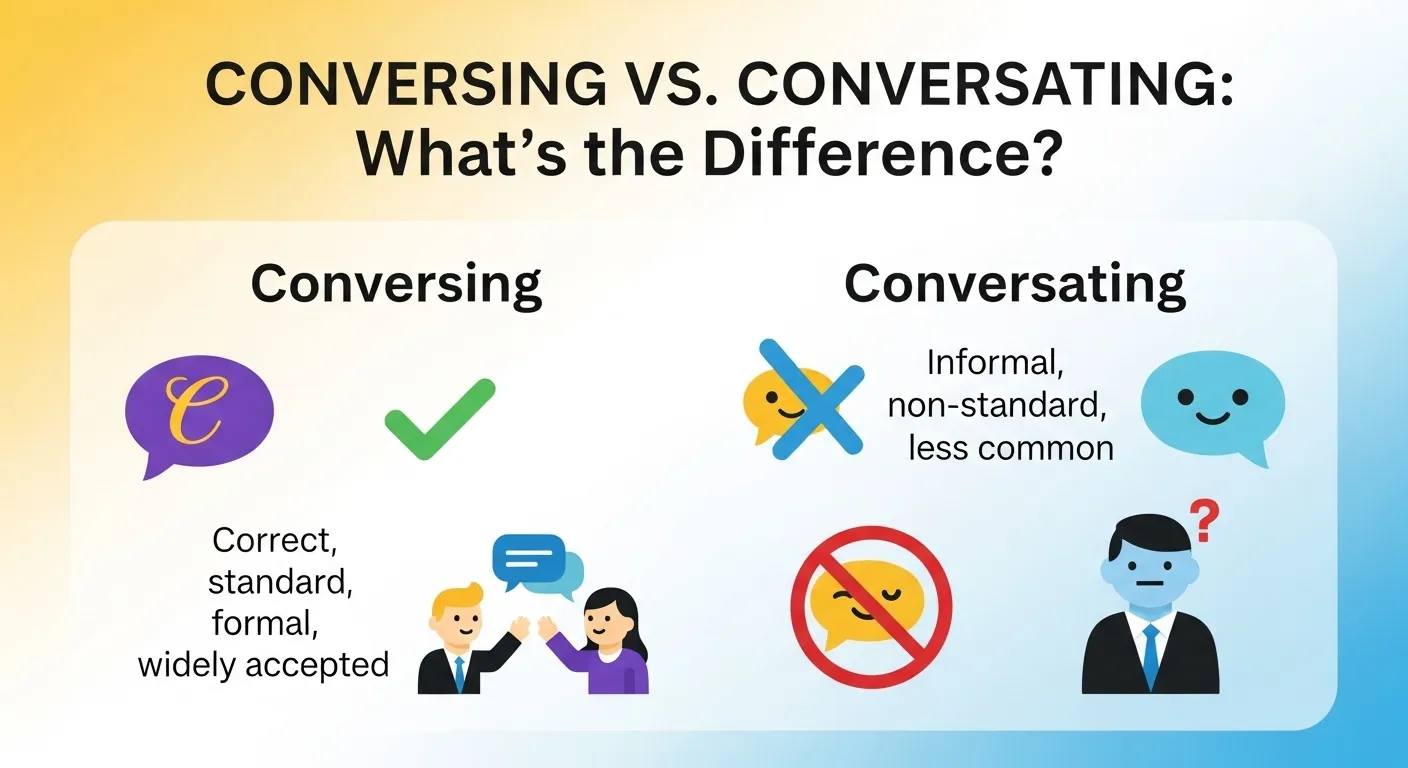
Conversing is correct, while conversating is informal and often considered non standard, and this single fact answers the main confusion right away.
Many people search for “conversing or conversating” because both words are heard in daily speech, meetings, podcasts, and social media.
When people hear others say conversating, they assume it must be correct and then hesitate while writing emails, articles, or academic work.
The confusion grows because English allows new words to appear through usage, even if they are not fully accepted. This article solves that confusion clearly.
You will learn which word is correct, why both exist, how British and American English treat them, common mistakes and professional advice written in very simple English.
Conversing or Conversating: Quick Answer
Conversing is the correct and standard word in English.
Conversating exists but is informal, non-standard, and often avoided in professional writing.
Examples:
- They were conversing quietly in the hallway. ✅
- She enjoys conversing with clients. ✅
- They were conversating about work. ⚠️ (informal, not recommended)
Short rule:
Formal or correct English = conversing
The Origin of Conversing or Conversating

Origin of “Converse” and “Conversing”
The verb converse comes from Latin conversari, which means to associate with or to keep company. From this root, English developed:
- converse (verb)
- conversation (noun)
- conversing (present participle)
These forms entered English hundreds of years ago and became fully accepted in writing, education, and formal speech.
Where Did “Conversating” Come From?
The word conversating developed much later. It was formed by people who assumed that since we have conversation (noun), the verb must be conversate.
This process is common in spoken English. People create new verbs by adding -ate, similar to:
- educate
- communicate
- participate
However, conversate never became a fully accepted standard verb in English dictionaries.
Why the Confusion Exists
The confusion exists because:
- Conversation is a very common noun
- Many English verbs end in -ate
- Conversating sounds natural in speech
Even so, standard English still prefers conversing.
British English vs American English Spelling
In this case, British and American English are mostly the same.
British English
British English strongly prefers conversing. The word conversating is generally viewed as incorrect or informal.
Example:
- The students were conversing after class.
American English
American English also prefers conversing, but conversating is heard more often in casual speech.
In writing, education, media, and business English, conversing is still the safe choice.
Comparison Table
| Feature | British English | American English |
| Preferred form | Conversing | Conversing |
| Conversating in writing | ❌ Avoided | ❌ Avoided |
| Conversating in speech | Rare | Informal only |
Which Spelling Should You Use?
For US Audiences
Use conversing in all professional, academic, and published writing. Avoid conversating, especially in emails and reports.
For UK and Commonwealth Audiences
Always use conversing. Conversating may be seen as an error.
For Global English
If your audience is international, conversing is the only safe and correct choice.
In Formal Writing
Editors, teachers, and style guides consistently recommend conversing. Using conversating may reduce credibility.
Is It Conversing or Conversating? (Correct Usage Explained)
Many learners ask is it conversing or conversating or which is correct: conversing or conversating because both forms are heard in daily conversation.
Clear Answer:
👉 Conversing is correct and standard English
👉 Conversating is informal and not recommended
This directly answers common queries like:
- is it conversing or conversating?
- which is correct conversing or conversating?
Meaning:
- Conversing → talking or having a conversation
- (Also searched as conversing artinya → meaning “to talk” or “to communicate”)
Examples:
- They were conversing during the meeting. ✅
- She enjoys conversing with new people. ✅
- ❌ They were conversating about the topic.
Simple Rule:
👉 Use conversing in all writing and professional speech
👉 Avoid conversating unless referring to informal spoken language
Common Mistakes with Conversing or Conversating

Mistake 1: Treating Both as Equal
❌ Conversing and conversating are both correct. ✅ Only conversing is standard.
Mistake 2: Using Conversating in Emails
❌ We were conversating about the project. ✅ We were conversing about the project.
Mistake 3: Assuming Conversation = Conversate
The noun conversation does not create the verb conversate.
Conversing or Conversating in Everyday Examples
Emails
- We were conversing about the deadline.
- I enjoyed conversing with you today.
News Writing
- Officials were conversing behind closed doors.
Social Media
- Love conversing with positive people 😊
- We were just conversing about life.
Formal Writing
- The participants were conversing in a structured setting.
Conversing or Conversating – Google Trends & Usage Data
Search interest for “conversing or conversating” has increased in recent years, especially among students and non native speakers.
Popular by Country
- United States: High searches, casual speech influence
- United Kingdom: Lower usage of conversating
- India & Pakistan: Confusion due to spoken English
- Canada & Australia: Mostly conversing
Usage by Context
- Academic and professional: conversing
- Casual spoken English: conversating sometimes heard
This data shows that usage does not equal correctness.
Comparison Table: Conversing vs Conversating
| Feature | Conversing | Conversating |
| Grammatically correct | Yes | No (standard) |
| Used in formal writing | Yes | No |
| Common in speech | Yes | Sometimes |
| Dictionary approved | Yes | Limited |
| Recommended usage | Always | Avoid |
Frequently Asked Questions
Is conversating a real word?
It exists in informal speech but is not standard English.
Is conversing always correct?
Yes, conversing is correct in all contexts.
Can I use conversating in casual talk?
You may hear it, but it is better to avoid it.
Which word do teachers prefer?
Teachers prefer conversing.
Is conversating American English?
It appears in casual American speech, not formal writing.
Which sounds more professional?
Conversing sounds professional and correct.
Should I ever use conversating?
Only if quoting speech, otherwise avoid it.
Conclusion
The confusion between conversing or conversating is very common, especially because both words sound natural in spoken English.
However, correctness in English depends on accepted usage, not just how often a word is heard. Conversing is the correct, standard, and widely accepted form.
It comes from the verb converse and has been part of English for centuries. It is safe to use in emails, academic writing, business communication, journalism, and everyday conversation.
Conversating, on the other hand, developed informally and is mostly limited to casual speech.
While some people use it, many teachers, editors, and style guides still consider it non-standard. Using it in formal or professional writing can make your English look weak or incorrect.
If you want clear, confident, and professional English, always choose conversing. It works in every situation, for every audience, and in both British and American English.
When in doubt, remember this simple rule: if you are writing, publishing, or speaking professionally, conversing is the right choice.
Related posts!
Whose vs Who’s: What’s the Difference?In 30 Seconds
Some vs Any: What’s the Difference?(2026)

