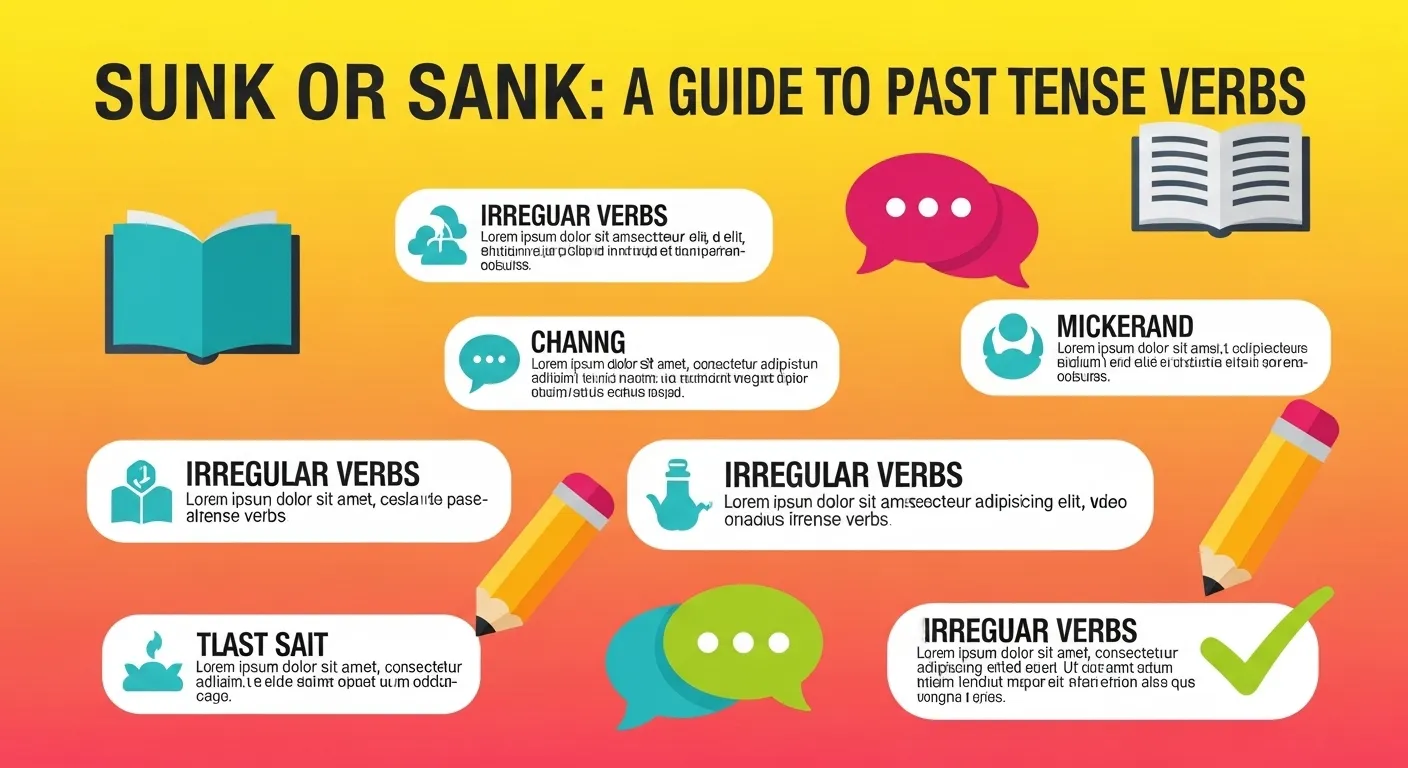
Sank is the simple past tense, and sunk is the past participle of sink.
Many people search for “sunk or sank” because both words sound correct in daily speech. This confusion is very common in spoken and written English.
Learners, students, bloggers, and even native speakers often mix these forms in exams, emails, news writing, and social media posts.
The verb sink is irregular, so it does not follow normal -ed rules. This article solves that confusion clearly. You will get a quick answer first.
Then you will learn origin, tense rules, British vs American usage, common mistakes, real-life examples and expert advice. Sentences are short. Language is simple. Everything is clear.
Sunk or Sank: Quick Answer
Sank is the simple past tense of sink.
Sunk is the past participle of sink.
Examples:
- The boat sank yesterday. ✅
- The boat has sunk already. ✅
❌ The boat has sank. (Incorrect)
Easy rule:
Past time only = sank. Helping verb = sunk.
Sank vs Sunk: Meaning, Usage & Common Questions
Sank vs Sunk Explained Simply
Many learners search for sunk vs sank or difference between sank and sunk. The rule is simple:
- Sank = past tense
- Sunk = past participle (used with has/have/had)
This also answers queries like:
- is sank a word → Yes, it is correct past tense
- sunk past tense → ❌ Incorrect alone
- past tense of sink → sank
- sink past participle → sunk
Meaning of “Sank”
The word sank means went down in the past.
Examples:
- The ship sank quickly.
- My heart sank after the news.
This covers:
- what does sank mean
- sank meaning in English
- definition of sank
- sank in a sentence
Meaning of “Sunk”
The word sunk shows a completed action with a helping verb.
Examples:
- The ship has sunk.
- The boat had sunk before help arrived.
This covers:
- has sunk meaning
- had sunk / have sunk
- the boat has sunk meaning
Common Confusion Examples
- My heart sank ✅ (correct)
- My heart has sunk ✅ (also correct with helper)
- My heart sunk ❌
Covers:
- my heart sank or sunk
- heart sank or sunk
The Origin of Sunk or Sank
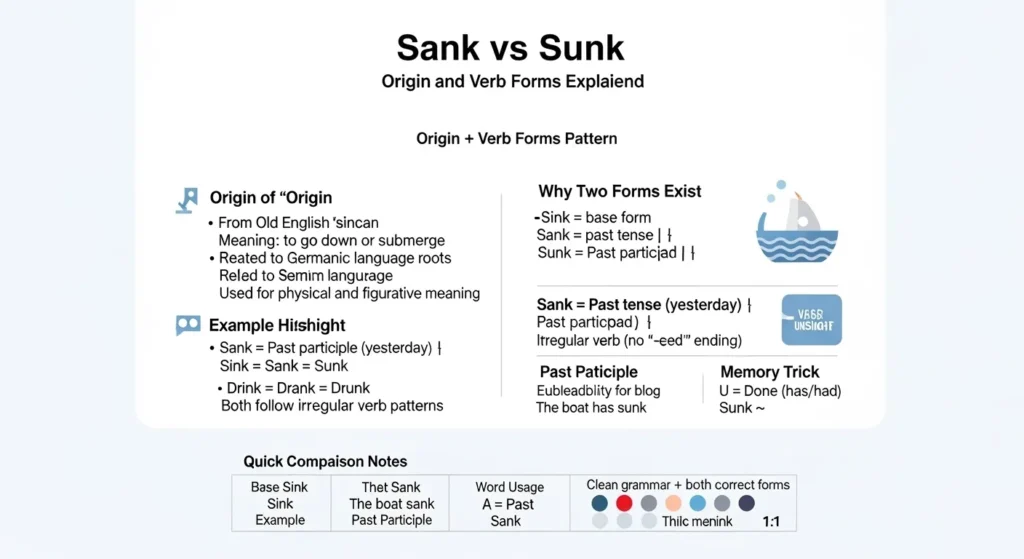
Origin of the Verb “Sink”
The verb sink comes from Old English sincan. It meant to go down, fall, or submerge. Germanic languages have similar forms. Over time, English kept this irregular verb pattern.
The verb forms developed as:
- sink (base form)
- sank (simple past)
- sunk (past participle)
Why Two Forms Exist
English has many irregular verbs. These verbs change vowels instead of adding -ed. This pattern causes confusion. Drink :drank :drunk works the same way. Sink :sank :sunk follows this family pattern.
Why People Mix Them
In fast speech, people often say has sank. This sounds natural to some ears. But grammar rules still apply in writing and formal English.
British English vs American English Spelling
There is no spelling difference between British English and American English for sunk or sank.
Both varieties follow the same verb rules.
British English Examples
- The ship sank during the storm.
- The ship has sunk near the coast.
American English Examples
- The boat sank quickly.
- The boat has sunk already.
Comparison Table
| Feature | British English | American English |
| Simple past | sank | sank |
| Past participle | sunk | sunk |
| Has sank accepted? | No | No |
| Formal writing | Same | Same |
Key point: Rules are identical.
Which Spelling Should You Use?
For US Writers
Use sank for finished past actions. Use sunk with has, have, had.
For UK and Commonwealth Writers
The same rule applies. There is no regional difference.
For Global English Users
Follow tense rules. Readers everywhere expect this structure.
For Students and Exams
Using has sank is marked wrong. Always use has sunk.
Clear advice:
Check for a helping verb. If it exists, choose sunk.
Common Mistakes with Sunk or Sank

Mistake 1: Using “Sank” with Helping Verbs
❌ The ship has sank.
✅ The ship has sunk.
Mistake 2: Using “Sunk” Alone
❌ The ship sunk yesterday.
✅ The ship sank yesterday.
Mistake 3: Mixing Tenses
❌ Yesterday it has sunk fast.
✅ Yesterday it sank fast.
Mistake 4: Ignoring Time Words
Words like yesterday need sank, not sunk.
Sunk or Sank in Everyday Examples
In Emails
- The costs sank last year.
- Our budget has sunk again.
In News Writing
- The ship sank after the collision.
- Several boats have sunk this season.
On Social Media
- My heart sank 😞
- My confidence has sunk lately.
In Formal Writing
- Profits sank sharply in 2023.
- Market confidence has sunk.
In Academic Writing
- The experiment sank due to errors.
Literal vs Figurative Use
Literal Meaning
Used for physical sinking.
- The stone sank in water.
- The stone has sunk already.
Figurative Meaning
Used for emotions or situations.
- His heart sank.
- Morale has sunk.
Rules stay the same in both meanings.
Verb Forms of “Sink”
| Form | Word |
| Base form | sink |
| Present participle | sinking |
| Simple past | sank |
| Past participle | sunk |
This table helps quick revision.
Sink, Sank, Sunk: Forms, Patterns & Correct Usage
Full Verb Pattern
The verb follows a vowel-change pattern:
- sink → sank → sunk
This answers:
- sink sank sunk
- vowel pattern sink sank sunk
- sink past form
- past of sink
Why Not “Sinked”?
Many learners ask:
- sinked or sunk
Correct answer:
- ❌ sinked
- ✅ sank / sunk
English irregular verbs do not use -ed here.
Sentence-Based Usage
- The ship sank yesterday.
- The ship has sunk already.
This covers:
- the ship sank or sunk
- the boat sank or sunk
- sank sentence
- sunk in a sentence
Related Forms & Variations
Some people search:
- sunk or sunken
Difference:
- Sunk = verb (has sunk)
- Sunken = adjective (sunken ship)
Sunk or Sank: Google Trends & Usage Data
Search Popularity
- “Sunk or sank” is searched worldwide.
- Error-based searches are very common.
By Country
- United States: High confusion in informal writing
- United Kingdom: Frequent exam-related searches
- India & Pakistan: High ESL search volume
- Australia & Canada: Grammar clarification searches
Context of Searches
Most users want:
- Exam safety
- Correct tense usage
- Professional writing clarity
Comparison Table: Sunk vs Sank
| Point | Sank | Sunk |
| Verb type | Simple past | Past participle |
| Needs helping verb | No | Yes |
| Used with yesterday | Yes | No |
| Used with has/have | No | Yes |
| Correct alone | Yes | No |
Frequently Asked Questions
Is “has sank” ever correct?
No. The correct form is has sunk.
Is “sunk” a real word?
Yes. It is the past participle of sink.
Can I say “the ship sunk yesterday”?
No. Use sank with yesterday.
Why do people confuse sunk and sank?
Because both sound natural in speech.
Is the rule same in British and American English?
Yes. There is no difference.
Is sunk used without a helping verb?
No. It needs has, have, had, or be.
What is the pattern of sink?
It follows drink :drank : drunk.
Conclusion
The keyword “sunk or sank” causes confusion, but the rule is simple. Sank is used for completed actions in the past. Sunk is used with helping verbs to show connection with the
present or another past moment. The verb sink is irregular, so it does not follow normal spelling rules. This is why mistakes happen so often.
There is no difference between British English and American English here. Writers everywhere follow the same tense structure. If your sentence includes yesterday, last night, or a finished time, use sank.
If your sentence includes has, have, or had, use sunk. This rule works in literal meanings and figurative meanings.
For exams, professional writing, and daily communication, using the correct form matters. One wrong tense can reduce clarity and credibility.
Remember one simple line: no helper means sank, helper means sunk. If you follow this rule, you will never confuse sunk or sank again.
Related posts!
Common Mistakes with Duffel or Duffle
Whose vs Who’s: What’s the Difference?In 30 Seconds
Some vs Any: What’s the Difference?(2026)

