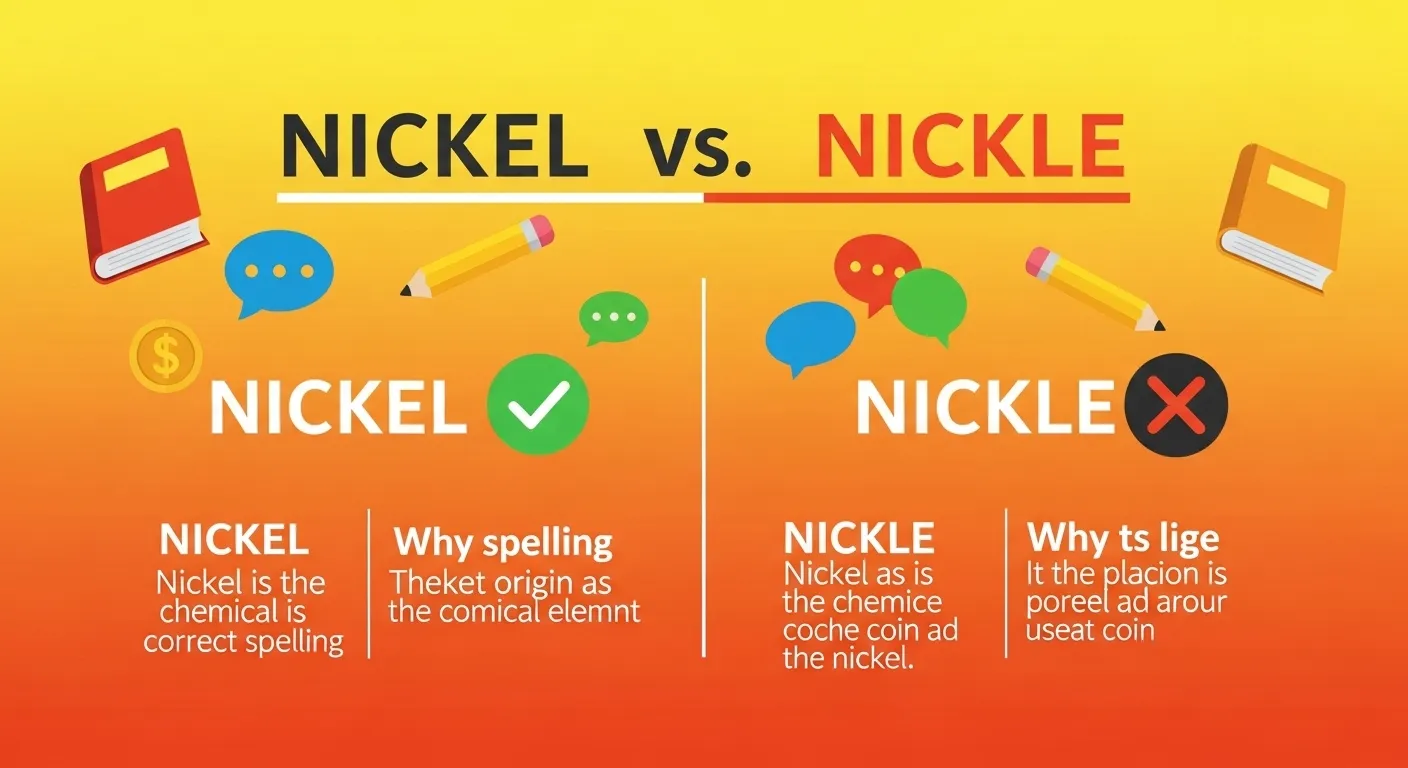
Nickel is the correct spelling, and nickle is incorrect.
Many people search for “nickel or nickle” because they see both forms online and feel unsure while writing exams, emails, product descriptions, or educational content.
The confusion often comes from pronunciation. The sound ends with a clear “l,” so writers assume the spelling should end with “le.” English spelling does not always follow sound rules. This article clears that confusion fully.
It explains the correct spelling, its origin, common mistakes, real-life examples, usage patterns, and clear advice. By the end, you will confidently use nickel correctly and avoid the spelling nickle in all situations.
Nickel or Nickle: Quick Answer
- Nickel is the correct spelling ✅
- Nickle is incorrect ❌
Meaning: a chemical element, a metal, and a five-cent coin in the United States.
Examples:
- This ring is made of nickel.
- I found a nickel on the road.
❌ Incorrect example:
- I found a nickle. (wrong spelling)
The Origin of Nickel or Nickle

Early History
The word nickel comes from the German word Kupfernickel. It means “devil’s copper.” German miners used this word when they found ore that looked like copper but was not.
Entry into English
The term entered English in the 18th century. Scientists adopted nickel as the official name of the metal. The spelling became fixed early.
Why Confusion Exists
English has many words that end with “-le.” Examples include little, table, and apple. Because nickel sounds similar, many writers mistakenly add an extra “l” and write nickle. This spelling has never been standard.
British English vs American English Spelling
British English
- Correct spelling: nickel
- Used for the metal and alloys
Example:
- The coin contains nickel.
American English
- Correct spelling: nickel
- Used for the metal and the five-cent coin
Example:
- He paid with a nickel.
Important Note
There is no spelling difference between British and American English for this word.
Comparison Table
| Feature | British English | American English |
| Correct Spelling | Nickel | Nickel |
| Incorrect Form | Nickle | Nickle |
| Meaning | Metal | Metal / Coin |
| Variation | None | None |
Which Spelling Should You Use?
Always use nickel.
Use Nickel When
- Writing about money
- Writing about metals
- Writing academic or formal text
- Writing casual messages
Never Use Nickle
- It is a spelling mistake
- It is not accepted in standard English
- It appears due to pronunciation confusion
Clear rule:
If you mean the metal or the coin, write nickel.
Common Mistakes with Nickel or Nickle

Mistake 1: Adding Extra “L”
❌ nickle ✅ nickel
Mistake 2: Trusting Sound Over Spelling
❌ Writing what you hear ✅ Writing the standard form
Mistake 3: Copying Informal Text
❌ Social posts using nickle ✅ Check dictionaries
Mistake 4: Exam Errors
❌ Losing marks due to spelling ✅ Memorize the correct form
Mistake 5: Product Descriptions
❌ nickle coating ✅ nickel coating
Nickel or Nickle in Everyday Examples
Emails
- The item contains nickel.
Education
- Nickel is a chemical element.
News
- Prices of nickel increased this year.
Social Media
- Found a nickel today.
Formal Writing
- The alloy includes iron and nickel.
Nickel or Nickle: Google Trends & Usage Data
Search Patterns
People search both spellings, but results clearly favor nickel.
Reason for Searches
- Pronunciation confusion
- Misspelling habits
- Auto-correct errors
Usage Context
- Education: correct spelling only
- Science: correct spelling only
- Money: correct spelling only
Comparison Table
| Aspect | Nickel | Nickle |
| Correct | Yes | No |
| Common Search | High | Medium |
| Dictionary Listed | Yes | No |
| Formal Use | Yes | No |
Comparison Table: Nickel vs Nickle
| Point | Nickel | Nickle |
| Correct Spelling | Yes | No |
| Accepted in English | Yes | No |
| Used in Exams | Yes | No |
| Professional Writing | Yes | No |
| Meaning | Metal / Coin | None |
Frequently Asked Questions
Is nickle ever correct?
No. It is always incorrect.
Why do people write nickle?
Because the sound is confusing.
Is nickel British or American?
It is used in both.
Is nickel a metal?
Yes. It is a chemical element.
Is nickel a coin?
Yes. In the United States.
Does spellcheck catch nickle?
Often yes, but not always.
Can nickle be slang?
No. It has no standard meaning.
Extra Practice and Usage Notes
Many learners ask how to remember the correct spelling of nickel. A simple trick helps. Think of the word metal. It ends with a single “l.” Nickel follows the same pattern. This connection makes the spelling easier to recall.
In classrooms, teachers often point out that nickel behaves like a fixed scientific term. Scientific words usually keep one accepted spelling.
They do not change by region. This is why British English and American English both use nickel without variation.
In daily writing, mistakes often happen during fast typing. Auto-correct may not always fix nickle. Writers should slow down and check final drafts. This habit prevents small errors that reduce credibility.
For students, correct spelling matters in exams. A single wrong letter can lead to lost marks. Memorizing nickel as a complete word is safer than sounding it out. Sound-based spelling often fails in English.
For professionals, correct spelling builds trust. Product descriptions, reports, and technical documents must be accurate.
Using nickel correctly shows attention to detail. Over time, this habit improves writing quality and confidence.
Conclusion
The confusion between nickel or nickle is common, but the rule is simple. Nickel is the only correct spelling. It applies to the metal, the chemical element, and the five-cent coin.
The spelling nickle is always wrong. It appears due to pronunciation habits and spelling assumptions. English spelling does not always match sound.
Clear writing requires correct forms. Students should memorize it. Writers should proofread it. Professionals should standardize it. Once you remember this rule, you will never hesitate again. Write nickel with confidence every time.
Discovers more posts!

