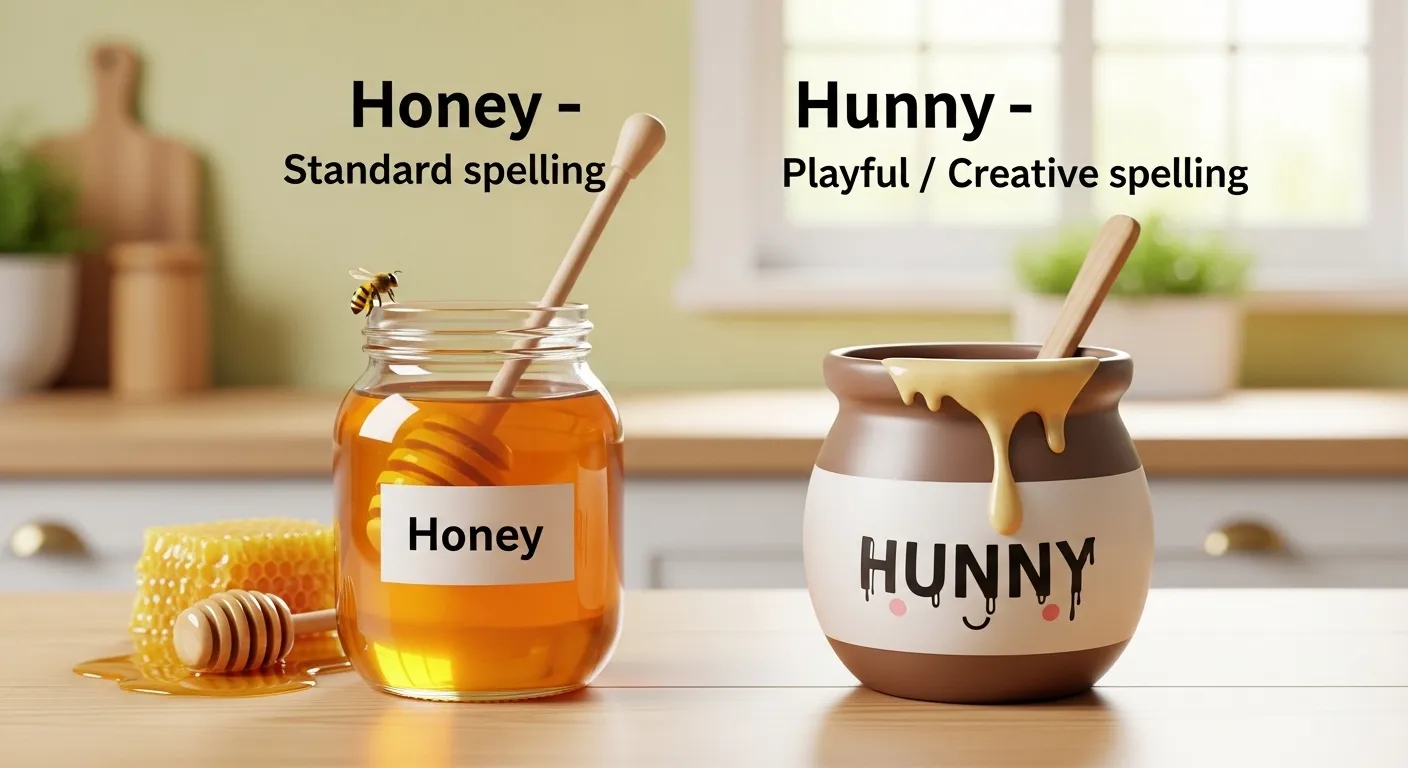
Honey is the correct spelling, while hunny is informal and playful. Many people get confused when they see “hunny” in cartoons, social media, or text messages.
People search for “honey or hunny” to know the right spelling for writing, labeling products, or using it as a term of affection.
This article solves that confusion. You will learn the origins of both spellings, the difference between them, common mistakes, and professional advice.
By the end, you will know when to use honey, when hunny is acceptable, and how to communicate clearly without errors in formal or casual settings.
The confusion exists because “hunny” is widely used in fictional writing and playful messages. Meanwhile, honey has been the correct spelling for centuries.
Understanding the difference ensures accurate writing, credibility in communication, and proper use in professional and everyday contexts.
Honey or Hunny: Quick Answer
Honey is the standard, correct spelling.
Hunny is informal, playful, and mostly used in fiction or casual writing.
Use honey in:
- School assignments
- Emails and letters
- Articles and blogs
- Product labels
Use hunny in:
- Social media posts
- Cute messages
- Fictional dialogue
Examples:
- ✅ I like honey in my tea.
- ❌ I like hunny in my tea.
- ✅ Thank you, honey.
- 😊 Hey hunny, see you soon!
Honey is correct for all formal writing. Hunny is safe only in playful or fictional contexts.
The Origin of Honey vs Hunny
Honey comes from Old English “hunig”, used for centuries to describe the sweet food made by bees.
Over time, it became a term of affection. Honey has remained the standard spelling in English dictionaries.
Hunny is a modern, informal variation. It gained popularity in children’s literature and cartoons.
A famous example is Winnie the Pooh, where the character spells honey as “hunny” on pots of honey.
The playful spelling imitates childlike pronunciation. It is used for stylistic effect, humor, or cuteness.
While widely recognized in informal writing, hunny is never correct in professional or academic writing.
The difference exists because honey is a historical, dictionary approved word, while hunny is intentionally altered for creative or entertainment purposes.
British English vs American English Spelling
The spelling of honey does not change between British and American English. Both regions use honey as the standard. Hunny is informal in both regions.
| Feature | American English | British English |
| Correct spelling | Honey | Honey |
| Informal / playful spelling | Hunny | Hunny |
| Used in formal writing | Yes | Yes |
| Used in fiction | Sometimes | Sometimes |
| Product labeling | Honey | Honey |
Unlike other words with regional differences, honey remains consistent in spelling.
Which Spelling Should You Use?
United States:
Always use honey for school, work, or formal communication.
UK / Commonwealth:
Use honey in professional and academic writing.
Global audience:
Honey is the safest choice. It is universally recognized and correct.
Use hunny only for:
- Texting close friends
- Social media captions
- Fictional or playful writing
Professional writers should avoid hunny. It may confuse readers or seem unprofessional. Honey communicates clearly, accurately, and safely across all audiences.
Common Mistakes with Honey and Hunny
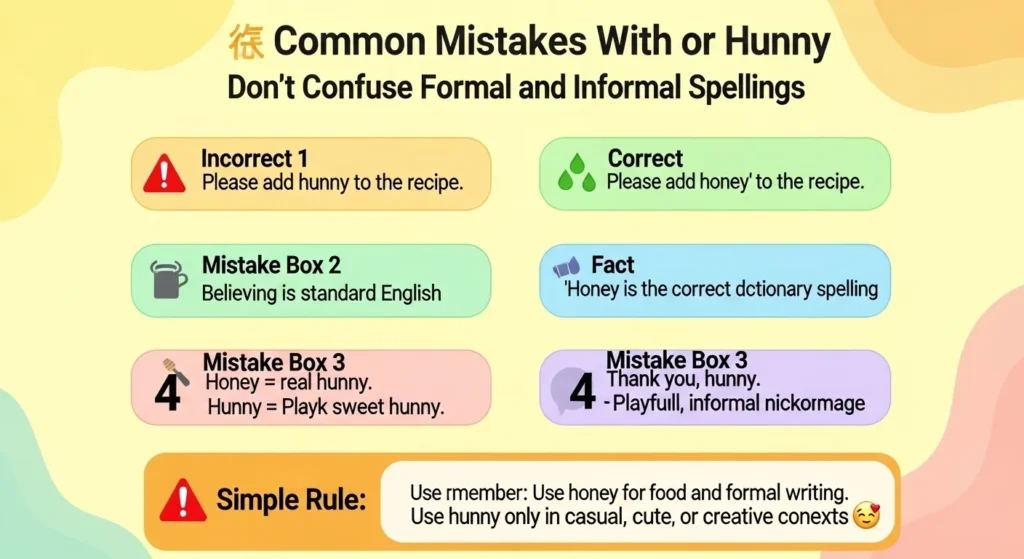
- ❌ Using hunny in essays
✅ Use honey instead - ❌ Writing hunny on product labels
✅ Write honey to avoid mistakes - ❌ Using hunny in business emails
✅ Use honey or omit casual terms - ❌ Assuming hunny is modern slang
✅ It is mostly fictional and playful - ❌ Forgetting honey is also a term of affection
✅ Use honey correctly in both food and affectionate contexts
Correct spelling builds credibility and ensures understanding.
Honey or Hunny in Everyday Examples
Emails:
- “Please buy honey for the school project.”
News articles:
- “The price of honey rose this year due to poor harvests.”
Social media (formal brand):
- “Our raw honey is 100% organic and pure.”
Social media (casual):
- “Good morning hunny! 😍”
Formal writing:
- “Honey production supports sustainable farming practices.”
The context determines which form is appropriate.
Why the Confusion Between Honey and Hunny Continues
Several factors contribute to the confusion:
- Digital culture: Social media encourages creative spellings. People use hunny to appear cute or friendly.
- Autocorrect / saved words: Phones may not correct hunny if it is added to personal dictionaries.
- Branding: Some companies use hunny in brand names to attract attention.
- Cartoons and books: Characters like Winnie the Pooh popularized hunny, making it familiar.
Despite these factors, honey remains the correct, dictionary approved spelling. Formal writing, labels, and academic work always require honey.
Honey or Hunny: Google Trends & Usage Data
Search data shows:
- Honey has consistently high search volume.
- Common searches include honey benefits, honey recipes, and honey as a term of affection.
- Hunny has much lower search volume.
- Most searches for hunny relate to children’s books, cartoons, and casual texting.
Top countries searching for honey:
- United States
- India
- United Kingdom
- Canada
- Australia
Hunny searches are mostly playful and informal.
Comparison Table: Honey vs Hunny
| Feature | Honey | Hunny |
| Dictionary word | Yes | No |
| Correct spelling | Yes | No |
| Used in school / academic writing | Yes | No |
| Used in professional emails | Yes | No |
| Used in fiction | Yes | Yes |
| Tone | Standard | Playful / Cute |
| Safe for formal use | Yes | No |
| Recognizable globally | Yes | Informal / Limited |
FAQs: Honey or Hunny
1. Is hunny ever correct?
Only in playful or fictional contexts.
2. Can I use hunny in professional emails?
No. Always use honey in formal communication.
3. Why does Winnie the Pooh use hunny?
It shows a childlike, cute style of writing.
4. Is hunny in the dictionary?
No. Major dictionaries list honey as correct.
5. Is honey only about food?
No. It is also used as a term of affection.
6. Can honey be used for all genders?
Yes. Honey is gender neutral.
7. Is hunny slang?
Not exactly. Hunny is playful and informal spelling.
Additional Insights on Usage
Honey has been used in literature, songs, and culture for centuries. It conveys sweetness literally and metaphorically. Hunny, in contrast, is almost always used to create a playful tone.
This makes hunny ideal for text messages, memes, fan content, and children’s books. However, relying on hunny in formal contexts can reduce credibility.
When writing for business, school, or online content aimed at a broad audience, honey should always be the default choice.
Hunny can enhance personality and humor, but only in informal or creative writing. Being aware of these nuances ensures proper communication and avoids misinterpretation.
Conclusion
In summary, honey is the correct and standard spelling. It refers to the sweet food made by bees and is also used as a term of affection. Hunny is informal, playful, and used mainly in fiction, cartoons, or casual messages.
The confusion arises because hunny is widely recognized in pop culture, but it is not correct in formal writing.
Using honey in school, business, and professional writing shows accuracy and credibility. Hunny is safe only for casual texts or fictional dialogue.
By choosing the right spelling, you communicate clearly and maintain professionalism while still having fun in informal settings. Remember this rule: formal writing → honey; playful writing → hunny.
Clear usage strengthens communication and ensures your message is understood by all audiences.
Discover More Posts!
📝 Coaches or Coach’s: Correct Spelling for Exams & Writing
Truth or Drink Game Ideas and Examples 📝
Choose or Die: Everything You Need to Know About the Game 🎮

