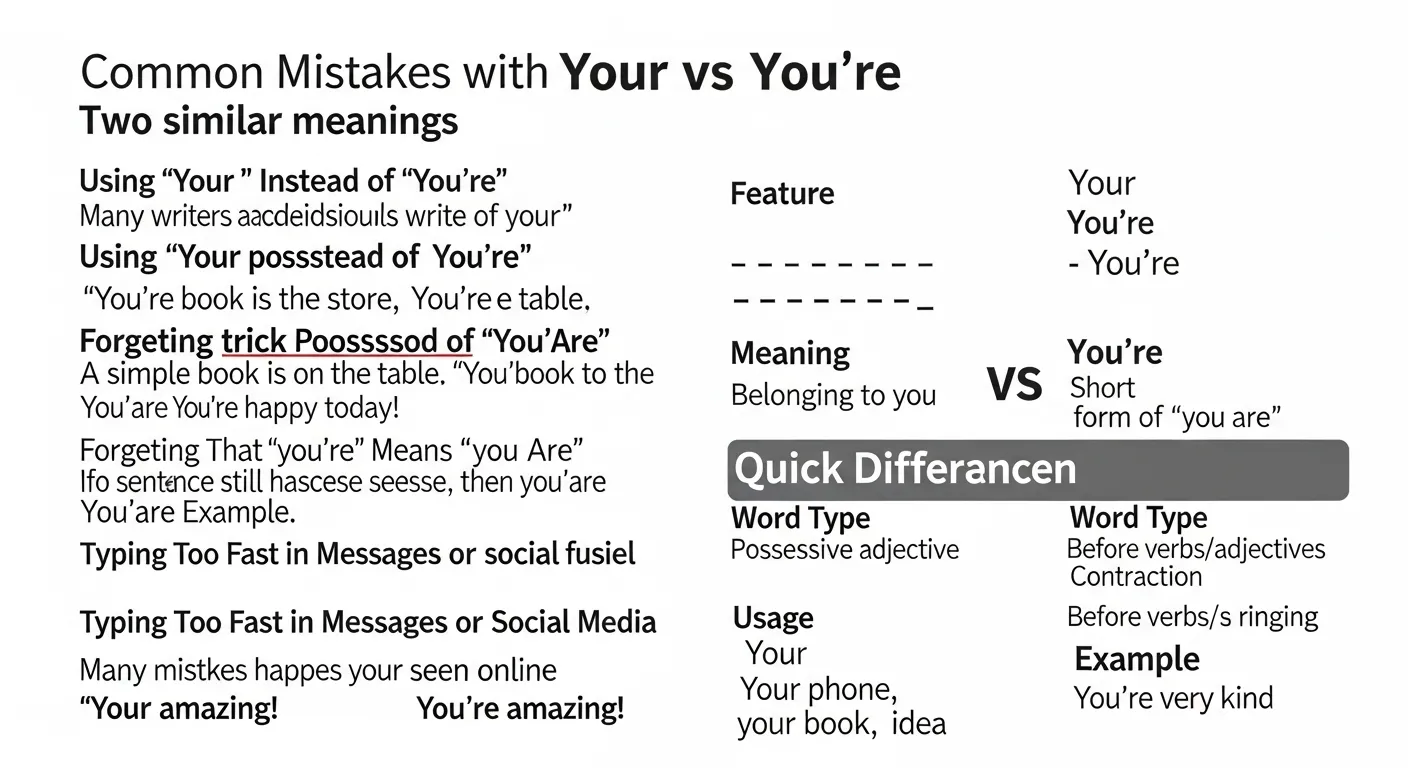
Your shows possession, while you’re means “you are.” This is the simple answer people want when they search “your vs you’re.”
These two words look very similar. They also sound the same when spoken. Because of this, many people confuse them in writing.
Students, writers, and even professionals sometimes make this mistake. It often appears in emails, social media posts, school assignments, and text messages.
The confusion happens because your and you’re are homophones. Homophones are words that sound the same but have different meanings and spellings.
Knowing the difference is important because using the wrong word can change the meaning of a sentence or make writing look unprofessional.
Understanding your vs you’re helps improve grammar and writing clarity. It also helps students avoid common grammar mistakes in exams and everyday communication.
In this guide, you will learn the meaning of your and you’re, their origin, the key differences, examples, common mistakes, and answers to popular Google questions about these words.
📖 Your vs You’re Definition
🔤 Your Definition
Your is a possessive adjective.
It shows that something belongs to the person you are talking to.
The word comes before a noun.
Examples:
| Sentence | Meaning |
| Your book is on the table. | The book belongs to you. |
| I like your idea. | The idea belongs to you. |
| Your phone is ringing. | The phone belongs to you. |
Example sentence:
Your car is parked outside.
🔤 You’re Definition
You’re is a contraction.
It is a short form of “you are.”
The apostrophe replaces the missing letter a.
Examples:
| Sentence | Full Form |
| You’re happy today. | You are happy today. |
| You’re a great friend. | You are a great friend. |
| You’re going to school. | You are going to school. |
Example sentence:
You’re doing a great job.
⚡ Your vs You’re: Quick Answer
The difference is simple.
| Word | Meaning | Example |
| Your | Shows possession | Your bag is here. |
| You’re | Short form of “you are” | You’re late today. |
Simple idea:
- Your → shows ownership
- You’re → means you are
🕰️ Origin of Your and You’re
Origin of Your
The word your comes from Old English.
Early forms included “eower” and “yower.”
Over time, the spelling changed.
The modern form your became common in English writing.
The word has always shown possession.
Origin of You’re
The word you’re is a contraction.
It combines two words:
- You
- Are
English contractions became popular in spoken and informal writing.
They help make sentences shorter and easier to say.
🌍 Key Differences Between Your and You’re
Your and you’re look similar but serve different grammar roles.
| Feature | Your | You’re |
| Word type | Possessive adjective | Contraction |
| Meaning | Belonging to you | You are |
| Use | Before nouns | Before verbs or adjectives |
Example comparison:
| Correct Sentence | Explanation |
| Your dog is cute. | Dog belongs to you |
| You’re very kind. | You are very kind |
📝 Examples of Your and You’re
Examples Using Your
Your homework is on the desk.
Your friend is waiting outside.
Examples Using You’re
You’re going to love this movie.
You’re the best player on the team.
⚠️ Common Mistakes with Your vs You’re
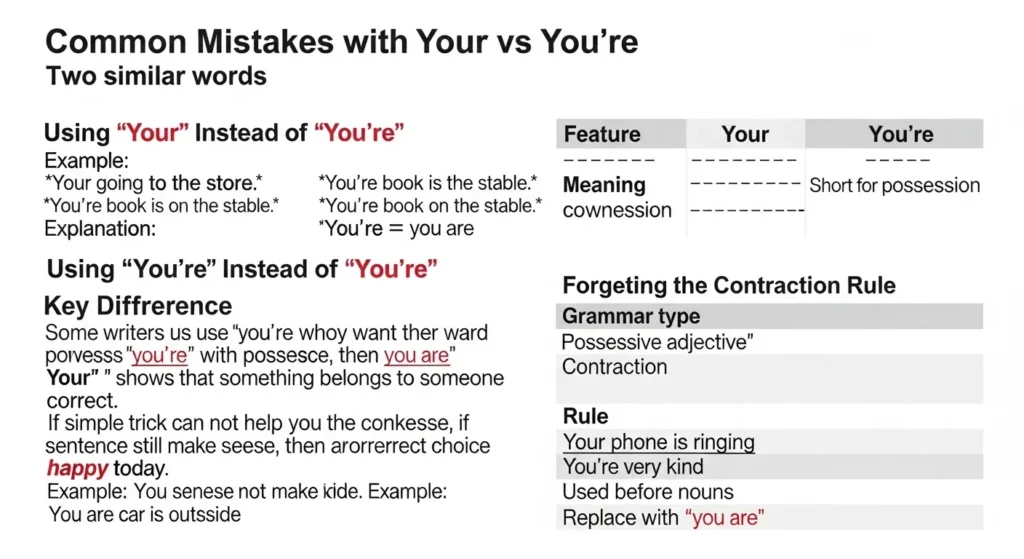
Using your instead of you’re
Incorrect:
Your going to the store.
Correct:
You’re going to the store.
Using you’re instead of your
Incorrect:
You’re book is on the table.
Correct:
Your book is on the table.
Forgetting the contraction meaning
A helpful trick:
Replace you’re with you are.
If the sentence still makes sense, then you’re is correct.
Example:
You’re happy today → You are happy today ✔
💬 Your vs You’re in Everyday Examples
Social media
Many posts contain mistakes like:
“Your amazing!”
Correct sentence:
“You’re amazing!”
Text messages
People often write quickly and mix these words.
Example:
“Your coming to the party?”
Correct:
“You’re coming to the party?”
School writing
Teachers often correct this mistake in essays.
Correct grammar improves writing quality.
📊 Google Search Queries Related to Your vs You’re
People search many questions about this topic.
| Popular Search Query | Meaning |
| your vs you’re difference | Grammar explanation |
| when to use your or you’re | Writing help |
| what does you’re mean | Contraction meaning |
| your vs you’re examples | Learning examples |
These questions show that many learners want simple grammar explanations.
❓ FAQs
What is the difference between your and you’re?
Your shows possession. You’re means “you are.”
Is your a possessive word?
Yes. Your shows ownership.
Example: Your house is beautiful.
What does you’re mean?
You’re is a contraction for “you are.”
Example: You’re very kind.
How can I remember the difference?
Replace you’re with “you are.”
If the sentence still makes sense, it’s correct.
Why do people confuse your and you’re?
They sound the same when spoken.
Is using the wrong word a grammar mistake?
Yes. It is a common grammar error.
Can you’re be used in formal writing?
It is usually better to write the full form “you are” in formal documents.
Conclusion
The difference between your and you’re is simple but important in English grammar. Your is a possessive adjective.
It shows that something belongs to the person being addressed. For example, in the sentence “Your book is on the table,” the book belongs to you.
You’re, on the other hand, is a contraction of the words “you are.” The apostrophe replaces the missing letter “a.” For example, “You’re doing well” means “You are doing well.”
Because these words sound the same, many people confuse them when writing. However, remembering one simple rule can help.
If you can replace the word with “you are,” then you’re is correct. If the sentence shows ownership, then your is the right choice.
Understanding your vs you’re improves grammar, writing clarity, and communication skills in everyday English.
Discover More Articals!
Velo or Zyn : Which Nicotine Pouch Should You Choose?
🌐 TCP or UDP: Understanding the Meaning With In 30 Minutes
Heads or Tails: Meaning, Difference, Origin, and Correct Usage

