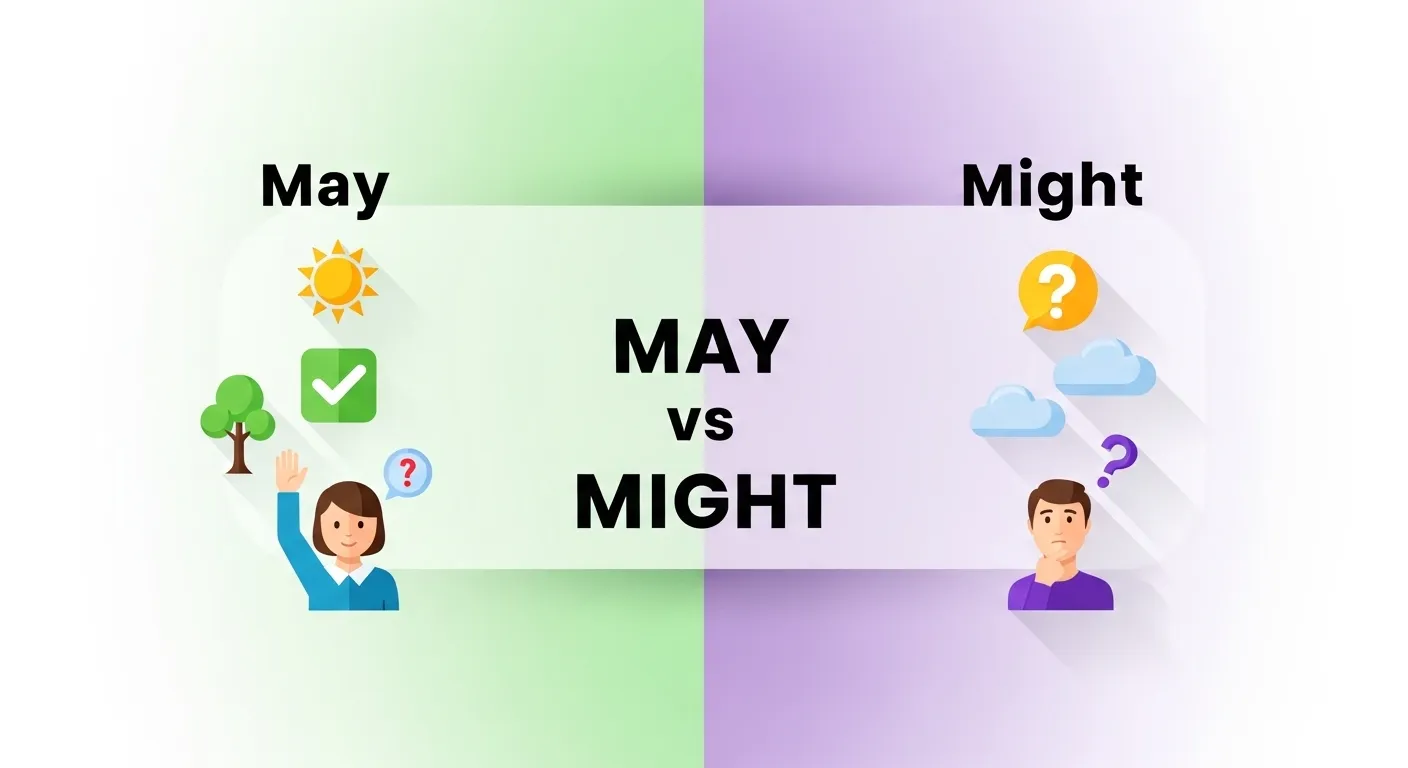
May shows possibility or permission, while might shows a weaker or less certain possibility.
This is the simple answer people want when they search “may vs might.”These two words are very common in English. They look simple. But many people feel confused when choosing between them.
Both words talk about possibility. This makes them seem the same. But there is a small difference in certainty and tone.
May often shows a stronger chance. It is also used to ask or give permission. Might shows a weaker chance. It is often used for less certain situations or polite speech.
Learning may vs might helps you speak clearly. It also improves your writing in school, exams, and daily life.
In this guide, you will learn the meaning of may and might, their origin, key differences, examples, common mistakes, and answers to popular Google search questions.
📖 May vs Might Definition
🔤 May Definition
May is a modal verb.
It shows possibility or permission.
It is used when something is likely or allowed.
Examples:
| Sentence | Meaning |
| It may rain today. | There is a good chance |
| May I come in? | Asking permission |
| You may leave now. | Giving permission |
Example sentence:
She may visit us tomorrow.
🔤 Might Definition
Might is also a modal verb.
It shows a small or less certain possibility.
It is more unsure than “may.”
Examples:
| Sentence | Meaning |
| It might rain later. | Small chance |
| He might come to the party. | Not sure |
| I might call you. | Low certainty |
Example sentence:
They might arrive late.
⚡ May vs Might: Quick Answer
The difference is about certainty and use.
| Word | Use | Example |
| May | Possibility or permission | It may rain |
| Might | Less certain possibility | It might rain |
Simple idea:
- May → stronger chance / permission
- Might → weaker chance
🕰️ Origin of May and Might
Origin of May
The word may comes from Old English.
It meant “to be able” or “to have power.”
Over time, it became used for permission and possibility.
Origin of Might
The word might also comes from Old English.
It was the past form of may.
Now it is used to show weaker possibility.
🌍 Key Differences Between May and Might
May and might differ in certainty and tone.
| Feature | May | Might |
| Certainty | Higher | Lower |
| Permission | Yes | No |
| Tone | Neutral | More polite or unsure |
Example comparison:
| Sentence | Explanation |
| It may rain. | More likely |
| It might rain. | Less likely |
📝 Examples of May and Might
Examples Using May
It may snow today.
May I ask a question?
You may enter the room.
She may call you later.
We may travel soon.
Examples Using Might
It might snow tonight.
He might join us.
I might go to the market.
They might not come.
She might be busy.
⚠️ Common Mistakes with May vs Might

Using might for permission
Incorrect:
Might I go outside?
Correct:
May I go outside?
Thinking both words are always the same
They are similar, but not always equal.
May shows more certainty.
Ignoring tone
“Might” sounds more polite or unsure.
💬 May vs Might in Everyday Examples
At school
“May I go to the restroom?”
Conversations
“I might visit you tomorrow.”
Weather talk
“It may rain today.”
“It might rain later.”
📊 Google Search Queries Related to May vs Might
People often search these questions:
| Popular Query | Meaning |
| may vs might difference | Grammar rule |
| when to use may or might | Usage help |
| may vs might examples | Learning examples |
| can might be used for permission | Common doubt |
These queries show common confusion.
❓ FAQs About May vs Might
What is the main difference between may and might?
May shows stronger possibility.
Might shows weaker possibility.
Can may and might be used the same way?
Sometimes yes, but not always.
Which word is more polite?
Might often sounds more polite.
Can I use might for permission?
No. Use may for permission.
Is might the past of may?
Yes, historically it was.
Which is more common in daily use?
Both are common.
How can I remember the rule?
May = more sure.
Might = less sure.
Conclusion
The difference between may and might is small but important in English. May is used to show possibility or to ask and give permission.
It often suggests a stronger chance that something will happen. For example, “It may rain today” means there is a good chance of rain.
Might is used to show a weaker or less certain possibility. It suggests that something could happen, but the chance is lower. For example, “It might rain later” means the chance of rain is not very strong.
Many people use these words in similar ways, especially in casual speech. However, using them correctly can improve your grammar and make your meaning clearer.
Understanding may vs might helps you express certainty, possibility, and politeness more effectively in everyday English.
Discover More Articals!
Wegovy or Mounjaro: Which Weight Loss Medication Is Better?
Among vs Between: What Is the Difference Between Them?
Mole or Wart: Understanding the Difference(2026)

