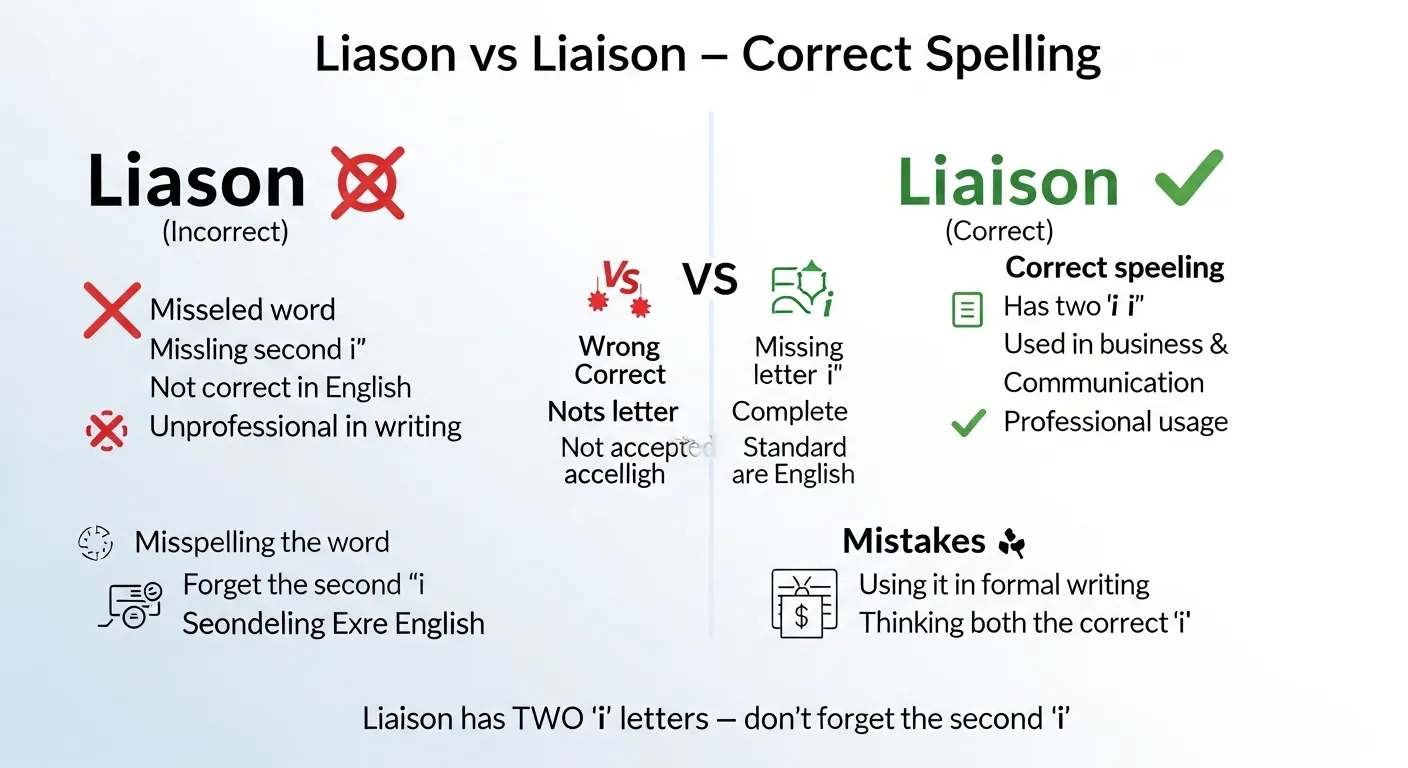
“Liaison” is the correct spelling, while “liason” is wrong. This is the simple answer people want when they search “liason vs liaison.”
This word confuses many people. It looks hard. The letters are not easy to remember. So people often write liason. But that spelling is not correct. The correct word is liaison.
You will see this word in work, school, and daily life. It is common in emails, job titles, and business talk. If you spell it wrong, it can look unprofessional. That is why it is important to learn the correct form.
The good news is simple. There is only one correct spelling. Once you learn it, you can use it with confidence.
Understanding liason vs liaison helps you avoid mistakes. It also improves your writing and makes your message clear.
In this guide, you will learn the meaning of liaison, its origin, spelling rules, examples, common mistakes, and answers to popular Google search questions.
📖 Liason or Liaison Definition
❌ Liason Definition
Liason is an incorrect spelling.
It is a common mistake.
People write it because it feels easier.
But it is not accepted in English.
Example (wrong):
He is the liason between teams. ❌
✅ Liaison Definition
Liaison is the correct spelling.
It means a connection between people or groups.
It is often used in work and communication.
Common uses:
- Business roles
- Team communication
- Government jobs
Example (correct):
She is the liaison for the project. ✅
⚡ Liason and Liaison – Quick Answer
The difference is simple.
| Word | Status | Use |
| Liason | Incorrect | Do not use |
| Liaison | Correct | Always use |
Simple idea:
- ❌ Liason → wrong spelling
- ✅ Liaison → correct spelling
🕰️ Origin of Liaison
The word liaison comes from French.
It comes from the verb lier, which means “to tie” or “to connect.”
So liaison means a link or connection.
The word entered English many years ago.
English kept the French spelling.
That is why it looks different from normal English words.
Many English words change spelling over time.
But liaison stayed the same.
That is why people find it hard to spell.
Still, the meaning is clear:
Liaison = connection
🌍 British English vs American English Spelling
There is no difference between British and American English.
Both use the same spelling.
| Version | Correct Spelling | Wrong Spelling |
| British English | Liaison | Liason |
| American English | Liaison | Liason |
Examples:
- UK: He works as a liaison officer.
- US: She is the team liaison.
So you do not need to change spelling for region.
The rule is simple:
Always use liaison.
📝 Which Spelling Should You Use?
You should always use liaison.
Here is simple advice:
- Writing for US → use liaison
- Writing for UK → use liaison
- Writing for global readers → use liaison
Never use liason.
Even in casual writing, it is wrong.
In formal writing, the mistake looks worse.
Using the correct spelling shows:
- Good English
- Clear writing
- Professional skill
⚠️ Common Mistakes with Liason vs Liaison

Missing the second “i”
Many people write liason.
They forget the second “i”.
Correct form has two “i” letters:
liaison
Writing by sound
People spell it how it sounds.
But English spelling is not always phonetic.
So this method fails.
Using wrong spelling in emails
This is very common.
It can look unprofessional.
Always check spelling before sending.
Thinking both are correct
Some people think both forms are okay.
This is false.
Only liaison is correct.
Confusing with similar words
People mix it with words like:
- lesson
- reason
But these are different words.
💬 Liaison vs Liason in Everyday Examples
Email example
I will act as the liaison between teams.
Office example
She is the project liaison.
Job title example
He works as a liaison officer.
News example
The liaison helped both sides agree.
Social media example
We need a liaison for our group.
📊 Liason vs Liaison – Google Trends & Usage Data
Many people search this topic.
This shows high confusion.
| Search Term | Usage |
| liaison | Very high |
| liason | Also high (mistake) |
Popular search queries:
- liason or liaison correct spelling
- how to spell liaison
- liaison meaning
- liaison in a sentence
- liaison officer meaning
- why is liaison spelled this way
- is liason ever correct
These searches show one thing:
People are unsure about spelling.
But the answer is always the same.
📊 Comparison Table (Keyword Variations)
| Term | Meaning | Status |
| Liaison | Connection | Correct |
| Liason | Misspelling | Incorrect |
| Liaison officer | Job role | Correct |
| Liason officer | Wrong form | Incorrect |
❓ FAQs About Liason vs Liaison
Is liason ever correct?
No. It is always wrong.
What is the correct spelling?
Liaison is correct.
Why is liaison hard to spell?
It comes from French.
What does liaison mean?
It means a connection.
Is liaison used in jobs?
Yes. Many jobs use this word.
Is there a US vs UK difference?
No. Both use the same spelling.
How can I remember liaison?
Remember this pattern:
li-ai-son
Think: two “i” letters.
Conclusion
The difference between liason and liaison is very clear. “Liason” is a common mistake and should never be used. “Liaison” is the only correct spelling and is accepted in all forms of English.
This word is important in professional and daily communication. It is used to describe a connection between people, teams, or groups.
Because it appears in emails, job titles, and official writing, spelling it correctly is very important.
Many people make this mistake because the word comes from French and has an unusual spelling pattern. But once you learn the correct form, it becomes easy to use.
Always choose liaison in your writing. Avoid “liason” completely. This simple step will improve your English and make your writing clear and professional.
Discover More Articals!
Strep or Tonsillitis: Understanding the Difference
Diamagnetic or Paramagnetic: Simple Guide to Magnetic Behavior
Parfum or Toilette: Easy Explanation and Key Differences(2026)

