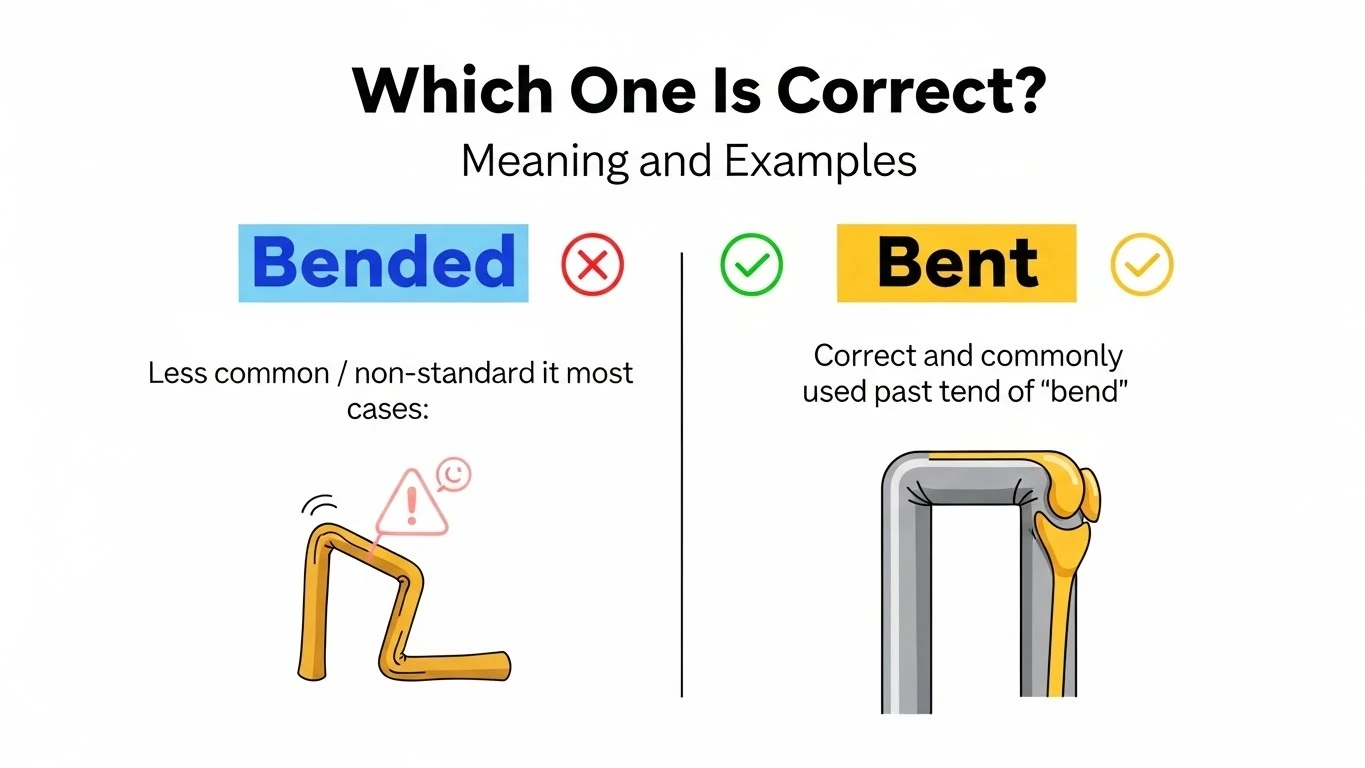
Bent is correct in almost all cases; “bended” is rare and only used in poetic or fixed expressions.
English learners often feel confused when choosing between bended and bent. Both words come from the verb bend, but they are not used the same way.
This confusion happens because bend is an irregular verb, and irregular verbs do not follow normal grammar rules.
Many people search for “bended or bent” when writing essays, emails, stories, or everyday messages.
At first glance, bended looks correct because we usually add -ed to make the past tense. But English does not always work that way.
Using the wrong word can make your sentence sound unnatural or incorrect. For example, “He bended his knees” sounds wrong to native speakers, while “He bent his knees” sounds natural and correct.
Understanding the difference between bent vs bend is important for speaking, writing, and professional communication.
This article explains the difference clearly, shows real examples, highlights common mistakes, and gives practical advice so you can use the correct word with confidence.
Bended or Bent ; Quick Answer

Bent is usually the correct word.
Bended is rarely used and only correct in special cases.
Simple Rule:
- Bent → past tense and past participle of bend (most common)
- Bended → used only in a few figurative or poetic expressions
Examples:
✅ He bent his knees to pick up the box.
✅ The road bent to the left.
❌ He bended the metal bar.
⚠️ Bended is not used for physical bending in modern English.
The Origin of Bended and Bent
Origin of Bent
The word bent comes from Old English “bendan”, which meant to curve, fold, or force into shape. Over time, English adopted bent as both:
- Past tense → He bent the wire
- Past participle → The wire is bent
This irregular form became standard and is used in daily English.
Origin of Bended
Bended also comes from bend, but it survived only in old, poetic, or figurative language. Today, it is mostly found in fixed expressions or literature.
Example from older English:
- With bended knee (showing respect or submission)
Understanding history explains why bent is normal English, while bended sounds outdated or poetic.
British English vs American English Usage
There is no difference between British and American English when it comes to bended or bent.
Both varieties:
- Use bent as the correct past tense
- Rarely use bended
- Accept bended only in fixed expressions
Comparison Table
| Form | British English | American English | Common Use |
| bent | ✅ Yes | ✅ Yes | Everyday use |
| bended | ⚠️ Rare | ⚠️ Rare | Poetic / fixed phrases |
👉 No matter where you live, bent is the safe and correct choice.
Which One Should You Use?
Use Bent When:
- Talking about physical bending
- Describing movement or shape
- Writing modern English
- Speaking casually or professionally
Examples:
- She bent the paper.
- The tree was bent by the wind.
- He bent down to tie his shoes.
Use Bended Only When:
- Writing poetry
- Using fixed expressions
- Referring to symbolic actions, not physical ones
Examples:
- He stood with bended knee.
- They begged with bended backs. (poetic)
💡 Tip: If you are unsure, always choose bent.
🔍 Is It Bent or Bended? (Bend vs Bent Difference Explained)
Many learners ask questions like “is it bent or bended”, “bend vs bent difference”, or “bent or bend which is correct.”
The answer is simple:
- Bent is the correct past tense of bend
- Bended is rarely used and only appears in poetic or fixed expressions
Quick Breakdown:
- Bend (base form) → I bend the wire
- Bent (past tense) → He bent the wire
- Bent (past participle) → The wire has bent
💡 This is why queries like “bend and bent difference”, “difference between bend and bent”, and “bend vs bent” all point to the same rule:
👉 Bent is standard English
👉 Bended is not used in normal grammar
Common Mistakes with Bended or Bent
Many learners make the mistake of treating bend like a regular verb.
❌ Common Errors:
- He bended his arm.
- She bended the wire.
- The road bended sharply.
✅ Correct Versions:
- He bent his arm.
- She bent the wire.
- The road bent sharply.
Why This Happens:
Learners think:
“Open → opened, Close → closed, Bend → bended”
But bend is irregular, like:
- Go → went
- Take → took
- Bend → bent
Bended or Bent in Everyday Examples
Emails
✅ I accidentally bent the document while printing.
❌ I accidentally bended the document.
News Articles
✅ The metal was bent during the accident.
❌ The metal was bended during the accident.
Social Media
✅ I bent my phone charger again 😩
❌ I bended my phone charger.
Formal Writing
✅ The structure was bent due to pressure.
❌ The structure was bended due to pressure.
Fixed Expressions with “Bended”
Although rare, bended survives in some traditional phrases.
Common Fixed Phrases:
- With bended knee (showing respect or submission)
- Bended in prayer (religious or poetic)
- Bended backs (figurative hardship)
- ⚠️ These are exceptions, not everyday grammar.
📖 Is “Bended” a Word? Meaning, Usage, and Examples
A common question is “is bended a word” or “is bended a real word.”
✔️ Yes, bended is a real word, but its usage is very limited.
Meaning of Bended:
- Used in poetic or old-fashioned English
- Often appears in phrases like:
- with bended knee
- bended in prayer
This answers related queries like:
- “bended meaning”
- “bended meaning in English”
- “meaning of bended”
- “what is bended”
- “bended definition”
Example Sentences:
- He stood with bended knee.
- They prayed with bended backs.
⚠️ Important:
- You should NOT use bended in normal sentences like:
- ❌ He bended the rod
- ✅ He bent the rod
💡 So for queries like “bent vs bended”, “bended vs bent”, and “bent or bended meaning”:
👉 Bent = correct in modern usage
👉 Bended = rare, poetic only
Bent as an Adjective
Bent is also used as an adjective, which makes it even more common.
Examples:
- a bent pipe
- a bent spoon
- a bent tree
There is no adjective form “bended” in modern English.
Bended or Bent ; Google Trends & Usage Data
Search data shows:
- “bent” is searched far more than “bended”
- Learners often search “bended or bent” to check correctness
Who Searches This Term?
- ESL learners
- Students
- Writers
- Teachers
Usage by Context
| Context | Preferred Word |
| Physical action | bent |
| Everyday speech | bent |
| Formal writing | bent |
| Poetry | bended |
| Idioms | bended (rare) |
Comparison Table: Bended vs Bent
| Word | Correct? | Usage | Example |
| bent | ✅ Yes | Past tense, adjective | He bent the wire |
| bended | ⚠️ Rare | Poetic only | With bended knee |
| bend (base) | ✅ Yes | Present | I bend the paper |
| bending | ✅ Yes | Continuous | He is bending |
FAQs1. Is “bended” grammatically correct?
Yes, but only in very limited, poetic usage.
2. Which is more common, bended or bent?
Bent is far more common.
3. Can I say “bended my arm”?
No. Say “bent my arm.”
4. Is “bended knee” correct?
Yes. It is a fixed expression.
5. Are bended and bent interchangeable?
No. Bent is standard. Bended is special-case only.
6. Is bend a regular or irregular verb?
Irregular verb.
7. Does British English use bended more?
No. Both use bent.
Simple Practice Exercise
Choose bent or bended:
- He ___ down to pick up the coin.
- The fork is ___.
- She prayed with ___ knee.
Answers:
- bent
- bent
- bended
Pro Writing Tips
- Always use bent in normal writing
- Avoid bended unless writing poetry
- Remember: bend → bent → bent
- If it sounds old or dramatic, it might be bended
- read more about!Yesterdays or Yesterday’s ;Quick Answer
Conclusion
The difference between bended or bent is simple once you know the rule. Bent is the correct and natural past tense and adjective form of bend.
It is used in daily speech, writing, emails, news, and formal documents.
Bended still exists, but only in rare, poetic, or fixed expressions like with bended knee.
Using bended for physical actions is incorrect in modern English and can make your writing sound unnatural.
Remember:
👉 Bent = correct in almost all cases
👉 Bended = rare, poetic only
If you follow this rule, your English will sound clear, natural, and professional.
Related posts!
cues vs ques Which One Should You Use
Fewer vs Less: What Is the Difference and When to Use Each?
Problemo or Problema: Which Word Is Correct?

