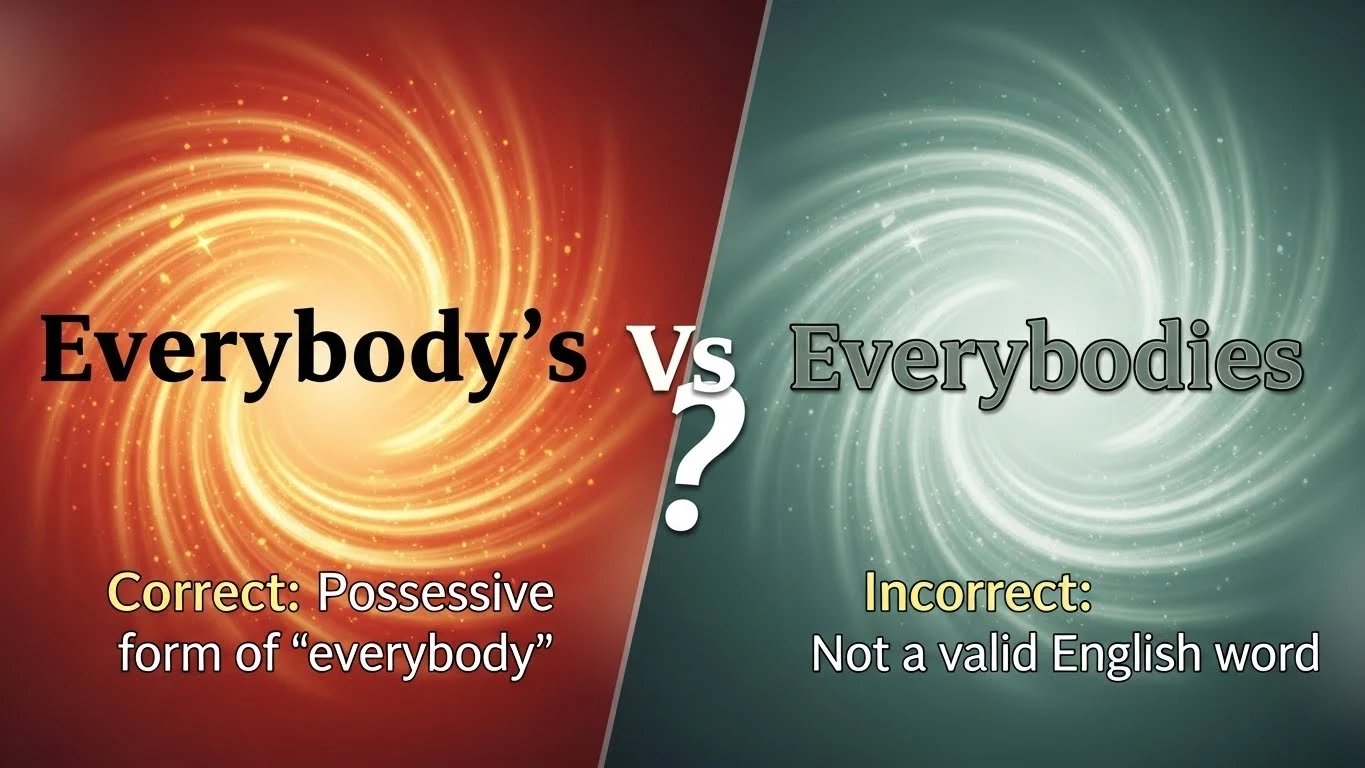
“Everybody’s” is correct (it shows possession or “everybody is”), while “everybodies” is incorrect and not used in standard English.
English learners and even fluent speakers often get confused when choosing between “everybody’s” and “everybodies.” At first glance, both forms look similar, and many people assume they mean the same thing.
This confusion is one of the main reasons why people search for everybody’s or everybodies online.
The problem becomes even bigger in writing, where a small apostrophe can completely change the meaning of a sentence.
In everyday English, apostrophes are commonly used for possession and contractions, but they are also one of the most misunderstood grammar tools. Many writers think adding -s or ’s automatically makes a word plural.
That is not always true. With words like everybody, the rules work differently, and this is where mistakes happen.
This article is written to solve that exact confusion. You will get a quick answer, a clear explanation, historical background, British vs American usage, common mistakes, real-life examples, and professional advice.
By the end of this guide, you will know exactly when to use everybody’s, when everybodies might appear, and which form is correct in modern English.
everybodies or everybody’s : Quick Answer
Everybody’s is the correct and commonly used form in modern English.
It is either:
- The possessive form of everybody (meaning something belongs to everyone), or
- A contraction of everybody is.
Everybodies is rare and usually incorrect. It can only be used as a plural of everybody in very specific, informal, or theoretical contexts.
Examples:
- This is everybody’s responsibility. ✅
- Everybody’s ready to leave. ✅
❌ Everybodies responsibility is important. (Incorrect)
The Origin of Everybody’s or Everybodies
The word everybody comes from two parts:
- every (meaning all)
- body (meaning person)
It entered English in the 14th century as a singular indefinite pronoun, meaning “all people as one group.” Even though it refers to many people, it is treated as singular in grammar.
The apostrophe in everybody’s follows standard English rules:
- ’s is added to show possession
- Or to shorten is
The form everybodies exists only because English allows plural nouns to end in -s, but since everybody already means “all people,” it is rarely pluralized. Over time, standard English accepted everybody as grammatically singular, which is why everybodies is almost never needed.
British English vs American English Spelling
There is no spelling difference between British and American English for everybody’s.
Both varieties:
- Treat everybody as singular
- Use everybody’s for possession or contraction
- Avoid everybodies in standard writing
Examples
- British English: Everybody’s opinion matters.
- American English: Everybody’s invited to the meeting.
Comparison Table
| Feature | British English | American English |
| Singular usage | Everybody is | Everybody is |
| Possessive form | Everybody’s | Everybody’s |
| Plural form | Rare/avoided | Rare/avoided |
Which Spelling Should You Use?
The correct choice depends on clarity and correctness, not location.
- For US audiences: Use everybody’s
- For UK & Commonwealth audiences: Use everybody’s
- For global audiences: Always choose everybody’s to avoid confusion
Professional advice: If you are writing emails, articles, academic work, or social media posts, do not use everybodies. It looks incorrect to most readers.
Common Mistakes with Everybody’s or Everybodies
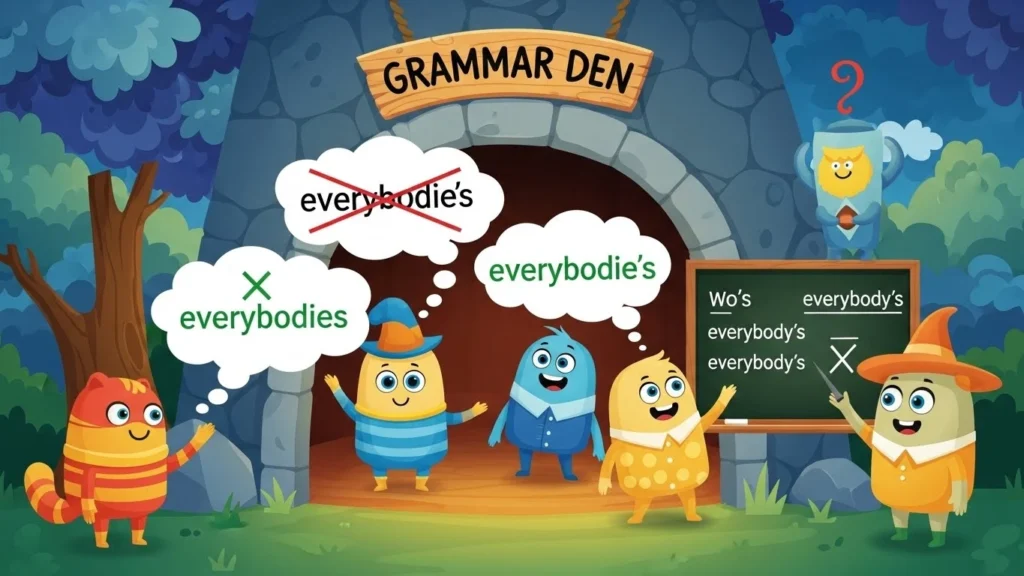
Mistake 1: Using “everybodies” instead of possessive
❌ Everybodies opinion matters. ✅ Everybody’s opinion matters.
Mistake 2: Forgetting the apostrophe
❌ Everybodys fault is the system. ✅ Everybody’s fault is the system.
Mistake 3: Confusing plural meaning
❌ Everybodies are welcome. ✅ Everybody is welcome.
Everybody’s or Everybodies in Everyday Examples
Emails
- Everybody’s feedback is appreciated.
- Everybody’s invited to tomorrow’s meeting.
News
- Everybody’s attention is on the final vote.
Social Media
- Everybody’s excited about the match! 🎉
- Everybody’s talking about this trend.
Formal Writing
- Everybody’s role must be clearly defined.
- read more about!The Origin of Else’s or Elese
Everybody’s or Everybodies: Google Trends & Usage Data
Online search trends show that “everybody’s or everybodies” is mostly searched by:
- ESL learners
- Students
- Content writers
The majority of searches come from South Asia, Southeast Asia, and English-learning regions. Usage data from books, news, and online content shows everybody’s is overwhelmingly more common. The word everybodies appears rarely and mostly in informal or experimental writing.
Comparison Table: Everybody’s vs Everybodies
| Form | Meaning | Correct? | Example |
| Everybody’s | Possessive / contraction | ✅ Yes | Everybody’s plan worked |
| Everybodies | Plural (rare) | ⚠️ Rare | Different everybodies think differently |
🔍 Everybody’s vs Everybodies: Spelling, Apostrophe, and Correct Form
Many learners search queries like everybody’s or everybodies, everybodys or everybody’s, how do you spell everybody’s, and is it everybody’s or everybodies because the apostrophe creates confusion.
Correct Spelling
- ✔ Everybody’s → correct
- ❌ Everybodies / everybodys → incorrect in standard English
👉 This is why searches like “everybodies or everybodys,” “everybodys or everybodies,” and “is everybodies a word” are so common.
Apostrophe Rule
The apostrophe in everybody’s follows normal grammar rules:
- Shows possession → everybody’s opinion
- Shows contraction → everybody’s ready (everybody is)
This also answers queries like “everyone’s apostrophe” — the same rule applies.
Key Insight
- “Everybody” is already singular
- So adding s without an apostrophe does NOT make it correct
👉 Final rule:
✔ Always use everybody’s
❌ Avoid everybodies / everybodys
🌍 Everybody or Every Body: Meaning and Common Confusion
Some users search variations like everybody or every body, everybody or everybodies, and everybodies meaning because they are unsure about structure and usage.
Difference Between “Everybody” and “Every Body”
- Everybody → means all people
- Every body → means each individual body (rare, literal meaning)
Examples:
- Everybody is welcome. ✅
- The doctor examined every body in the lab. (very rare context)
What About “Everybodies”?
Queries like:
- “everybodies meaning”
- “everybody or everybodies”
👉 lead to this simple answer:
❌ “Everybodies” is not standard English
✔ Use everybody or everybody’s instead
Final Tip
- Use everybody → for general meaning
- Use everybody’s → for possession or contraction
- Avoid everybodies → not accepted in proper writing
FAQs About
Is “everybody’s” singular or plural?
It is grammatically singular, even though it refers to many people.
Can “everybodies” ever be correct?
Only in rare, informal, or theoretical contexts. Avoid it in standard writing.
Does “everybody’s” mean “everybody is”?
Yes, sometimes. Context decides the meaning.
Is “everybody’s” used in formal writing?
Yes. It is perfectly acceptable in formal English.
Is there a difference between British and American English?
No. Both use everybody’s the same way.
What is the safest choice?
Always use everybody’s.
Conclusion
The confusion between everybody’s or everybodies comes from misunderstanding apostrophes and plural forms.
In modern English, everybody’s is the correct and widely accepted choice. It is used to show possession or as a contraction for everybody is.
On the other hand, everybodies is rarely needed and often sounds incorrect to native speakers.
If your goal is clear, professional, and correct English, the answer is simple: choose everybody’s. This applies to emails, exams, articles, social media posts, and formal writing.
Understanding this small rule helps you avoid common grammar mistakes and makes your writing more polished and confident.
Remember, everybody is treated as singular in English, even though it refers to many people. Once you accept that rule, the confusion disappears completeley.
Related posts!
Lie Down or Lay Down: Quick Answer
Kandi or Bracelet: What Is the Difference and When to Use Each?
Army or Marines: What Is the Difference?With In 30 Seconds

