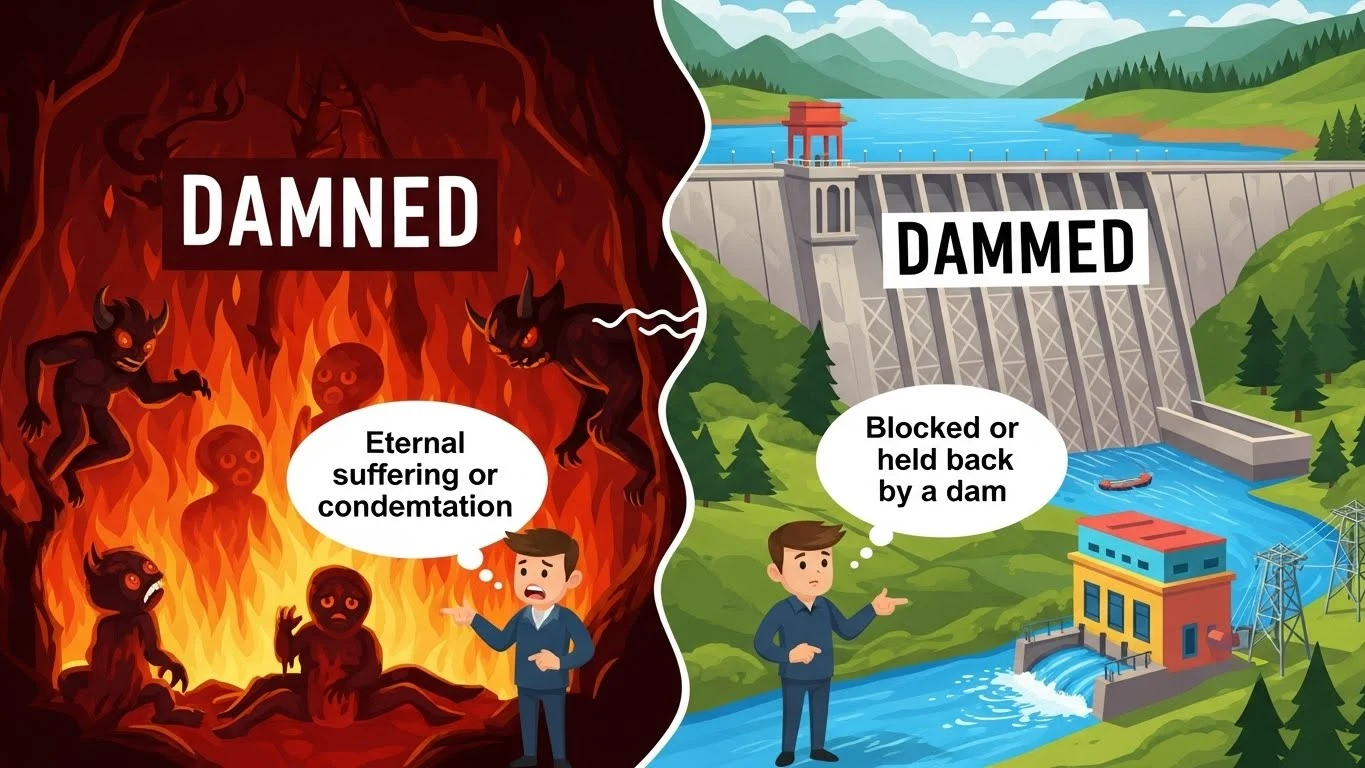
“Damned” is correct (meaning cursed), while “dammed” means blocked with a dam.
Many people search for “dammed or damned” because these two words look very similar but have very different meanings. One small letter changes everything.
This confusion is common among English learners, writers, students, and even native speakers.
When you see these words in writing, it is easy to wonder which one is correct and when to use each.
The problem usually comes from pronunciation and spelling. Both words come from the verb to dam, but they developed in different ways. Damned is often used in emotional, religious,
or informal expressions, while dammed is mostly used in technical or environmental contexts.
If you choose the wrong word, your sentence may sound strange, unclear, or even offensive in formal writing.
People want a quick answer, but they also want to understand the deeper difference. Is dammed just another spelling of damned?
Is one British and the other American? Can they be used in the same sentence? This article clears all that confusion.
In this complete guide, you will find a quick answer, word origins, British vs American usage, common mistakes, real-life examples, tables, FAQs, and professional advice.
By the end, you will confidently know when to use damned and when to use dammed.
Damned or Dammed : Quick Answer
Damned means condemned, cursed, or criticized. It is often emotional, religious, or informal.
Dammed means blocked or held back by a dam, usually water. It is a physical and technical term.
Examples:
- He was damned for his actions. ✅
- The river was dammed to control flooding. ✅
❌ The river was damned. (Incorrect) ❌ He was dammed by society. (Incorrect)
The Origin of Damned or Dammed

Both damned and dammed come from different historical paths, even though they look related.
Origin of “Damned”
The word damned comes from the Latin word damnare, meaning to condemn or punish. It entered English through Old French (damner). Over time, it became strongly connected with religion, judgment, and moral punishment.
That is why damned is often used in religious texts, strong opinions, and emotional speech. It later became a common intensifier in informal English.
Origin of “Dammed”
The word dammed comes from the noun dam, meaning a barrier built to hold back water. This word has Germanic roots. When you add -ed, it becomes dammed, meaning blocked by a dam.
The spelling difference exists because these words evolved from different roots, even though they look similar today.
read more about!The Origin of Recognisable or Recognizable
British English vs American English Spelling
There is no spelling difference between British English and American English for damned and dammed. Both varieties use the same forms and meanings.
However, usage style can differ slightly.
British English
- More common in formal writing to avoid damned as a swear word.
- Dammed is used in environmental and engineering contexts.
American English
- Damned is more common in casual speech and media.
- Dammed is common in news about rivers, floods, and construction.
Comparison Table
| Feature | British English | American English |
| Damned | Same spelling, careful use | Same spelling, more casual use |
| Dammed | Same spelling | Same spelling |
| Grammar rules | Same | Same |
Which Spelling Should You Use?
The correct choice depends on meaning, not region.
- Use damned when talking about blame, criticism, curse, or strong feeling.
- Use dammed when talking about water, rivers, lakes, or barriers.
Audience Based Advice
- US audience: Both words are fine, but avoid damned in formal writing.
- UK/Commonwealth: Same rule; damned may sound strong or rude.
- Global audience: Use dammed for technical topics and damned carefully for emotions.
Tip: If water is involved, choose dammed.
Dammed Meaning, Definition, and Correct Usage
This section covers queries like “is dammed a word,” “dammed meaning,” “dammed definition,” “what does dammed mean,” and “define dammed.”
The word dammed is a correct English word. It comes from the noun dam, which means a structure that blocks water.
Dammed means: water has been blocked, controlled, or held back by a dam.
Examples:
- The river was dammed to prevent flooding.
- Engineers dammed the lake for irrigation.
Common learner questions:
- Is dammed a word? → Yes, fully correct
- What does dammed mean? → Blocked by a dam
- Where is it used? → Geography, engineering, environment
Simple tip:
If your sentence involves water, rivers, or barriers, use dammed.
Damned vs Dammed: Difference, Spelling, and Common Confusion
This section naturally targets queries like “damned vs dammed,” “difference between damn and damned,” “is it damned or dammed,” and “damn or damned difference.”
The difference is based on meaning and grammar:
- Damned → from “damn” (emotion, curse, criticism)
- Dammed → from “dam” (physical barrier for water)
Examples:
- He was damned for his mistakes. ✅
- The river was dammed last year. ✅
Common confusion:
- Is it damned or dammed? → Depends on meaning
- How to spell damned? → D-A-M-N-E-D
- What does it mean to be damned? → criticized, condemned, or cursed
Quick comparison:
- Emotion / opinion → damned
- Water / structure → dammed
Easy memory trick:
If you see water, think dam → dammed
If you feel emotion, think damn → damned
Common Mistakes with Damned or Dammed
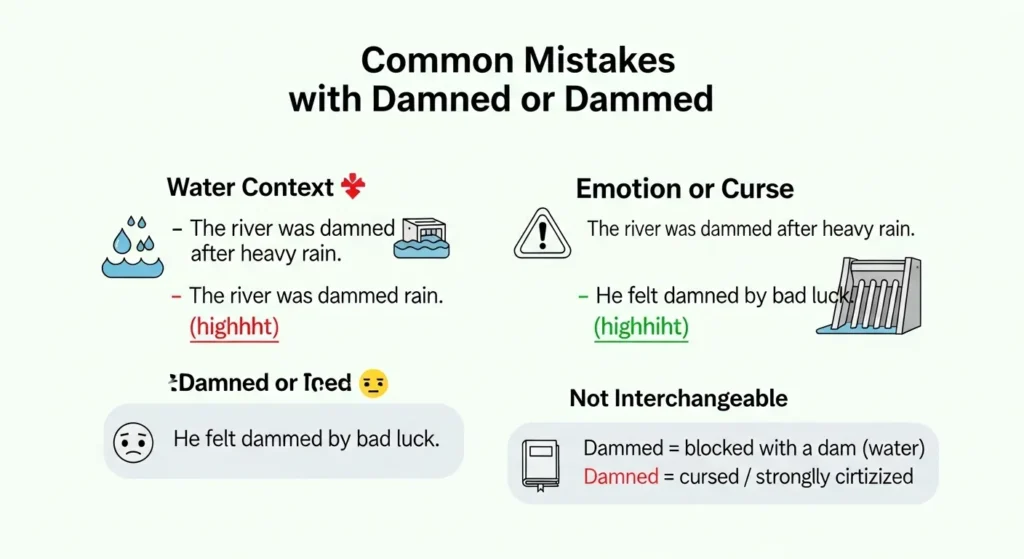
Mistake 1: Using “damned” for water
❌ The river was damned after heavy rain. ✅ The river was dammed after heavy rain.
Mistake 2: Using “dammed” for emotions
❌ He felt dammed by bad luck. ✅ He felt damned by bad luck.
Mistake 3: Thinking they are interchangeable
They are not interchangeable. Each word has a separate meaning.
Damned or Dammed in Everyday Examples
Emails
- I am damned sure this is the right file. (informal)
- The reservoir was dammed last year. (formal)
News
- The politician was damned by critics.
- The river has been dammed to prevent floods.
Social Media
- This traffic is damned annoying!
- The valley was flooded after the river was dammed.
Formal Writing
- The project was damned by poor planning.
- Several rivers were dammed for irrigation.
Damned or Dammed:Google Trends & Usage Data
Search trends show that “damned or dammed” is often searched in:
- South Asia
- Middle East
- ESL learning countries
Most users search this keyword while writing essays, articles, or exam answers. Damned is searched more in literature and expression-based contexts, while dammed appears more in geography, science, and environmental studies.
In general:
- Damned → opinions, emotions, criticism
- Dammed → water control, engineering, environment
Comparison Table: Damned vs Dammed

| Word | Meaning | Context | Example |
| Damned | Cursed, blamed | Emotional, informal | He was damned by history |
| Dammed | Blocked by a dam | Technical, physical | The river was dammed |
FAQs
Is “damned” a bad word?
It can be mild or strong depending on context. In formal writing, it is often avoided.
Is “dammed” related to religion?
No. Dammed only relates to physical dams.
Can “damned” and “dammed” be used interchangeably?
No. They have completely different meanings.
Is there any spelling difference in US and UK English?
No. Both use the same spelling.
Which one is more common?
Damned is more common in speech; dammed is common in technical writing.
Can “damned” be used positively?
Yes, informally, as an intensifier.
Does “dammed” only apply to rivers?
Mostly yes, but it can apply to any water flow.
Conclusion
The difference between damned or dammed may seem small, but it is very important. These two words are not spelling variations of the same idea. They come from different origins and serve very different purposes in English.
Damned deals with judgment, blame, curses, and strong emotions. It is common in speech, literature, and informal writing, but should be used carefully in professional contexts.
Dammed, on the other hand, is a neutral and technical word. It refers to water being blocked or controlled by a physical structure.
When choosing between them, do not think about British or American English. Think about meaning.
If water or a barrier is involved, choose dammed. If emotion, criticism, or strong feeling is involved, choose damned.
By following this simple rule, you will avoid common mistakes and write clearer, more professional English every time.
Related posts!
Comparison Table: Recognisable vs Recognizable
Boat or Ship: What Is the Difference and When to Use Each?
Dear vs Deer: What’s the Difference?

