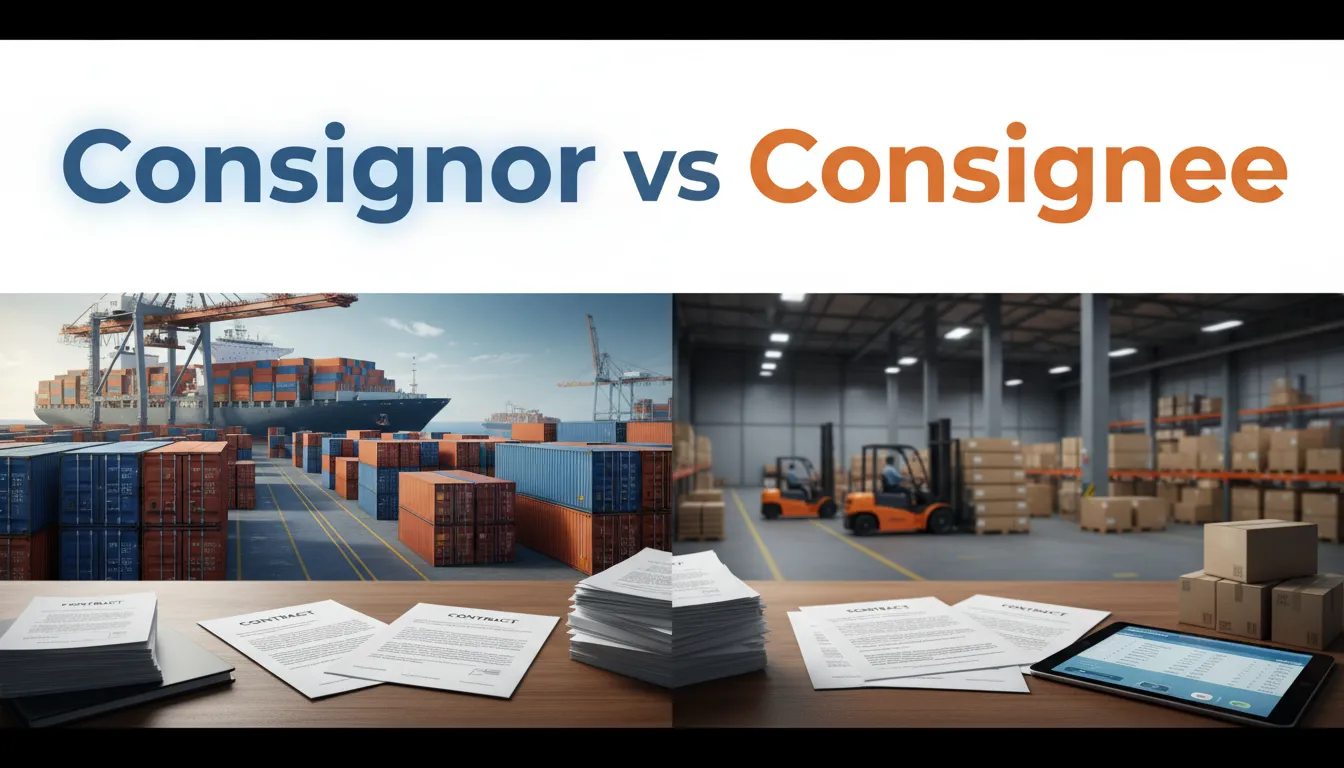
In shipping, logistics, and legal documents, one small spelling choice can cause big confusion.
Many people search for “consignor vs consigner” because both words look correct, sound almost the same, and appear in real documents.
Emails, invoices, contracts, and customs forms often use one or the other. This makes writers wonder: Are both correct? Is one British and the other American? Or is one simply wrong?
This confusion usually comes from spelling differences in English and from industry habits. Some companies use one form consistently, while others mix them.
Students, professionals, and business owners often want a quick answer so they can write correctly and professionally.
This article solves that confusion step by step. First, you’ll get a clear and direct answer. Then, you’ll learn where these words came from and why both forms exist.
We’ll compare British and American English, show which spelling you should use based on your
audience, and highlight common mistakes to avoid. You’ll also see real-life examples from emails, news, and formal writing. By the end, you’ll know exactly which word to use and when without guessing.
Consigner vs Consignor:Quick Answer
Both “consigner” and “consignor” are correct.
They mean the person or company that sends goods to someone else.
- Consignor is the older and more traditional spelling.
- Consigner is a modern variant, formed like other “-er” agent nouns.
Simple examples:
- The consignor is responsible for shipping the goods.
- The consigner must provide accurate documents.
In most cases, they mean the same thing and are used in the same way.
The Origin of Consigner or Consignor
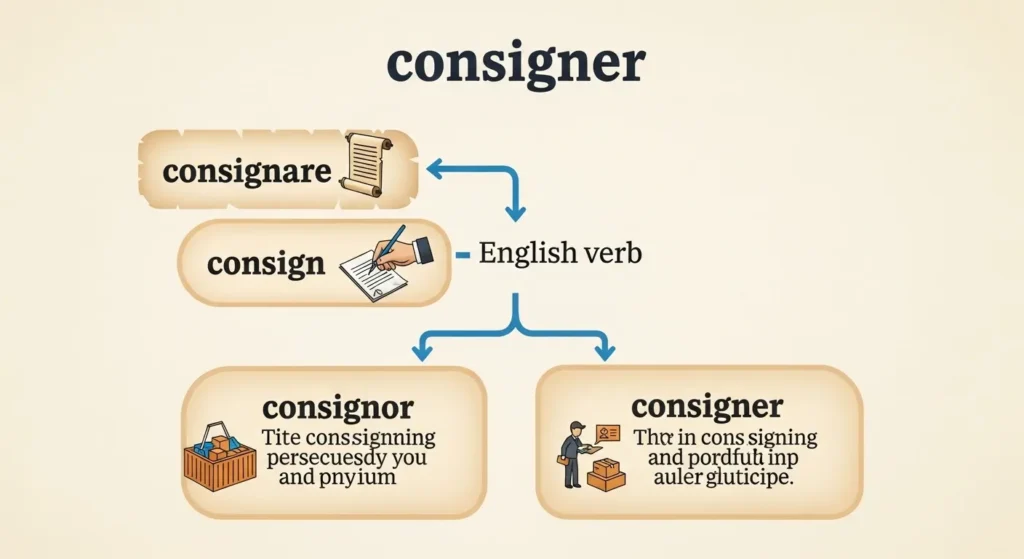
Both words come from the verb “to consign”, which means to send goods to someone for sale, storage, or delivery.
Word history:
- Consign comes from Latin consignare, meaning to mark or hand over.
- From this verb, English formed nouns for the person who performs the action.
Why two spellings exist:
- Consignor follows the Latin-based “-or” pattern, like actor or creator.
- Consigner follows the English “-er” pattern, like sender or driver.
Over time, both forms entered English usage. Different industries and regions preferred different spellings, and both remained acceptable.
British English vs American English Spelling
Unlike many spelling debates, this one is not strictly British vs American. However, there are clear trends.
General usage patterns:
- Consignor appears more often in:
- Legal documents
- Shipping contracts
- International trade laws
- Consigner appears more often in:
- Informal business writing
- Internal company documents
- Modern logistics software
Comparison Table
| Aspect | Consignor | Consigner |
| Spelling style | Latin-based (-or) | English-based (-er) |
| Traditional use | Very common | Less traditional |
| Legal documents | Preferred | Rare |
| Informal business | Used | Common |
| Meaning | Sender of goods | Sender of goods |
Both spellings are grammatically correct, but context matters.
Which Spelling Should You Use?

Your choice should depend on your audience and purpose.
Use Consignor if:
- You are writing for:
- Legal contracts
- Customs documents
- International trade
- Your audience is:
- Global
- Professional
- Formal
Use Consigner if:
- You are writing:
- Internal emails
- Informal business notes
- Modern logistics platforms
- Your audience is:
- Internal staff
- Tech or startup teams
Professional advice:
If you are unsure, use “consignor.” It is safer and more widely accepted in formal settings.
Common Mistakes with Consigner or Consignor
Even though both words are correct, mistakes still happen.
Mistake 1: Mixing spellings in one document
❌ The consigner must pay the fee. The consignor must also sign the form.
✅ Choose one spelling and use it consistently.
Mistake 2: Confusing with “consignee”
❌ The consignor receives the goods.
✅ The consignee receives the goods.
The consignor/consigner sends them.
Mistake 3: Assuming one spelling is wrong
❌ Consigner is incorrect English.
✅ Both forms are correct English.
Consigner or Consignor in Everyday Examples
Emails
- Please confirm the consignor details before shipment.
- The consigner must attach the invoice.
News
- The consignor was held responsible for incorrect labeling.
Social Media
- Always double-check if you are the consignor or consignee before shipping.
Formal Writing
- The consignor agrees to comply with all customs regulations.
Consigner or Consignor:Google Trends & Usage Data

Search data shows that “consignor” is searched more often globally, especially in:
- The United States
- The United Kingdom
- International trade hubs
“Consigner” appears less often but still shows steady use in:
- Software documentation
- Internal business searches
- Logistics-related tools
Usage by context:
- Legal & international trade: Consignor
- Modern logistics platforms: Both
- Education & exams: Consignor
This tells us one thing clearly: consignor is more dominant, but consigner is not disappearing.
Read more about!
Gibberish or Jibberish: Quick Answer
Comparison Table: Consigner vs Consignor
| Feature | Consigner | Consignor |
| Correct English | Yes | Yes |
| Meaning | Sender of goods | Sender of goods |
| Formal use | Medium | High |
| Informal use | High | Medium |
| Global acceptance | Moderate | Very high |
Frequently Asked Questions
1. Is consigner or consignor correct?
Both are correct. They mean the same thing.
2. Which spelling is more professional?
Consignor is more professional and formal.
3. Is consigner American English?
Not exactly. It is a modern variant, not strictly American.
4. Should I use consignor in legal documents?
Yes. Legal and trade documents usually prefer consignor.
5. Can I use both in the same text?
No. Choose one spelling and stay consistent.
6. What is the difference between consignor and consignee?
The consignor sends the goods.
The consignee receives the goods.
7. Which spelling is better for ?
Consignor has higher global search volume.
Conclusion
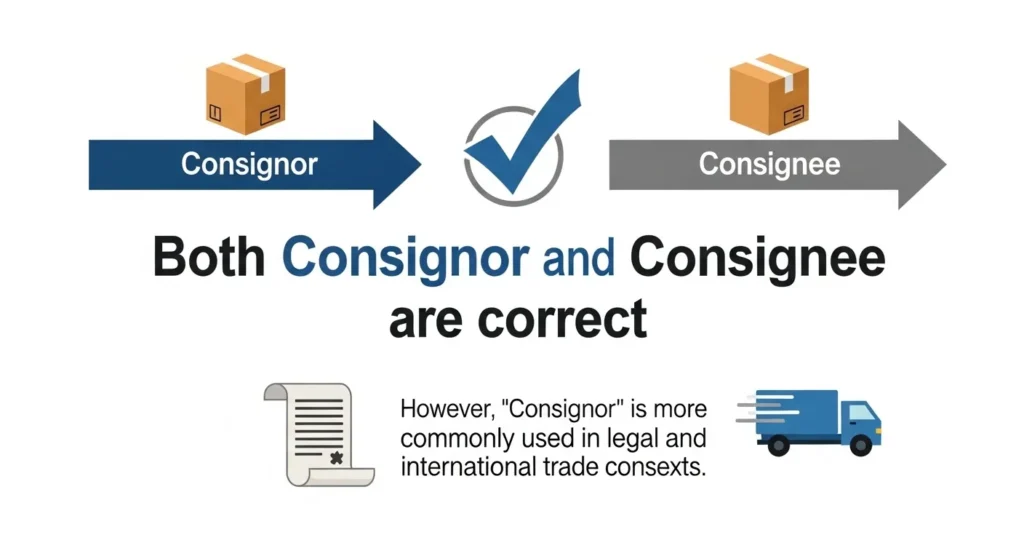
The confusion around consignor or consigner exists because English allows both spellings, and both are correct. They come from the same verb, share the same meaning,
and are used in real world writing every day. The key difference is usage preference, not correctness.
If you want a safe and professional choice especially for legal, international, or formal writing consignor is the better option. It is more traditional, more widely recognized, and more common in official documents.
On the other hand, consigner works well in informal business settings and modern internal communication.
The most important rule is consistency. Pick one spelling based on your audience and purpose, and use it throughout your document. By doing this, your writing will look clear, confident, and professional.
Related posts!
Comparison Table: Broche vs Brooch
Choose or Die: Everything You Need to Know About the Game 🎮
West Linn or: Meaning, Location, and Why People Search It

