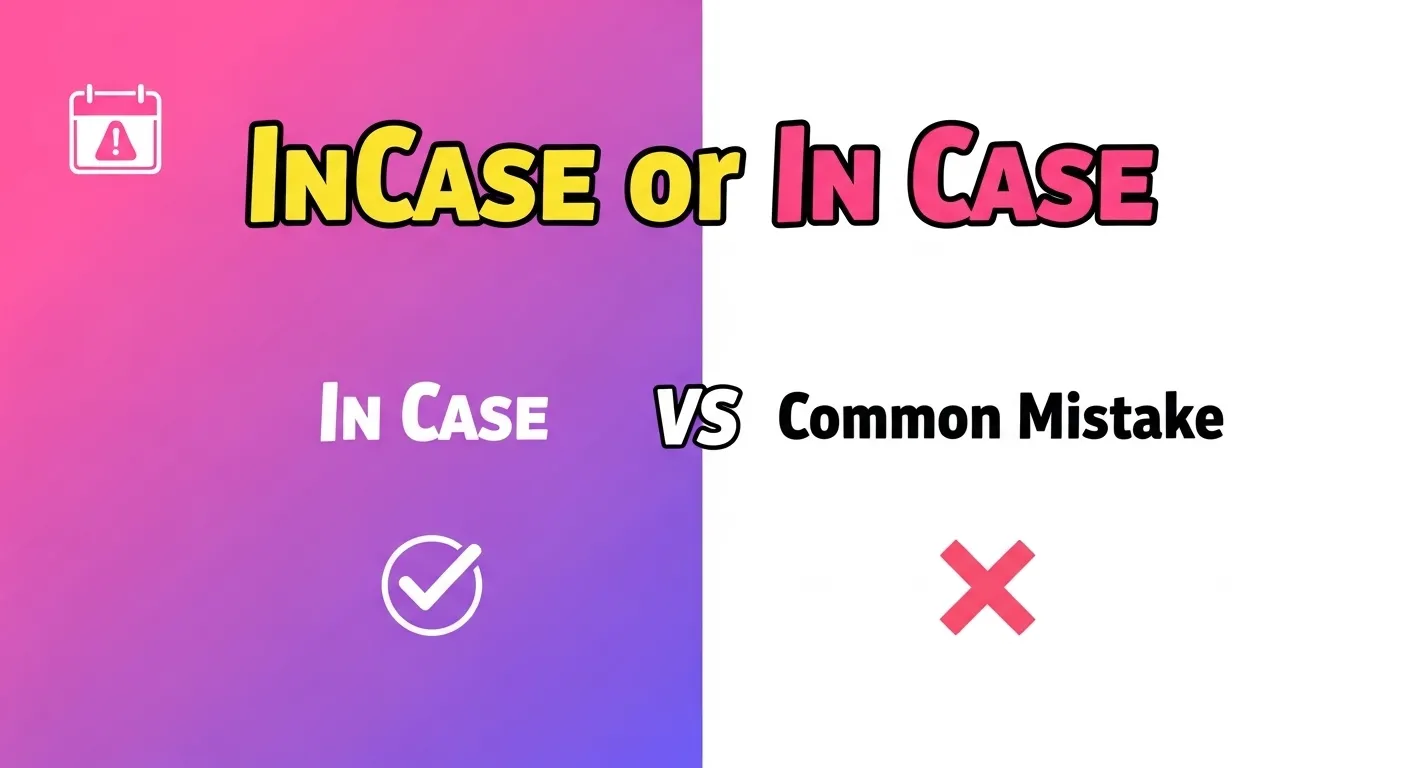
“In case” is the correct form (two words) meaning if something happens.
“Incase” is not correct in standard English.
Many English learners and even fluent speakersoften search for “incase vs encase” because these two forms look very similar but are used very differently in real English. This
confusion is common in emails, exams, professional writing, and social media posts. People want to know which spelling is correct and when to use it.
Using the wrong form can change the meaning of a sentence or make writing look unprofessional. This article clears thatconfusion completely.
You will get a quick answer, British vs American usage, and expert advice in simple English. By the end, you will know exactly when to use in case and why incase is usually wrong.
Incase or In Case: Quick Answer
In case is the correct and commonly used phrase in modern English.
Incase (one word) is almost always incorrect and should be avoided in normal writing.
Examples:
- Take an umbrella in case it rains. ✅
- Call me in case you need help. ✅
❌ Take an umbrella incase it rains. (Incorrect)
In simple words: Always use “in case” (two words).
The Origin ofincase or incase
Origin of “In Case”
The phrase in case comes from Middle English and Old French, where case meant event or situation. Over time, in case developed the meaning as a precaution or if something happens. It has been used as a two-word phrase for hundreds of years.
Example from meaning:
- In case of fire, use the stairs.
Why “Incase” Exists
The one-word form incase sometimes appears because:
- People write fast
- It sounds like one word when spoken
- Learners assume it follows patterns like inside or into
However, standard English dictionaries do not accept “incase” as a correct alternative to in case in normal usage. That is why spelling differences exist.
British English vs American English Spelling
Unlike many spelling pairs, there is NO British vs American difference here.
Both British and American English agree:
- ✅ in case (correct)
- ❌ incase (incorrect)
Examples
- British English: Take a copy in case you lose the original.
- American English: Keep the receipt in case you need a refund.
Comparison Table
| Feature | British English | American English |
| Correct form | in case | in case |
| One-word form | incase ❌ | incase ❌ |
| Meaning | precaution | precaution |
| Style difference | None | None |
Which Spelling Should You Use?
The answer is simple and universal.
Use “In Case” When:
- You mean as a precaution
- You are talking about a possible future situation
- You are writing emails, articles, exams, or messages
Examples:
- Save the file in case the computer crashes.
- I will call you in case I am late.
Never Use “Incase” When:
- Writing formally or informally
- Writing professionally
- Writing for exams or publications
Professional Advice: If you want correct English, always write “in case” as two words.
Common Mistakes with Incase or In Case
Mistake 1: Writing “Incase” as One Word
❌ Incase you need help, call me. ✅ In case you need help, call me.
Mistake 2: Confusing “In Case” with “If”
- In case = precaution
- If = condition
❌ Call me in case you are free. ✅ Call me if you are free.
Mistake 3: Using Wrong Verb Tense
❌ Take notes in case you will forget. ✅ Take notes in case you forget.
Mistake 4: Overusing “In Case”
Use it only when precaution is needed.
Incase or In Case in Everyday Examples
Emails
- Please keep a copy in case we need it later.
News Writing
- Extra police were deployed in case of emergency.
Social Media
- Charging my phone early in case the power goes out 🔋
Formal Writing
- Data was backed up in case of system failure.
Incase or In Case: Google Trends & Usage Data
Search behavior shows that “incase or in case” is a very common grammar query.
Popular by Country
- High searches: India, Pakistan, UK, USA
- Reason: ESL learners and professional writers
Usage Context
- Emails and office writing
- Exams and assignments
- Online publishing and blogging
Google Trends clearly shows that “in case” is the dominant and correct form, while “incase” appears mostly as a mistake.
Comparison Table: Incase vs In Case
| Form | Correct? | Meaning | Example |
| incase | ❌ No | Not standard | ❌ Incase it rains |
| in case | ✅ Yes | As a precaution | ✅ In case it rains |
FAQs
Is “incase” ever correct?
No. Incase is not accepted in standard English.
Is “in case” one word or two?
It is always two words.
Can I use “in case” instead of “if”?
No. They have different meanings.
Is “in case of” correct?
Yes. In case of emergency is a common phrase.
Do native speakers make this mistake?
Yes, especially in informal writing.
Is “in case” formal or informal?
It works in both formal and informal writing.
Will exams mark “incase” wrong?
Yes. It is considered a spelling and grammar error.
Conclusion
The confusion between incase or in case is very common, but the rule is simple. In case (two words) is the only correct and accepted form in modern English. It is used when you talk about precautions or possible future situations.
On the other hand, incase as one word is almost always wrong and should be avoided in exams, professional writing, and daily communication.
There is no British or American difference here, which makes the rule even easier to follow. No matter where you live or who you are writing for, in case is always the safe choice.
By understanding the meaning, examples, mistakes, and usage tips in this article, you can write with confidence and accuracy.
Small grammar details like this matter a lot. Using in case correctly makes your writing clearer, more natural, and more professional. Remember this simple rule, and you will never make this mistake again.
Read more!
Minimize or Minimise:Which One Is Correct?

I am Michael T. Collins.I am a English language writer and researcher known for my work on grammar, vocabulary, and common word confusions. I focuses on explaining complex language rules in a simple, reader friendly way. My writing helps students, bloggers, and professionals improve clarity and accuracy in English.My content is especially popular among learners seeking practical, real world examples.