The correct spelling is “knives.” Many people get confused because “knife” ends with an -fe, which changes to -ves in the plural form. Some think it might be “knifes,” but this is incorrect.
Knowing the right spelling matters for writing clearly in emails, articles, recipes, or schoolwork. People often search “knives or knifes” because they want quick clarification.
This article will explain the difference, give historical context, compare British and American English, show common mistakes, and provide examples in everyday writing. By the end, you will confidently use knives in all contexts.
Knives or Knifes: Quick Answer
The plural of knife is knives.
Why not “knifes”?
English has special rules for words ending in -f or -fe. When making them plural, the f often changes to v and you add -es.
Examples:
- One knife → two knives
- One leaf → two leaves
- One wolf → three wolves
Incorrect version:
- Knifes → ❌ Not standard English
So, whenever you talk about more than one knife, always use knives.
The Origin of Knives or Knifes
The word knife comes from the Old English cnīf, meaning a cutting tool or blade. The spelling evolved over centuries.
During Middle English, the plural was written knives, reflecting the sound change from f → v in some nouns.
Historical context:
- Old English: cnīf → cnīfes (early plural forms)
- Middle English: knyfe → knyves
- Modern English: knife → knives
The spelling “knifes” does not appear in historical records. It likely comes from people applying a regular plural rule by just adding -s instead of following the irregular -f to -ves rule.
This pattern is common in English for other words ending in -f or -fe. For instance:
- Life → lives
- Wife → wives
- Shelf → shelves
Knowing this history explains why knives is correct, not knifes.
British English vs American English Spelling
Both British and American English agree that the plural of knife is knives. Unlike some words where spelling differs between the US and UK, this one remains consistent.
| Word | Singular (UK & US) | Plural (UK & US) | Notes |
| Knife | knife | knives | Standard English |
| Wife | wife | wives | Standard English |
| Shelf | shelf | shelves | Standard English |
| Leaf | leaf | leaves | Standard English |
Key points:
- Knives is correct in both UK and US English.
- Knifes is never correct in either variant.
- Some words like colour/color differ, but knife/knives does not.
Which Spelling Should You Use?
- Use “knives” in all English writing.
- Avoid “knifes” in professional or academic contexts.
- If your audience is international, knives is universally understood.
Advice by context:
- US readers: knives ✅
- UK & Commonwealth readers: knives ✅
- Recipes, blogs, emails: knives ✅
- Schoolwork or formal writing: knives ✅
Bottom line: There is no audience or context where “knifes” is correct.
Common Mistakes with Knives or Knifes
Many errors happen due to applying regular plural rules incorrectly. Here are the most frequent mistakes:
- Knifes instead of knives
- ❌ “I bought three knifes.”
- ✅ “I bought three knives.”
- ❌ “I bought three knifes.”
- Knifees (wrong doubling of letters)
- ❌ “Knifees are sharp.”
- ✅ “Knives are sharp.”
- ❌ “Knifees are sharp.”
- Confusing knife with the verb “to knife”
- ❌ “He knifed the vegetables.” (verb form correct, noun plural needed)
- ✅ “He cut the vegetables with knives.”
- ❌ “He knifed the vegetables.” (verb form correct, noun plural needed)
- Forgetting the rule for other -f/-fe nouns
- ❌ “I have many shelfs.”
- ✅ “I have many shelves.”
- ❌ “I have many shelfs.”
Tip: Always check if a word ending in f/fe changes to ves in the plural.
Knives or Knifes in Everyday Examples
Emails:
- “Please make sure all knives are sanitized before use.”
News articles:
- “Police seized several illegal knives from the suspect.”
Social media posts:
- “Check out my new chef knives set! 🔪”
Formal writing:
- “The kitchen inventory includes five chef knives and ten cutting boards.”
Recipe instructions:
- “Chop the onions with a sharp knife. Repeat for all other knives.”
Using knives correctly signals professionalism and language accuracy.
Knives: Google Trends & Usage Data
Popularity:
- Searches for “knives” peak around holidays and cooking seasons like Thanksgiving and Christmas.
- Common searches include “chef knives,” “hunting knives,” and “kitchen knives.”
Country trends:
| Country | Popularity Index | Notes |
| USA | High | Mainly culinary and tactical |
| UK | Medium | Culinary and gardening usage |
| Australia | Medium | Kitchen and camping knives |
| Canada | High | Culinary and outdoor activities |
Insights:
- People mostly search for knives, not “knifes.”
- Confusion occurs in writing, especially in recipes or e-commerce listings.
Knives vs Knifes: Comparison Table
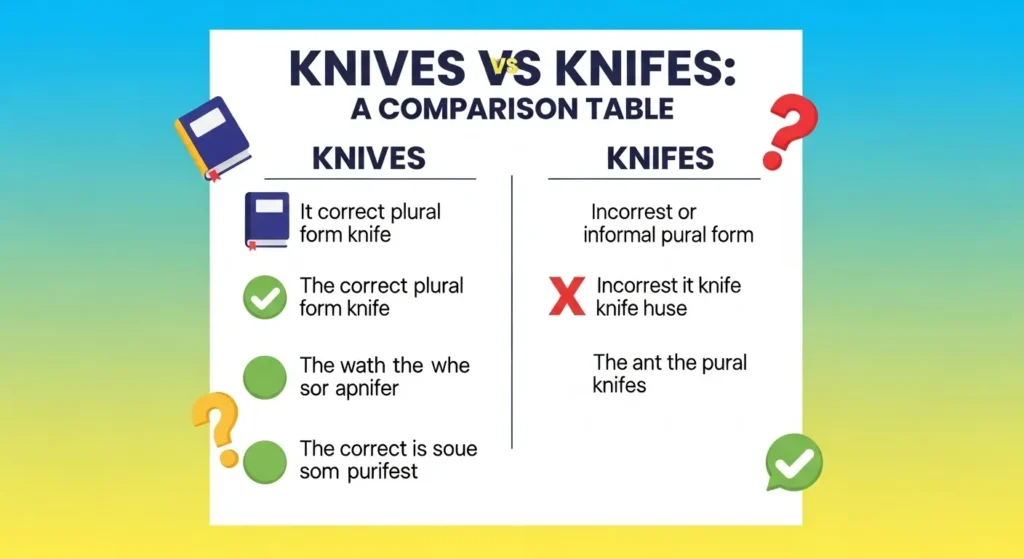
| Feature | Knives | Knifes |
| Correct spelling | ✅ Yes | ❌ No |
| Plural of knife | ✅ Yes | ❌ No |
| Used in US English | ✅ Yes | ❌ No |
| Used in UK English | ✅ Yes | ❌ No |
| Examples | Two knives | Two knifes ❌ |
This table makes it clear that knives is always correct.
FAQs About Knives or Knifes
Q1: Is “knifes” ever correct?
- No. The correct plural is always knives.
Q2: Why does knife become knives?
- English changes f → v and adds -es for some plurals.
Q3: Are there other words like knife?
- Yes: wife → wives, life → lives, shelf → shelves.
Q4: Can I use knifes in informal writing?
- Even in casual contexts, it’s better to use knives.
Q5: Does this rule apply to all f-ending words?
- Many f-ending words follow the f → v rule, but some just add -s (e.g., roof → roofs).
Q6: How do I remember the correct spelling?
- Think: “knife → knives,” “leaf → leaves,” “wife → wives.” Memorize the common irregulars.
Q7: Is knife singular or plural?
- Knife is singular; knives is plural.
Conclusion
The correct plural of knife is knives. Spelling it as knifes is a common mistake that should be avoided in every type of writing.
English uses a special rule where some nouns ending in -f or -fe change the f to v before adding -es to form the plural.
Both British and American English follow this rule, making knives universally correct.
Using knives correctly improves clarity, professionalism, and credibility,If you are writing emails, recipes, blogs, or academic work.
Avoiding common mistakes like knifes or knifees prevents confusion. When in doubt, always refer to trusted dictionaries or style guides.
Remember, correct spelling makes a big difference, where search engines and readers notice errors. By mastering this rule, you ensure your writing looks polished and authoritative.
Related posts!
Duffel or Duffle: Meaning and Examples

I am Michael T. Collins.I am a English language writer and researcher known for my work on grammar, vocabulary, and common word confusions. I focuses on explaining complex language rules in a simple, reader friendly way. My writing helps students, bloggers, and professionals improve clarity and accuracy in English.My content is especially popular among learners seeking practical, real world examples.