The transition from high school to undergraduate studies often feels like entering a different world, especially when it comes to academic writing. Many students arrive at university clinging to old habits and “rules” that no longer apply. These misconceptions do more than just lower your grades; they create unnecessary stress and prevent you from developing a skill set that is actually quite valuable in the professional world.
A major point of confusion for most students is the relationship between word count and content depth. We often see students asking, “How much do I really need to write?” It is a valid question, but the answer is rarely a single number. Understanding how long is an essay involves looking at the assignment’s goals, the complexity of the thesis, and the specific expectations of your faculty. Once you move past the idea that “more is always better,” your writing becomes sharper and more persuasive.
Myth 1: The “Word Count” is a Goal, Not a Limit
Many students believe that if a professor asks for 2,000 words, they must hit exactly 2,000 to get an A. In reality, word counts are usually ranges meant to signal the expected level of research. If you find yourself “fluffing” your sentences with extra adjectives just to hit a target, you are actually hurting your grade. Quality writing is about efficiency. A concise, 1,800-word paper that proves its point will always outperform a 2,100-word paper filled with repetitive ideas.
Myth 2: Complex Language Equals Intelligence
There is a persistent myth that using a thesaurus to find the most “academic” sounding words makes a paper better. This is rarely true. Professors value clarity and precision. If you use a complex word incorrectly, it breaks the flow of your argument. The goal of an undergraduate essay is to communicate complex ideas simply, not simple ideas complexly. In the same way, students should not rely only on tools like ai detection to judge writing quality, because clear thinking, accurate wording, and a strong argument matter far more than how “advanced” the language appears.
Myth 3: The Myth of the “One-Size-Fits-All” Structure
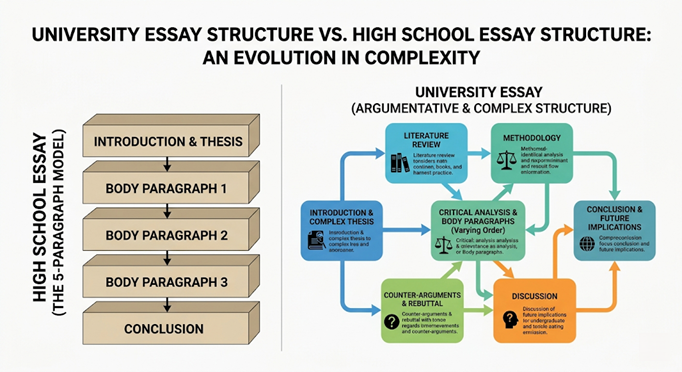
The five-paragraph essay (Intro, three body paragraphs, Conclusion) is a great training tool for younger students, but it is often too restrictive for university-level analysis. Different subjects require different flows. A historical analysis might be chronological, while a science report follows the IMRAD (Introduction, Methods, Results, and Discussion) format.
| Essay Type | Common Structure Focus | Best Approach |
| Argumentative | Claim and Counter-argument | Logical progression of evidence |
| Expository | Explaining a process | Clear, step-by-step clarity |
| Narrative | Storytelling/Reflection | Emotional engagement and themes |
| Comparative | Similarities and Differences | Point-by-point or Block method |
Myth 4: Feedback is a Personal Attack
Many students view a red pen on their paper as a sign of failure. However, academic writing is a process, not a destination. Even professional writers go through multiple rounds of editing. If a professor gives you heavy feedback, it means they see potential in your arguments but want you to refine your execution. Accepting this is the first step toward professional growth.
Myth 5: Writing is a “Solo” Activity with No Market Value
This is perhaps the biggest myth of all. Students often think that once they submit their paper, the skill they used is no longer useful. However, the global demand for high-quality academic and technical content is massive. Organizations like MyAssignmentHelp have shown that there is a significant professional market for those who can research deeply and write clearly. Many graduates actually find success writing essays for money as freelance consultants or academic researchers because they have mastered the very skills you are learning right now. This industry relies on people who understand academic integrity and can meet strict deadlines while maintaining high standards.
Myth 6: Research is Just About Finding “Quotes”
Many students treat research like a scavenger hunt for quotes to “prove” what they already think. Real research is about discovery. You should read broadly enough that your own opinion might actually change. Your essay should be a conversation with existing literature, not just a list of citations. When you integrate sources, you are joining a global community of scholars.
Myth 7: You Should Start Writing at the Introduction
It sounds counterintuitive, but the introduction is often the hardest part to write first. Many successful students write their body paragraphs first and save the introduction and conclusion for last. This ensures that your “roadmap” (the intro) actually matches the “journey” (the essay). If you start with the body, you allow your ideas to evolve naturally without being trapped by a thesis statement you wrote before you did the deep thinking.
The Professional Path: Why These Skills Matter
Beyond the classroom, the ability to synthesize information and present it logically is one of the most sought-after skills in the corporate world. Whether you are writing a marketing proposal, a legal brief, or a medical report, the “rules” of the essay apply. You are learning how to think, not just how to write. By treating every assignment as a professional deliverable rather than a chore, you set yourself up for long-term career success.
Frequently Asked Questions (FAQ)
Q1: Is it okay to go slightly over or under the word count?
Ans: Most professors allow for a 10% margin. If your limit is 1,000 words, anywhere between 900 and 1,100 is usually acceptable. However, always check your specific department’s handbook, as some are stricter than others.
Q2: How can I improve my “Information Gain” in an essay?
Ans: Avoid simply repeating what is in the textbook. Try to find a unique angle, use a recent case study, or compare two theories that aren’t usually linked. This shows “Expertise” and “Originality,” which are key for high marks.
Q3: Is professional writing help ethical?
Ans: Using services for guidance, research, or understanding complex topics is a common way students bridge the gap in their knowledge. The key is to use these resources as learning tools to improve your own drafting and research capabilities.
Q4: What is the most important part of an essay?
Ans: The thesis statement. It is the “anchor” of your entire paper. Without a clear, debatable thesis, your essay is just a collection of facts without a purpose.
Q5: How do I avoid sounding “robotic” in my writing?
Ans: Vary your sentence length. Use short sentences for impact and longer sentences for explanation. Read your work out loud; if you run out of breath, the sentence is too long. If it sounds choppy, you need better transitions.
About The Author
Hello, I’m Lachlan Nguyen. As a dedicated academic consultant at MyAssignmentHelp, I specialize in helping undergraduate students bridge the gap between classroom theory and real-world application. My focus is on developing high-quality content strategies that prioritize depth and authority, ensuring that every student I work with can master complex subjects like STEM and healthcare with confidence.

