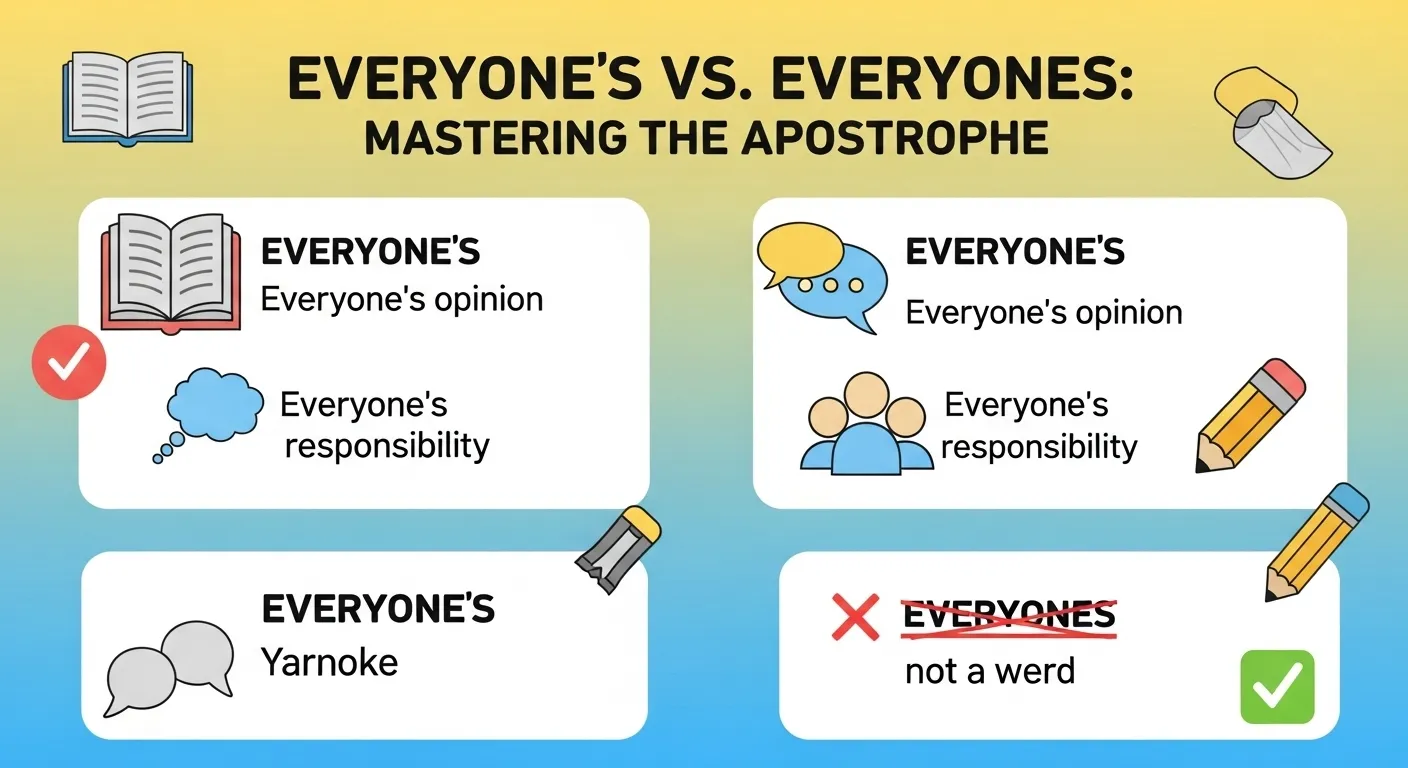
Everyone’s is correct because it means “everyone is” or “everyone has,” while Everyones is incorrect and not a proper word in English.
Many English learners and even native speakers often pause when they need to write everyone’s or everyones’.
The confusion usually happens because apostrophes in English can change meaning, and small punctuation marks often create big mistakes. People search
for “everyone’s or everyones” because they want to sound correct in emails, exams, social media posts, blogs, and professional writing. One wrong apostrophe can make a sentence look careless or unclear.
This keyword solves a very common problem: Is “everyones” ever correct, or should it always be “everyone’s”?
The answer is simple, but the rule behind it needs clear explanation. Many writers think the apostrophe shows plural form, while others are unsure
how possessive nouns work with words like everyone. Because everyone already refers to many people, it feels logical to add s without an apostrophe but English grammar works differently.
In this article, you will get a quick answer, a deep explanation, real life examples, common mistakes, and professional advice based on audience and region.
By the end, you will confidently know when to use everyone’s, why everyones is wrong, and how to avoid this mistake forever.
Everyone’s vs Everyones :Quick Answer
Correct form: ✅ everyone’s
Incorrect form: ❌ everyones
Everyone’s is the possessive form of everyone. It shows that something belongs to all people.
Examples:
- Everyone’s opinion matters.
- Everyone’s phone was turned off.
- Everyone’s responsibility is important.
Everyones (without an apostrophe) is not a correct English word and should never be used in standard writing.
The Origin of Everyone’s or Everyones

The word everyone comes from two parts:
- every (meaning all)
- one (meaning person)
Together, they mean all people considered as individuals. Even though everyone refers to many people, it is treated as a singular indefinite pronoun in grammar.
The possessive form in English is created by adding an apostrophe + s (’s) to show ownership:
- John → John’s book
- Everyone → Everyone’s responsibility
The confusion exists because writers assume:
- everyone = many people
- many people = plural
- plural = no apostrophe
But English does not work that way here. Everyone stays singular, and possession requires ’s.
That is why everyone’s exists and everyones does not.
British English vs American English Spelling

There is no difference between British English and American English for this keyword. Both follow the same rule.
Comparison Table
| Form | British English | American English | Correct |
| everyone’s | ✅ Correct | ✅ Correct | Yes |
| everyones | ❌ Incorrect | ❌ Incorrect | No |
Examples:
- British English: Everyone’s luggage must be labeled.
- American English: Everyone’s vote counts.
Both dialects agree fully on this rule.
Which Spelling Should You Use?
Your choice depends on grammar, not audience.
Use everyone’s if:
- You are writing for US readers
- You are writing for UK or Commonwealth readers
- You are writing globally
- You are writing formally or informally
Never use everyones in:
- Emails
- Essays
- Articles
- Social media captions
- Exams
- Professional documents
Professional advice:
If your sentence shows ownership, responsibility, or belonging, always use everyone’s.
Common Mistakes with Everyone’s or Everyones

❌ Mistake 1: Using “everyones” as a plural
- ❌ Everyones ideas were shared.
- ✅ Everyone’s ideas were shared.
❌ Mistake 2: Dropping the apostrophe
- ❌ Everyones duty is important.
- ✅ Everyone’s duty is important.
3: Confusing with “everyone is”
- ❌ Everyones going to attend.
- ✅ Everyone’s going to attend. (short for “everyone is”)
❌ Mistake 4: Overthinking plurality
Remember: everyone = singular in grammar.
Everyone’s or Everyones in Everyday Examples
Emails
- Everyone’s attendance is mandatory.
- Please submit everyone’s report by Friday.
News
- Everyone’s safety is the top priority, officials said.
Social Media
- Everyone’s excited for the new update!
- Everyone’s opinion matters 💬
Formal Writing
- Everyone’s contribution was acknowledged in the final report.
Casual Speech
- Everyone’s ready to go.
Everyone’s or Everyones : Google Trends & Usage Data
Search data shows that:
- “everyone’s” is widely used in:
- United States
- United Kingdom
- Canada
- Australia
- India
- Pakistan
- “everyones” appears mostly in:
- Misspelled searches
- Grammar questions
- Learner queries
Why people search this keyword:
- Apostrophe confusion
- Grammar exams
- Professional writing concerns
- ESL learning
Google Trends indicates that everyone’s is the accepted standard, while everyones is searched mainly to check correctness.
discover more about!The Origin of Tale or Tail
Comparison Table:Everyone’s vs Everyones
| Feature | Everyone’s | Everyones |
| Grammatically correct | ✅ Yes | ❌ No |
| Shows possession | ✅ Yes | ❌ No |
| Used in formal writing | ✅ Yes | ❌ No |
| Accepted in US & UK | ✅ Yes | ❌ No |
| Common learner mistake | ❌ No | ✅ Yes |
📝 Everyone’s Apostrophe, Meaning, and Correct Usage
Many learners ask questions like does everyone’s need an apostrophe, how do you spell everyone’s, and is it everyones or everyone’s because apostrophes can be confusing.
Here is the clear rule:
- everyone’s = correct
- everyones = incorrect
👉 The apostrophe (’s) is necessary because it shows:
- possession → everyone’s responsibility
- contraction → everyone’s (everyone is)
This explains common searches like:
- everyone’s apostrophe
- possessive form of everyone
- possessive of everyone
- everyone’s grammar
✔ Examples
- Everyone’s phone is ringing.
- Everyone’s happy today.
❌ Incorrect Forms
- everyones
- everyones’
- everyone s
These are not correct in standard English, which answers:
- does everyones have an apostrophe
- is everyones a word (No)
👉 Simple rule:
If you mean ownership or “everyone is”, always use everyone’s
Frequently Asked Questions
1. Is “everyones” ever correct?
No. Everyones is never correct in standard English.
2. Why does “everyone’s” need an apostrophe?
Because it shows possession or contraction (everyone is).
3. Is “everyone” singular or plural?
Grammatically, everyone is singular, even though it refers to many people.
4. Can “everyone’s” mean “everyone is”?
Yes. Example: Everyone’s happy today.
5. Does British English use a different rule?
No. British and American English follow the same rule.
6. Can I use “all people’s” instead?
Yes, but it changes the tone. Everyone’s is more natural.
7. Is “everybody’s” the same as “everyone’s”?
Yes. Both are correct and follow the same rule.
❓ Common Spelling Confusion & Related Questions
Many users search variations like everyone’s vs everyones’, everyone or everyones, and how to spell everyones to confirm the correct form.
🔹 Correct vs Incorrect
- ✅ everyone’s
- ❌ everyones
- ❌ everyones’
This covers:
- everyones or everyone’s meaning
- is it everyone’s or everyones’
- everyone’s or everyones’
🔹 Related Grammar Clarifications
- everyone’s vs everybody’s
👉 Both are correct and mean the same - everyone or everyone’s
👉 Use: - everyone → general subject
- everyone’s → possession or contraction
Examples:
- Everyone is here.
- Everyone’s ready to start.
🔹 Common Mistakes to Avoid
People often write:
- everyones
- everones
- evryones
These are spelling errors and should be avoided in:
- emails
- exams
- professional writing
🔹 Helpful Tip
If you can replace the word with:
👉 everyone is → use everyone’s
This trick helps answer:
- is everyone’s a contraction
- is everyone’s correct grammar
Conclusion
The confusion between everyone’s or everyones is common, but the rule is simple once you understand it. Everyone’s is the only correct form and is used to show possession or as
a contraction for everyone is. The spelling everyones is grammatically incorrect and should be avoided in all types of writing.
There is no difference between British and American English for this word. Whether you are writing an email, social media post, academic paper, or professional report, everyone’s is
always the safe and correct choice. Remember that everyone is treated as singular in grammar, which is why the apostrophe is required.
If you keep one rule in mind ownership needs ’s you will never make this mistake again. Clear grammar builds trust, professionalism, and confidence in your writing. Use everyone’s correctly, and your English will instantly look more polished and accurate.
Related posts!
Comparison Table: kept or keeped
Hydrate or Die:Simple Meaning and Key Differences(2026)
Strep or Tonsillitis: Understanding the Difference

