“Master’s degree” is correct; “masters degree” is incorrect because it needs an apostrophe.
Many students, professionals, and writers often search for “master degree or masters degree” because both forms appear online, in university brochures, emails, and resumes.
This creates real confusion, especially when applying for higher education, writing academic content, or updating a CV.
Is the apostrophe necessary? Does it change the meaning? Or is one American and the other British?
This confusion matters because academic writing requires precision. A small punctuation mistake can make your writing look careless or unprofessional. This article solves that confusion clearly and completely.
You will get a quick answer, historical background, British vs American usage, common mistakes and expert advice.
By the end, you will know exactly when to use masters degree and when master’s degree is the correct choice.
Masters Degree or Master’s Degree: Quick Answer

The correct and standard form is master’s degree (with an apostrophe).
- Master’s degree is correct because it means a degree belonging to a master.
- Masters degree (without an apostrophe) is generally considered incorrect in formal writing, though it appears in informal usage.
Examples:
- She is pursuing a master’s degree in economics. ✅
- He completed his master’s degree last year. ✅
❌ He completed his masters degree last year. (Formal writing: incorrect)
The Origin of Masters Degree or Master’s Degree

To understand why the apostrophe matters, we need to look at the history and structure of the term.
Origin of “Master”
The word master comes from the Latin magister, meaning teacher, leader, or person of authority. In medieval universities, a master was someone qualified to teach. The academic title Master of Arts (MA) and Master of Science (MS/MSc) come from this tradition.
Why the Apostrophe Exists
The phrase master’s degree is a possessive noun. It literally means:
a degree of a master
That is why the apostrophe comes before the s. The degree belongs to a “master,” not to “masters” (plural people).
Why “Masters Degree” Appears
Over time, informal writing, online content, and even marketing materials dropped the apostrophe for simplicity. This created the widespread but nonstandard form masters degree.
British English vs American English Spelling
Unlike many grammar debates, this one is NOT a British vs American difference.
American English
- Correct: master’s degree
- Incorrect (formal): masters degree
Example:
- She earned a master’s degree in computer science.
British English
- Correct: master’s degree
- Incorrect (formal): masters degree
Example:
- He is studying for a master’s degree in history.
Comparison Table
| Feature | American English | British English |
| Standard form | master’s degree | master’s degree |
| Apostrophe required | Yes | Yes |
| Meaning difference | None | None |
| Informal usage | masters degree (common) | masters degree (common) |
Both varieties of English follow the same rule.
Which Spelling Should You Use?
The best choice depends on context and purpose, but professional standards are clear.
Academic Writing
Always use master’s degree.
- Theses
- Research papers
- University applications
Professional Writing (CVs, LinkedIn, Emails)
Use master’s degree to appear polished and educated.
Informal or Content
You may see masters degree used often because people search it that way. However, even in writing, it is best to:
- Use master’s degree as the primary form
- Mention masters degree only when explaining the difference
Global Audience Advice
No matter where your audience is, master’s degree is the safest and most correct choice.
Master’s Degree or Masters Degree: Apostrophe Rules, Spelling, and Common Questions
Many people search queries like “masters or master degree,” “is it masters or master’s degree,” “masters vs master’s,” and “does master’s degree have an apostrophe” because the rule is not always clear.
Here is the correct explanation:
- Master’s degree ✅ → correct (possessive form)
- Masters degree ❌ → incorrect in formal writing
Key grammar point:
- Master’s degree = a degree of a master
- That is why the apostrophe is required
Common search questions explained:
- “masters degree apostrophe” / “master’s degree apostrophe” → Yes, the apostrophe is necessary
- “does masters degree have an apostrophe” → It should, in correct English
- “master degree or masters degree” → Both are incorrect; the correct form is master’s degree
- “is masters degree possessive” → No, only master’s degree is correctly possessive
Quick tip:
If you remove the apostrophe, the meaning becomes grammatically incorrect.
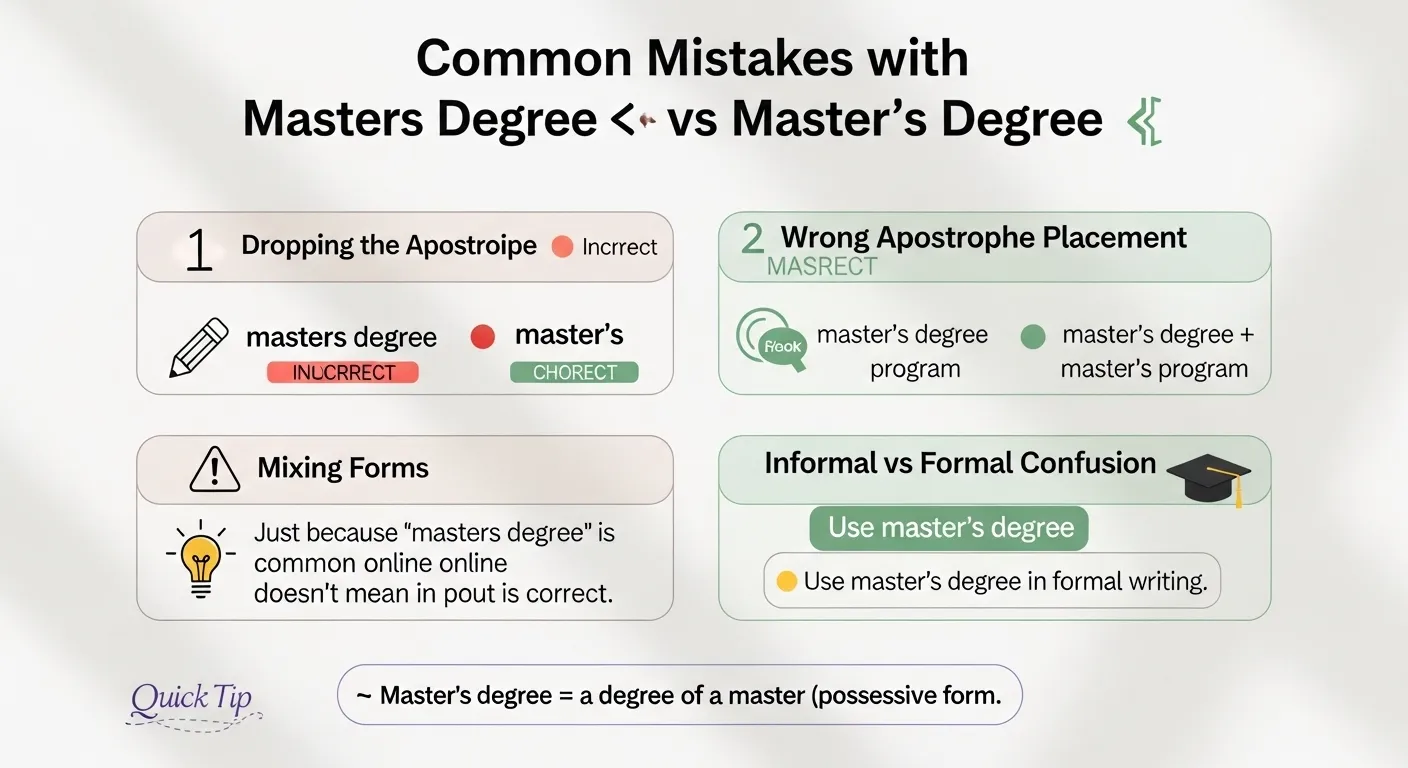
Common Mistakes with Masters Degree or Master’s Degree
Mistake 1: Dropping the Apostrophe
❌ I am applying for a masters degree. ✅ I am applying for a master’s degree.
Mistake 2: Using a Plural Apostrophe
❌ masters’ degree ✅ master’s degree
Explanation: The degree belongs to one master, not many masters.
Mistake 3: Inconsistent Usage
❌ She has a master’s degree and is enrolled in a masters program. ✅ She has a master’s degree and is enrolled in a master’s program.
Mistake 4: Assuming Informal Equals Correct
Just because something is common online does not make it grammatically correct.
Masters Degree or Master’s Degree in Everyday Examples
Emails
- I recently completed my master’s degree in marketing.
News Writing
- The report shows higher employment rates for those with a master’s degree.
Social Media
- Finally done with my master’s degree 🎓
Formal Writing
- Candidates must hold a master’s degree from an accredited institution.
Job Applications
- Education: Master’s Degree in Business Administration (MBA)
Masters Degree or Master’s Degree: Google Trends & Usage Data
Search behavior shows why this confusion is so common.
Popular Search Forms
- “masters degree” → very high search volume
- “master’s degree” → lower volume but grammatically correct
Popular by Country
- United States: both searched, informal form dominates
- United Kingdom: same pattern
- India, Pakistan, Philippines: high searches for both
Why This Happens
- Apostrophes are often ignored in search queries
- People type faster on mobile
- content sometimes favors search habits over grammar
Despite trends, universities and academic institutions consistently use master’s degree in official documents.
Comparison Table: Masters Degree vs Master’s Degree
| Form | Grammatically Correct? | Formal Use | Example |
| master’s degree | Yes | Yes | She earned a master’s degree |
| masters degree | No (formal) | No | Common in searches |
| masters’ degree | No | No | Incorrect possessive |
FAQs
Is “masters degree” ever correct?
In informal writing, it appears often, but it is not grammatically correct in formal English.
Why does “master’s degree” need an apostrophe?
Because it is a possessive noun, meaning the degree belongs to a master.
Is this different in British English?
No. Both British and American English use master’s degree.
What about “bachelor’s degree”?
The same rule applies. Bachelor’s degree also requires an apostrophe.
Can I use “Masters” as a short form?
Yes, in casual speech: “I’m doing my Masters.” This is informal but acceptable.
How should I write it on my CV?
Always write Master’s Degree with proper capitalization and apostrophe.
Do universities accept “masters degree” in applications?
They understand it, but official writing always uses master’s degree.
Master’s Degree: Meaning, Usage, Capitalization, and Writing Tips
Some users also search meaning-based and usage queries such as:
- “how to spell master’s degree”
- “master’s degree in a sentence”
- “is masters capitalized” / “do you capitalize master’s”
- “master’s degree or masters degree which is correct”
Clear answers:
👉 Master’s degree is the correct spelling and standard academic term.
Example sentences:
- She earned a master’s degree in finance.
- He is applying for a master’s degree abroad.
Capitalization rule:
- Use lowercase in general writing → master’s degree
- Use uppercase only in titles → Master of Science (MSc)
Other common confusion queries:
- “masters’ or master’s” → Correct form is master’s (singular possessive)
- “master of or masters of” → Correct form is Master of Arts, Master of Science
- “does masters have an apostrophe” → Only when written correctly as master’s
Important note:
Search variations like “masters or master,” “masters degree spelling,” or repeated forms are due to typing habits, not different meanings.
Final tip:
Always use master’s degree in formal, academic, and professional writing.
Conclusion
The difference between masters degree or master’s degree may look small, but it is important in correct English. The apostrophe in master’s degree shows possession and
reflects the long academic tradition behind the title. This makes master’s degree the only correct choice in formal, academic, and professional writing.
Although masters degree is widely searched and commonly seen online, it is best understood as an informal or simplified version, not a standard one. Universities, employers, academic journals, and style guides all agree on using master’s degree.
If you want your writing to look clear, educated, and professional, always choose master’s degree. Use it consistently in resumes, emails, applications, and formal content.
Understanding this small grammar point helps you avoid common mistakes and shows attention to detail an important quality in higher education and professional life.
Read more!
Minimize or Minimise:Quick Answer
Boat or Ship: What Is the Difference and When to Use Each?
Dear vs Deer: What’s the Difference?

