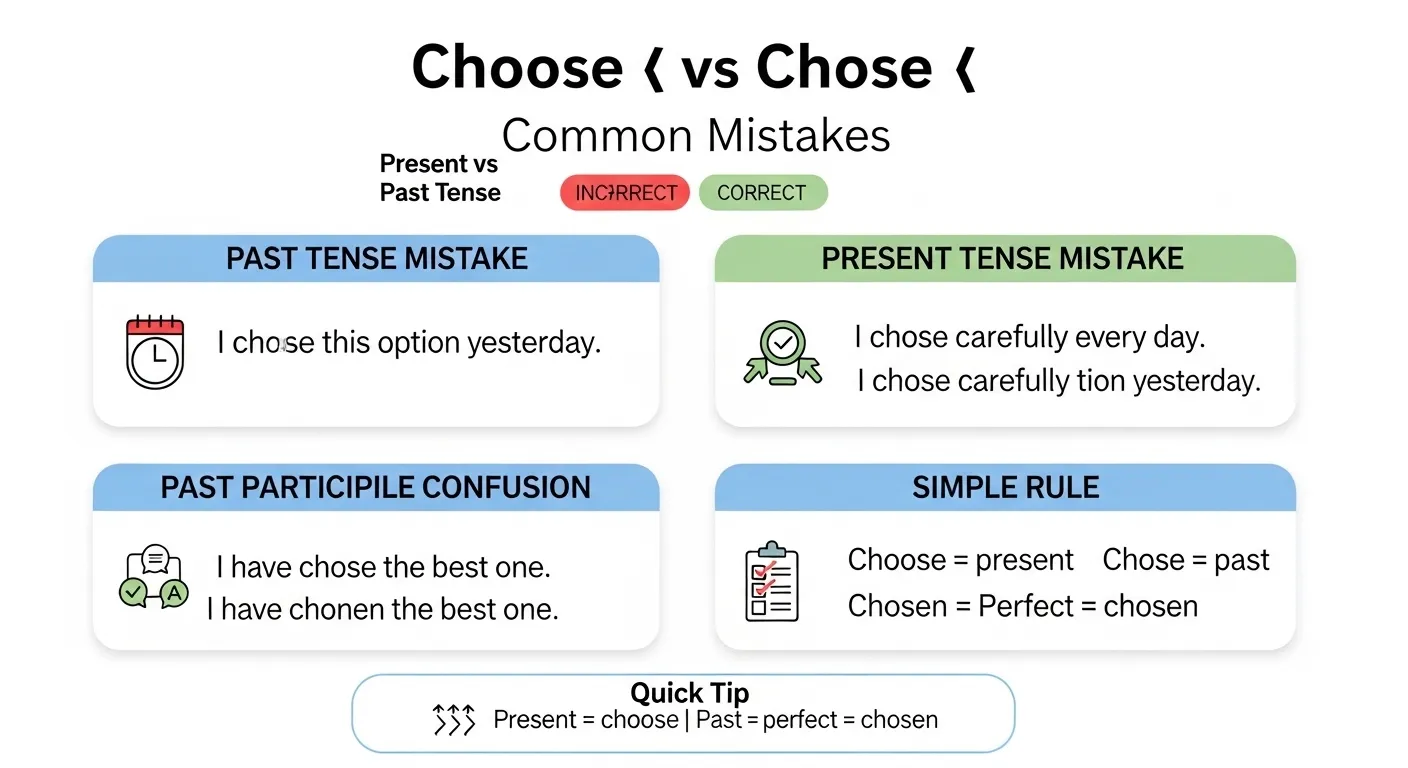
Choose is present tense (correct for current actions), while chose is past tense (used for actions already completed).
Many English learners search for “chose or choose” because both words look similar but are used in different situations. This small difference often causes big confusion in writing,
speaking, exams, and professional communication. People are unsure If chose is present tense or past tense, and when choose should be used instead.
Using the wrong form can make a sentence sound incorrect or unclear, especially in formal writing.
This confusion happens because choose is an irregular verb, and its past form does not follow simple rules. This article solves that problem clearly.
You will learn the quick answer, word origin, British vs American usage, common mistakes, real-life examples, trend insights, FAQs, and expert advice all written in simple, easy English.
Chose or Choose: Quick Answer
Choose is the present tense form of the verb.
Chose is the simple past tense form of the verb.
Examples:
- I choose my clothes carefully. (present)
- I chose this book yesterday. (past)
❌ I choose this book yesterday.
The Origin of choosed or chosed
Understanding the origin of these words helps reduce confusion.
Origin of “Choose”
The verb choose comes from Old English ceosan, meaning to select or decide. This word has existed for over a thousand years and has always carried the idea of making a decision between options.
Origin of “Chose”
Chose developed as the past tense form of choose. English kept it as an irregular verb, which is why it does not become choosed. Over time, pronunciation changed, but spelling stayed fixed.
Why the Spelling Difference Exists
English has many irregular verbs (go :went, take :took). Choose :chose follows this pattern, where vowel sounds change instead of adding -ed.
British English vs American English Spelling
There is no spelling difference between British and American English for chose and choose.
Both varieties use:
- choose for present tense
- chose for past tense
Examples
- American English: I choose quality over price.
- British English: She chose the blue dress.
Comparison Table
| Feature | American English | British English |
| Present tense | choose | choose |
| Past tense | chose | chose |
| Meaning difference | None | None |
| Spelling difference | None | None |
Which Spelling Should You Use?
The correct choice depends on time, not region.
Use “Choose” When:
- The action happens now
- The choice is general or repeated
Example:
- I always choose honesty.
Use “Chose” When:
- The action happened in the past
- A time word is present (yesterday, last year)
Example:
- She chose this career last year.
Global Writing Advice
For all audiences US, UK, or global the rule stays the same. Focus on tense, not location.
Difference Between Chose and Choose (Simple Explanation)
Many learners search for the difference between chose and choose or ask is it chose or choose because both forms look similar but represent different tenses.
Basic Rule:
- Choose → present tense
- Chose → past tense
This also answers common queries like:
- choose vs chose
- chose vs choose
- choose or chose
- chose or choose meaning
Examples:
- I choose healthy food every day. ✅
- I chose healthy food yesterday. ✅
Key Tip:
👉 If the action is happening now → use choose
👉 If the action already happened → use chose
This helps with:
- i choose or chose
- we chose or choose
- choose or chose UK (same rule globally)
Spelling Reminder:
- choose spelling → correct
- chose spelling → correct
- ❌ chosed / choosed → incorrect
So if you are wondering:
- is choosed correct → No
- choosed or chose → correct: chose
Common Mistakes with Chose or Choose
Mistake 1: Using “Choose” for the Past
❌ I choose this option yesterday. ✅ I chose this option yesterday.
Mistake 2: Using “Chose” for the Present
❌ I chose carefully every day. ✅ I choose carefully every day.
Mistake 3: Confusing with Past Participle
❌ I have chose the best one. ✅ I have chosen the best one.
Mistake 4: Overthinking the Rule
Remember: present = choose, past = chose.
Chose or Choose in Everyday Examples
Emails
- Please choose a suitable time.
- I chose the earlier meeting slot.
News Writing
- Voters choose their leaders through elections.
- The committee chose a new chairperson.
Social Media
- Always choose kindness ❤️
- I chose peace over drama ✨
Formal Writing
- Participants choose from multiple options.
- The board chose a long-term strategy.
Chose or Choose: Google Trends & Usage Data
Search data shows that “chose or choose” is a common grammar query worldwide.
Popular by Region
- High searches in: United States, India, Pakistan, UK
- Common among students, ESL learners, and professionals
Usage by Context
- Exams and tests: Very common
- Business writing: Frequent
- Academic writing: Moderate
Most searches happen when people are writing past events or reports and are unsure about tense.
Comparison Table: Chose vs Choose
| Word | Tense | Meaning | Example |
| Choose | Present | Decide now or generally | I choose quality |
| Chose | Past | Decided earlier | I chose quality yesterday |
Choose, Chose, and Chosen (Forms and Usage Guide)
Many learners also search for choose vs chosen and get confused between all verb forms.
Verb Forms:
- Choose → present
- Chose → past
- Chosen → past participle
This answers:
- choose vs chosen
- chose vs chosen
- choose chose chosen
- past tense of choose
- past of choose
Examples:
- I choose my path carefully.
- I chose this path yesterday.
- I have chosen the best option.
Common Mistakes:
- ❌ I have chose → incorrect
- ✅ I have chosen → correct
- ❌ choosen or chosen → correct: chosen
- ❌ chosing → correct: choosing
This covers:
- choosing vs chosing
- choosen or chosen
- chose or choosed
Related Forms:
- chooses → third person present
- Example: She chooses wisely
This helps with:
- chooses or choses
- how to spell chooses
Quick Rule:
👉 Present → choose
👉 Past → chose
👉 Perfect tense → chosen
FAQs About choose and chose
Is “chose” present tense?
No. Chose is simple past tense.
Is “choose” past tense?
No. Choose is present tense.
What is the past participle of choose?
The past participle is chosen.
Can I say “I have chose”?
No. Correct form is I have chosen.
Are chose and choose interchangeable?
No. They show different times.
Do British and American English use them differently?
No. Both follow the same rules.
Why is “choosed” incorrect?
Because choose is an irregular verb.
Conclusion
The difference between chose or choose is simple once you understand verb tense. Choose is used for present or general actions, while chose is used for actions that
happened in the past. They come from the same verb but serve different time meanings, and mixing them can cause grammar mistakes.
There is no British or American spelling difference here, which makes the rule easier to remember. Focus only on when the action happened.
If it is happening now or happens regularly, use choose. If it already happened, use chose. Also remember that the past participle is chosen, not chose.
By following the examples, tables, common mistakes, and FAQs in this guide, you can confidently use chose and choose in emails, exams, articles, and everyday English.
Mastering this small rule will make your writing clearer, more professional, and grammatically correct.
Read more!
Lend vs Borrow: What’s the Difference?In 30 Seconds
Some vs Any: What’s the Difference?(2026)

