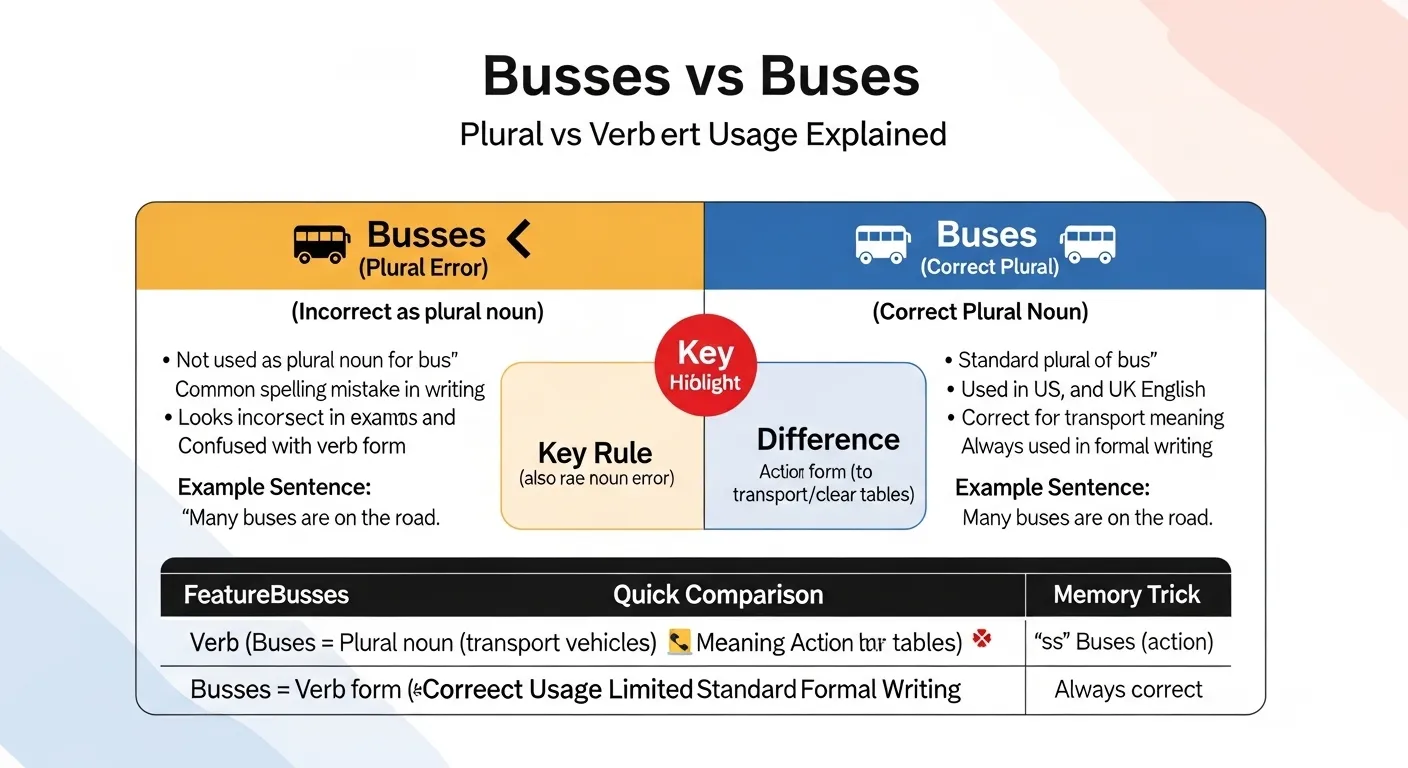
“Buses” is the correct plural of bus, while “busses” is mainly an old or verb form and not commonly used today.
Many English learners, students, and even native speakers search for “busses or buses” because both spellings appear online, in books, and on social media. This creates real
confusion, especially when writing emails, exams, articles, or professional documents. Is busses wrong? Is buses American English only? Or do both forms have different meanings?
The confusion happens because English plurals and verb forms do not always follow simple rules.
The word bus looks easy, but its plural form often surprises people. This article clearly solves that confusion. You will get a quick answer, historical background, British vs American
spelling rules, common mistakes, real-life examples, usage trends, FAQs, and expert advice. By the end, you will confidently know when to use buses and when busses is acceptable.
Busses or Buses: Quick Answer

Buses is the correct and standard plural noun of bus.
Busses is not correct as a plural noun, but it can be correct as a verb form.
Examples:
- The city operates many buses. ✅ (plural noun)
- The company busses tourists to the hotel. ✅ (verb)
❌ There are many busses on the road. (Incorrect as a noun)
Is It Buses or Busses? Plural Rules Explained Clearly
Many users ask questions like “is it buses or busses,” “what is the plural of bus,” “bus plural form,” and “school busses or buses.”
The answer is simple:
- The correct plural noun is buses
- The form busses is used only as a verb
For example:
- One bus → many buses ✅
- One bus → many busses ❌ (incorrect noun)
This follows a standard English rule:
Words ending in -s usually form plurals by adding -es
Examples:
- bus → buses
- class → classes
- box → boxes
That’s why searches like “bus in plural,” “plural of bus,” “bus or buses,” “one bus many buses,” and “more than one bus is called” all lead to the same correct answer: buses.
Even in different regions like the US, UK, or Canada, the rule stays the same. So queries like “buses or busses UK,” “buses or busses US,” and “busses or buses Canada” all have the same result.
👉 Key takeaway:
If you are talking about more than one bus, always use buses.
The Origin of Busses or Buses
Understanding the origin of the word helps explain why confusion exists.
Origin of “Bus”
The word bus comes from the Latin word omnibus, meaning for all. In the 19th century, omnibus was shortened to bus and became common in everyday English.
Why “Buses” Became the Standard Plural
In English, nouns ending in -s usually form the plural by adding -es (like glass → glasses). Since bus ends in s, the correct plural became buses.
Where “Busses” Comes From
The spelling busses developed mainly from verb usage, not from the noun plural. The verb to bus means to transport people or to clear tables (in restaurants). When conjugated in the third-person singular, it becomes busses.
This historical difference explains why both spellings exist but serve different grammatical roles.
British English vs American English Spelling

Unlike many spelling debates, busses vs buses is not mainly a British vs American issue.
American English
- Buses → correct plural noun
- Busses → verb form only
Example:
- School buses arrive at 8 a.m.
- The driver busses students daily.
British English
- Buses → correct plural noun
- Busses → verb form (less common but correct)
Example:
- Public buses are reliable.
- The company busses workers to the factory.
Comparison Table
| Feature | American English | British English |
| Plural noun | buses | buses |
| Verb form | busses | busses |
| Meaning difference | None | None |
| Regional preference | Same | Same |
Both varieties of English follow the same rule here.
Which Spelling Should You Use?
The correct choice depends on how the word is used in the sentence.
When to Use “Buses”
Use buses when talking about more than one bus.
- City buses are crowded.
- School buses run early.
When to Use “Busses”
Use busses only as a verb, meaning:
- To transport people by bus
- To clear tables (restaurant context)
- The company busses employees daily.
- The waiter busses tables quickly.
Global Writing Advice
For global audiences:
- Use buses for the plural noun
- Avoid busses unless you clearly mean the verb
Consistency and clarity are key.
Common Mistakes with Busses or Buses
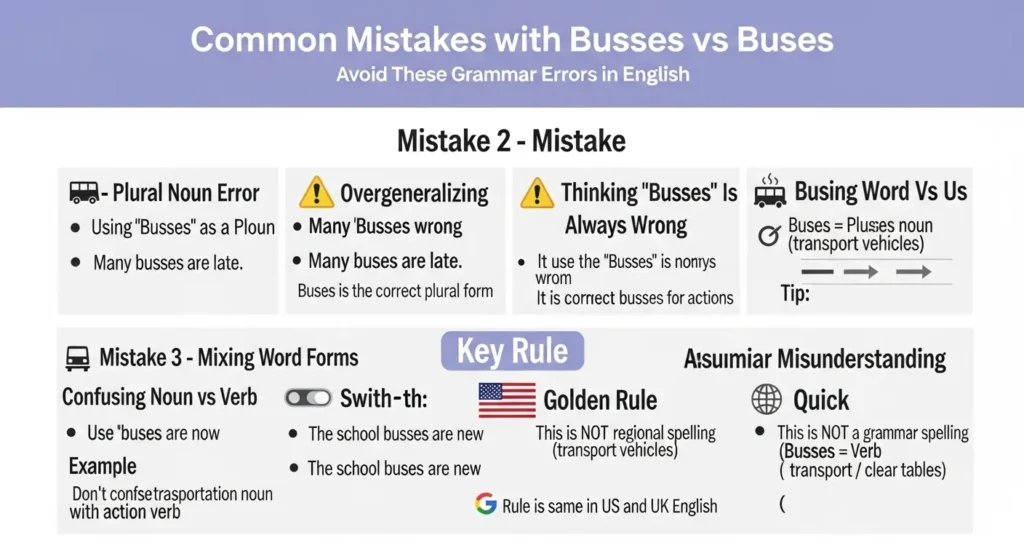
Mistake 1: Using “Busses” as a Plural Noun
❌ Many busses are late. ✅ Many buses are late.
Mistake 2: Thinking “Busses” Is Always Wrong
❌ Believing busses is never correct ✅ Busses is correct as a verb
Mistake 3: Mixing Noun and Verb Forms
❌ The school busses are new. ✅ The school buses are new.
Mistake 4: Overthinking British vs American Rules
This is a grammar issue, not a regional spelling difference.
Buses vs Busses: Meaning, Spelling & Common Confusions
People often search for variations like “buses vs busses,” “busses meaning,” “buses spelling,” “how to spell buses,” and even “is busses correct.”
Let’s break it down clearly:
✅ Buses (Correct Noun)
- Meaning: more than one bus
- Example:
The city buses are running late.
✅ Busses (Correct Verb)
- Meaning: to transport people OR clear tables
- Example:
The restaurant worker busses tables quickly.
❌ Common Confusions
- “bus’s or bus’” → incorrect plural forms
- “buse’s” or “buss” → incorrect spellings
- “busses plural” → incorrect usage as a noun
Related Search Clarifications
- “is buses a word?” → Yes ✅
- “is busses correct?” → Only as a verb ✅
- “buses plural” / “plural form of bus” → buses ✅
- “buses or busses spelling” → depends on usage
Even searches in other languages like “buses artinya” or “autobuses como se escribe” still point to the same English plural: buses.
👉 Simple rule to remember:
- Thing → buses
- Action → busses
Busses or Buses in Everyday Examples
Emails
- The office provides shuttle buses.
- The company busses staff from downtown.
News Writing
- Electric buses reduce pollution.
- The city busses refugees to safe areas.
Social Media
- Morning traffic and crowded buses 😩
- The hotel busses guests for free 🚌
Formal Writing
- Public buses play a vital role in urban transport.
- The organization busses participants between venues.
Busses or Buses: Google Trends & Usage Data
Search data shows “busses or buses” is a common grammar query worldwide.
Popular by Region
- High searches: United States, UK, India, Canada
- Reason: school writing, exams, and professional communication
Usage by Context
- Transportation topics → buses
- Hospitality and logistics → busses (verb)
- Academic writing → buses dominates
Overall, buses is far more frequent because it is the standard plural noun.
Comparison Table: Busses vs Buses
| Word | Part of Speech | Meaning | Example |
| Buses | Noun (plural) | More than one bus | City buses run late |
| Busses | Verb | Transports or clears tables | He busses customers daily |
FAQs
Is “busses” ever correct?
Yes. Busses is correct as a verb, not as a plural noun.
What is the plural of bus?
The correct plural noun is buses.
Is “busses” British English?
No. Both British and American English use buses as the plural noun.
Can I write “school busses”?
No. The correct form is school buses.
Why do people write “busses”?
Because many verbs double the final consonant, causing confusion.
Is “busses” common in restaurants?
Yes. It means to clear tables.
Which form should I use in exams?
Always use buses for the plural noun.
Conclusion
The confusion between busses or buses is very common, but the rule is actually simple. Buses is the correct and standard plural noun of bus in both American and British English.
If you are talking about public transport, school transport, or city vehicles, buses is always the right choice.
The spelling busses is not wrong by itself, but it serves a different role. It is a verb, meaning to transport people by bus or to clear tables in a restaurant.
Problems arise when writers mistakenly use busses as a plural noun, which makes sentences look incorrect and unprofessional.
To write clearly and confidently, always check the sentence structure. Ask yourself: Am I naming more than one bus, or describing an action? If it is a thing, use buses.
If it is an action, busses may be correct. Understanding this small difference improves accuracy, professionalism, and overall English fluency.
Read more !
Minimize or Minimise:Quick Answer
Whose vs Who’s: What’s the Difference?In 30 Seconds
Accept vs Except: What’s the Difference?(2026)

