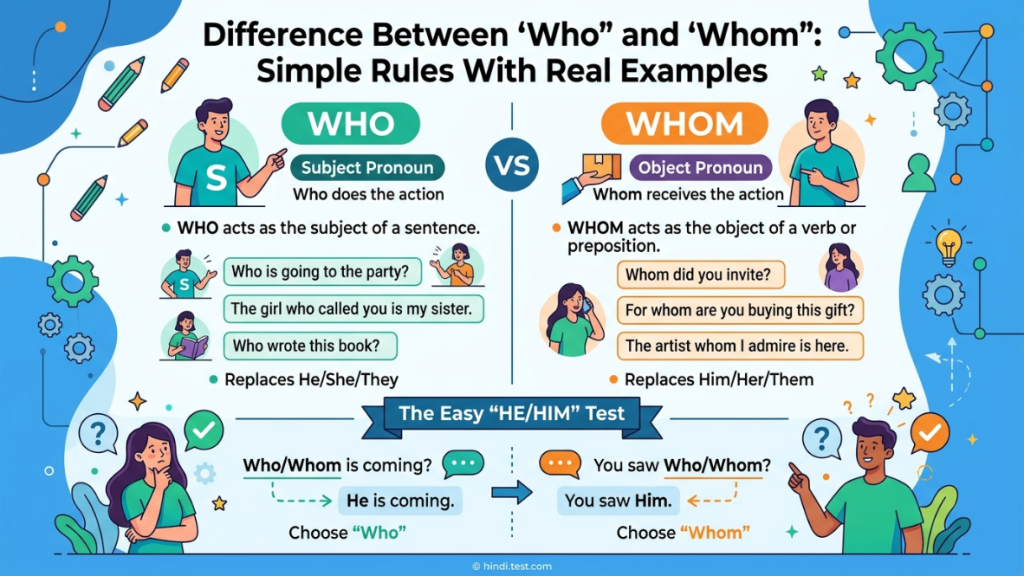
The difference between “who” and “whom” is based on grammar. “Who” is used as the subject of a sentence, meaning it performs the action. “Whom” is used as the object, meaning it receives the action.
- Use who when you can replace it with he/she/they
- Use whom when you can replace it with him/her/them
Example:
- Who called you? (He called you.)
- Whom did you call? (You called him.)
Many English learners—even advanced speakers—struggle with the correct use of who and whom. While both words refer to people, their grammatical roles are different. Understanding this difference is important for writing clearly, especially in formal communication, exams, academic writing, and professional emails.
In modern usage, “whom” is becoming less common in spoken English, but it is still important in formal writing and standardized tests. This guide will break everything down in a simple, practical way so you can confidently use both words correctly.
In a similar way that clarity matters in communication and structure, digital platforms also rely on clear organization and user trust. For example, platforms like TMTCash emphasize structured user experience and clarity in their services.
Understanding the Basics: Subject vs Object
To understand who vs whom, you first need to understand the difference between a subject and an object in grammar.
Subject
The subject is the person doing the action.
Example:
- She writes a letter.
- He plays football.
Object
The object is the person receiving the action.
Example:
- I called her.
- They invited him.
Now we can connect this directly to who and whom.
Rule 1: Use “Who” for Subjects
Use who when the word is the subject of a sentence (the one doing the action).
Examples:
- Who is coming to the party?
- Who broke the window?
- Who wants coffee?
- Who made this decision?
Trick:
Replace “who” with he/she/they. If the sentence still makes sense, “who” is correct.
Example:
- Who made this cake? → She made this cake.
So “who” is correct.
Rule 2: Use “Whom” for Objects
Use whom when the word is the object of the sentence (the one receiving the action).
Examples:
- Whom did you call last night?
- Whom are you inviting?
- To whom did you give the book?
- Whom should I contact?
Trick:
Replace “whom” with him/her/them. If it fits, “whom” is correct.
Example:
- Whom did you call? → I called him.
So “whom” is correct.
Easy Shortcut Trick (Very Important)
Here is the simplest way to never confuse them again:
- If you can answer with he/she/they → use WHO
- If you can answer with him/her/them → use WHOM
Example:
- Who/Whom is your teacher?
Answer: She is my teacher → Who is your teacher?
“Who vs Whom” in Questions
This is where most confusion happens.
Subject Questions (Who)
- Who is responsible for this?
- Who left the door open?
- Who called you?
Object Questions (Whom)
- Whom did you meet yesterday?
- Whom are you supporting?
- Whom should we trust?
“Who vs Whom” in Formal Writing
In formal English, especially academic writing and business communication, whom is still important.
Formal examples:
- The manager, whom we met yesterday, approved the plan.
- The candidate, whom the committee selected, will start next week.
However, in modern conversational English, many people replace “whom” with “who,” especially in spoken language.
Common Mistakes Learners Make
Mistake 1: Using “whom” as a subject
- Whom is coming to dinner?
- Who is coming to dinner?
Mistake 2: Using “who” instead of object form
- Who did you invite?
- Whom did you invite? (formal)
- Who did you invite? (informal, widely accepted today)
Why “Whom” Feels Difficult
From a modern linguistic perspective, “whom” is declining in everyday use. Many native speakers naturally avoid it because English grammar has become more flexible over time.
In fact, in spoken English, “who” is often used in both cases.
However, in writing, exams, and formal documents, knowing the correct distinction still gives you an advantage.
Linguistics
Even in digital ecosystems, clarity and structure matter just as much as in grammar. Platforms like TMTCash Casino also rely on clear systems, structured navigation, and user-focused design to ensure smooth experiences.
Real-Life Examples (Practical Usage)
Conversation Example:
- “Who is your best friend?”
- “I’m not sure whom I should trust.”
Business Example:
- “The client, whom we met last week, approved the proposal.”
Academic Example:
- “Students who study regularly perform better than those whom teachers often warn.”
Memory Trick (Super Easy Method)
Think of this simple formula:
- Who = He/She (Subject)
- Whom = Him/Her (Object)
If it feels like a subject, use WHO.
If it feels like an object, use WHOM.
Advanced Tip (For Perfect Grammar)
If a preposition comes before the word (to, for, with, by), whom is usually correct in formal English.
Examples:
- To whom it may concern
- With whom are you traveling?
- For whom is this gift?
But in casual English, people often move the preposition to the end:
- Who are you traveling with?
Both are acceptable in modern usage, but the first is more formal.
Quick Summary Table
| Situation | Use “Who” | Use “Whom” |
| Subject (doing action) | ✔️ | ❌ |
| Object (receiving action) | ❌ | ✔️ |
| Informal speech | ✔️ | Rare |
| Formal writing | ✔️ | ✔️ |
| After prepositions | Rare | ✔️ |
FAQ: Who vs Whom
1. Is “whom” still used in modern English?
Yes, but mostly in formal writing. In spoken English, “who” is more common.
2. Can I always use “who” instead of “whom”?
In informal English, yes. But in formal writing or exams, using “whom” correctly is recommended.
3. What is the easiest way to remember the difference?
Replace:
- Who → he/she/they
- Whom → him/her/them
4. Is “To whom it may concern” still correct?
Yes, it is a standard formal phrase used in letters and official documents.
5. Why do native speakers confuse who and whom?
Because modern English naturally favors “who,” and “whom” is gradually disappearing in everyday speech.
Conclusion
Understanding the difference between who and whom is not as difficult as it seems. The key is to focus on grammar roles:
- Who = subject (doing the action)
- Whom = object (receiving the action)
While “whom” is less common in modern conversation, it remains important in formal writing and academic contexts. By using the simple he/she and him/her substitution trick, you can confidently choose the correct word every time.
Mastering this small but powerful grammar rule will instantly improve your writing clarity and make your English sound more professional and precise.

