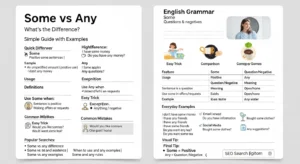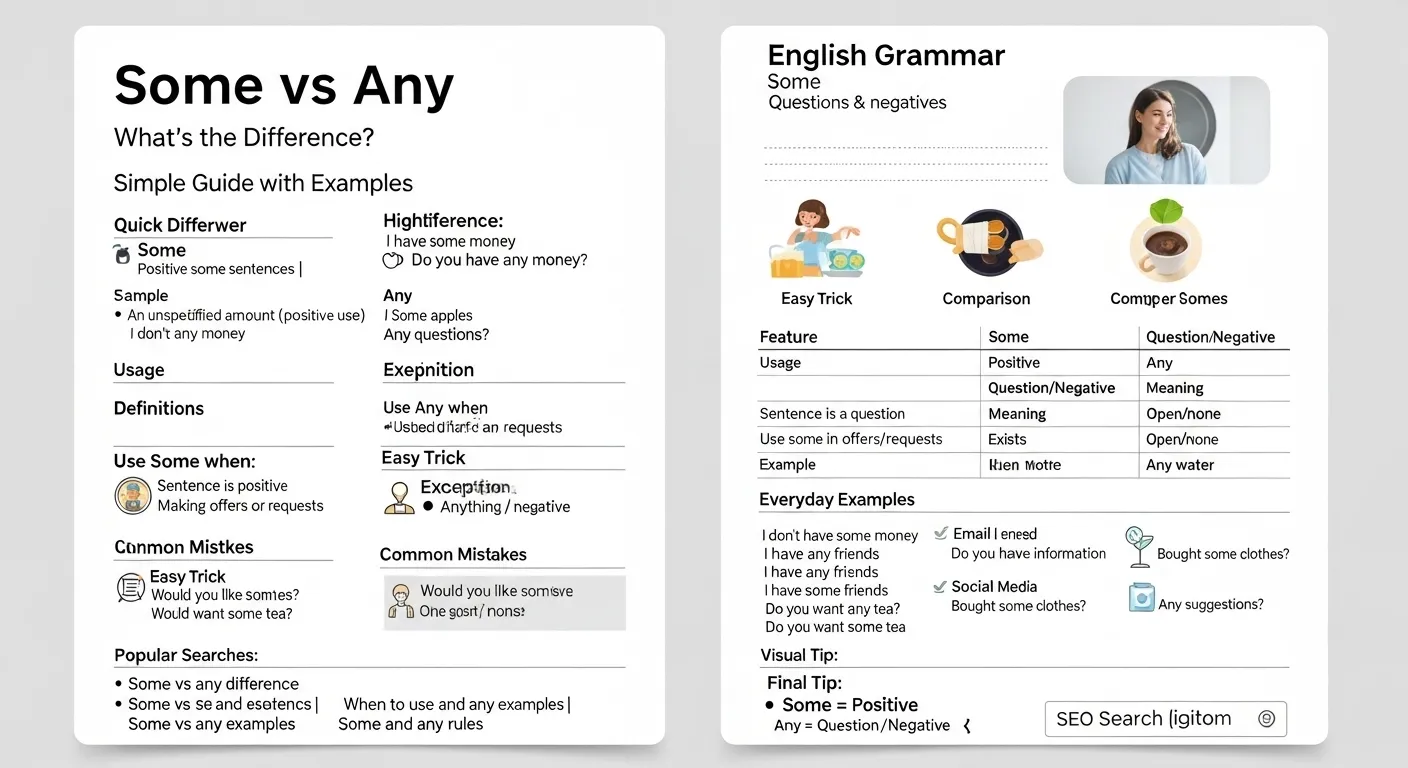
“Some” is used in positive sentences, while “any” is used in questions and negative sentences.
Many people search some vs any, difference between some and any, and when to use some or any because these words seem simple but cause confusion in daily English.
Learners often mix them in questions, offers, and requests. A small mistake can make a sentence sound unnatural.
This article explains everything in a clear and simple way. You will learn rules, definitions, examples, common mistakes, and easy tips to use both words correctly.
✅ Some or Any: Quick Answer
- Some → Used in positive sentences
- Any → Used in questions and negative sentences
📌 Examples:
- I have some money.
- Do you have any money?
- I don’t have any money.
👉 Popular search: “some or any which is correct?”
✔ Answer: Both are correct, depending on sentence type.
📖 Definitions with Examples
🍎 Some (Definition)
Some means an unspecified amount or number.
📌 Examples:
- I bought some apples.
- She has some free time.
- We need some help.
👉 Search query: “some meaning with example”
❓ Any (Definition)
Any means an unspecified amount, usually in questions or negatives.
📌 Examples:
- Do you have any questions?
- I don’t have any money.
- Is there any milk left?
👉 Search query: “any meaning in English with example”
📜 The Origin of Any vs Some
Both words come from Old English.
- Some → From “sum” meaning “a certain amount”
- Any → From “ænig” meaning “one or more”
Over time:
- “Some” became common in positive sentences
- “Any” became common in questions and negatives
👉 Popular query: “why use some and any differently”
🌍 British English vs American English Spelling
There is no difference in spelling or usage.
📊 Table:
| Word | British 🇬🇧 | American 🇺🇸 | Usage |
| Some | Same | Same | Positive |
| Any | Same | Same | Questions/negatives |
👉 The rule is the same everywhere.
🤔 Which Word Should You Use?
Focus on sentence type.
🎯 Use “some” if:
- The sentence is positive
✔ Example: I have some friends
🎯 Use “any” if:
- The sentence is negative or a question
✔ Example: Do you have any friends?
⚠️ Important Exception:
Use “some” in offers and requests
✔ Examples:
- Would you like some tea?
- Can I have some water?
👉 Popular search: “when to use some in questions”
🧠 Easy Memory Trick:
- Some → something exists
- Any → open choice (anything)
❌ Common Mistakes with Some vs Any
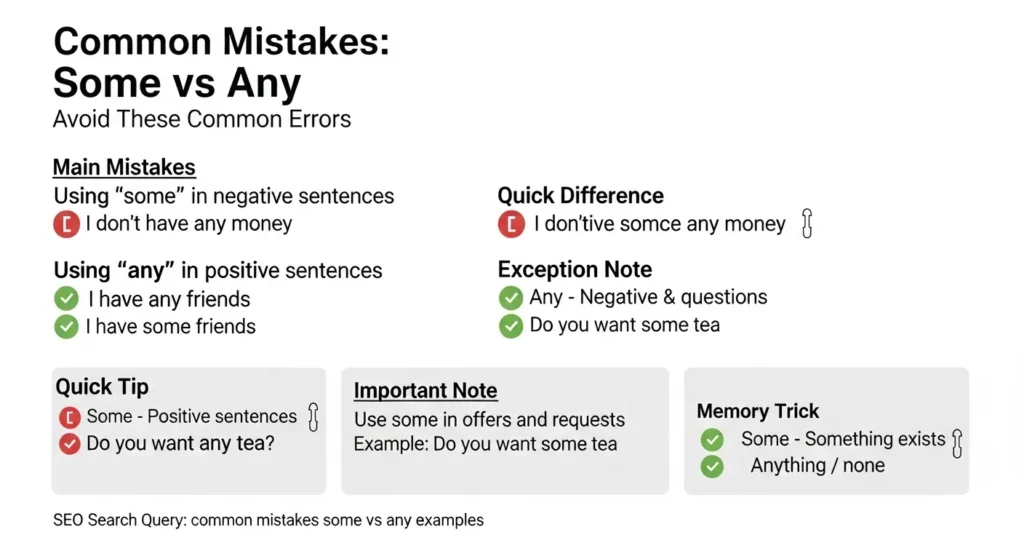
🚫 Mistake 1: Using “some” in negative sentences
❌ I don’t have some money
✔ I don’t have any money
🚫 Mistake 2: Using “any” in positive sentences
❌ I have any friends
✔ I have some friends
🚫 Mistake 3: Forgetting exception
❌ Do you want any tea? (less natural in offer)
✔ Do you want some tea?
👉 Search query: “common mistakes some vs any examples”
💬 Some vs Any in Everyday Examples
📧 In Emails:
- I need some information.
- Do you have any updates?
📰 In News:
- The company made some changes.
- There are not any major issues.
📱 On Social Media:
- I bought some new clothes 😍
- Do you have any suggestions? 🤔
📘 In Formal Writing:
- The study shows some results.
- There is no any error ❌ (wrong)
✔ There is no error / There are no any errors (rare)
👉 Search queries included:
- some in a sentence
- any in a sentence
📈 Some vs Any: Google Trends & Usage Data
🔍 Popular Searches:
- some vs any difference
- when to use some and any
- examples of some and any
- some vs any rules
- some vs any exercises
🌎 Usage Insight:
- “Some” is common in positive speech
- “Any” is common in questions and negatives
📊 Trend Table:
| Word | Popularity | Usage |
| Some | High | Positive |
| Any | High | Questions/negatives |
👉 Popular query: “where to use some and any in sentences”
📊 Comparison Table: Some vs Any
| Word | Usage | Sentence Type | Example |
| Some | Amount exists | Positive | Some water |
| Any | Open/unknown | Question/Negative | Any water |
❓ FAQs About Some vs Any
1. What is the difference between some and any?
Some is used in positive sentences. Any is used in questions and negatives.
2. Can I use “some” in questions?
Yes, in offers and requests.
3. Can I use “any” in positive sentences?
Rarely. It is not common.
4. Which is more common?
Both are very common.
5. Why is “any” used in negatives?
Because it shows zero or none.
6. Can I say “I don’t have some”?
No. Use “any.”
7. What is an easy rule?
Some = positive, Any = question/negative.
🧾 Conclusion
Both “some” and “any” are very common words in English, but they are used in different sentence types.
Some is mainly used in positive sentences when you talk about an unspecified amount of something.
On the other hand, any is used in questions and negative sentences. This is the basic rule that most learners follow.
However, there is an important exception: “some” is also used in offers and requests, which makes English sound more polite and natural. Many learners make mistakes by using “some” in negative sentences or “any” in positive ones.
The best way to avoid errors is to remember this simple rule: some for positive, any for questions and negatives.
With regular practice and simple examples, you can easily use both words correctly in speaking and writing without confusion.
Discover More Articals!
Kyoto or Tokyo: What Is the Difference Between Them?(2026)
Liason vs Liaison: What Is the Correct Spelling and When to Use It?
Ageing vs Aging: What Is the Difference?In 30 Seconds

Rulediff.com is my English grammar comparison website where I simplify confusing words, spelling differences, and usage rules through clear explanations and examples. My goal is to help learners, writers, and students understand English easily and use correct grammar with confidence.